About Ebykr
Ebykr celebrates classic and vintage lightweight bicycles through provocative imagery and opinion. Ride along with us.
About Ebykr
Ebykr celebrates classic and vintage lightweight bicycles through provocative imagery and opinion. Ride along with us.

Idéale saddles remain among the least understood classic bicycle components given their standout prominence and frequent exorbitant value. This feature unpacks the dizzying array of models produced under the Idéale marque, 82 and counting, and the collapsing French cycling industry that nearly ended the brand before its recent revival.

Idéale saddles remain among the least understood classic bicycle components given their standout prominence and frequent exorbitant value. The dizzying array of models produced under the Idéale marque (82 and counting) continues vexing even the most ardent collectors, who seem to enjoy the punishment received when combining obscurity of fact with broad product offerings and potential stratospheric price appreciation.
Oft-celebrated yet largely unknown Idéale saddles deserve their enigmatic reputation every bit as much as their enduring popularity affords them and then some. Had it not been for a collapsing French cycling industry and distinct inability to move beyond traditional manufacturing methods, Idéale might even be around today. Right down there, between your thighs and under your ass. (Rejoice! Idéale is around today and its saddles are available again: https://sellesideale.fr/en/)


1890 in France was a wonderful time and place for transportation breakthroughs. Armand Peugeot and Emile Levassor gave motorized four wheelers their first automobiles, while motorized two wheelers had Marquis Albert De Dion and Georges Bouton finalizing their motorcycle engine before emerging as the world’s largest car producer by 1900.
Motor-free transportation was of course widespread by now, with masses of cyclists discovering how profound an impact the safety bicycle was having on their mobility and well-being. Factoring in here somewhere were two events of critical importance to classic lightweight cycling, one social and the other economic.
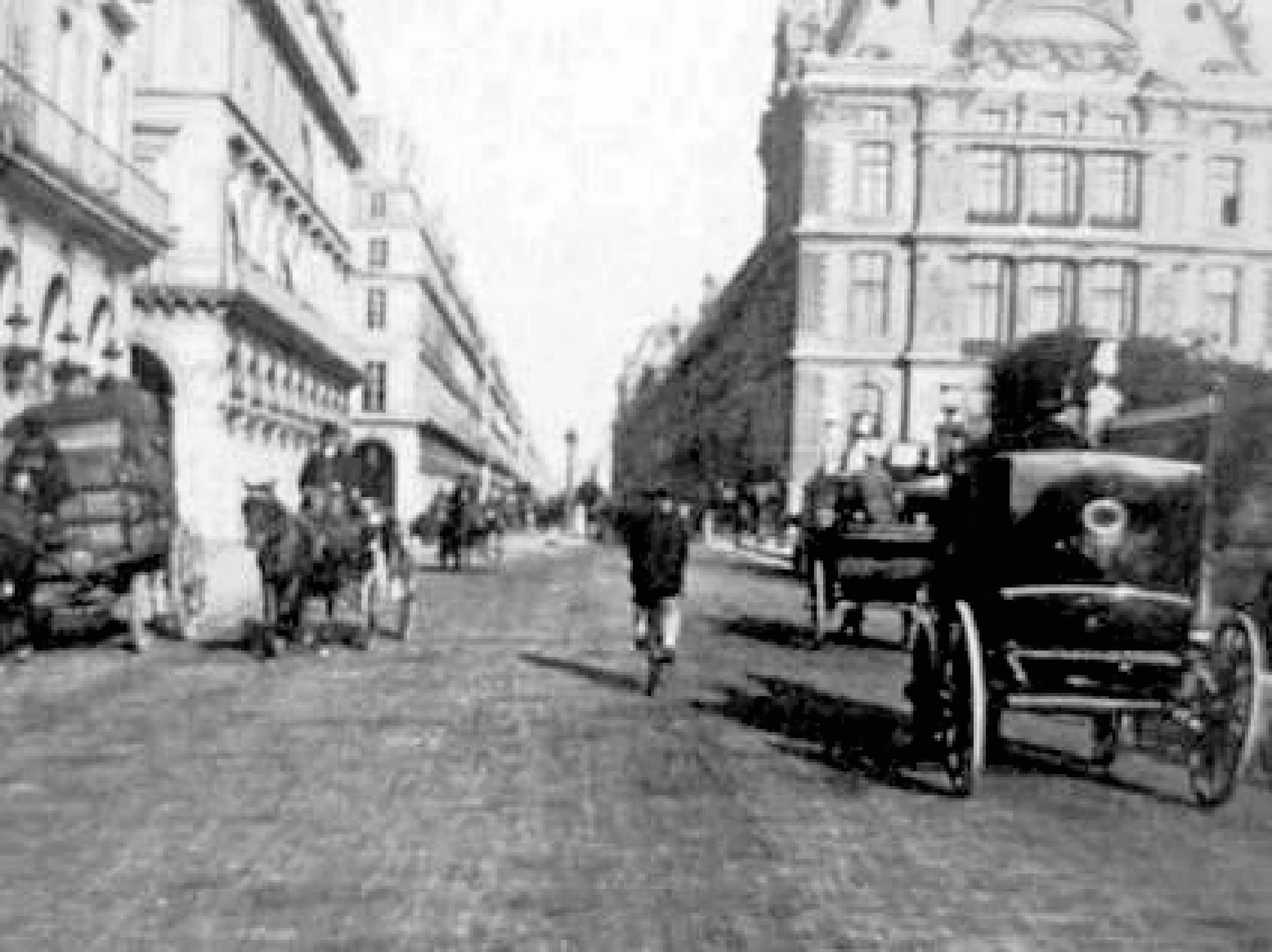
When the recreation, sport and business of cycling first intertwined in the late 19th century, the constructs that typically guide and rebalance such institutional amalgamations—laws to protect cyclists and their safety, rules to support sporting events, laws to protect bike companies and their profits, ethical guidelines to shape our collective beliefs, cultural norms to enforce those beliefs, and such—also started appearing for the first time.
Responding to a growing need for organizational support around recreational cycling, the Touring Club of France (TCF) was established in 1890 as the only nationally represented group of cyclotourists. With a purpose shaped by spiritual forebears like Paul de Vivie, or Vélocio, the TCF continues working hard to promote cyclotourism and de Vivie’s “Seven Commandments” as rules to ride (and live) by.
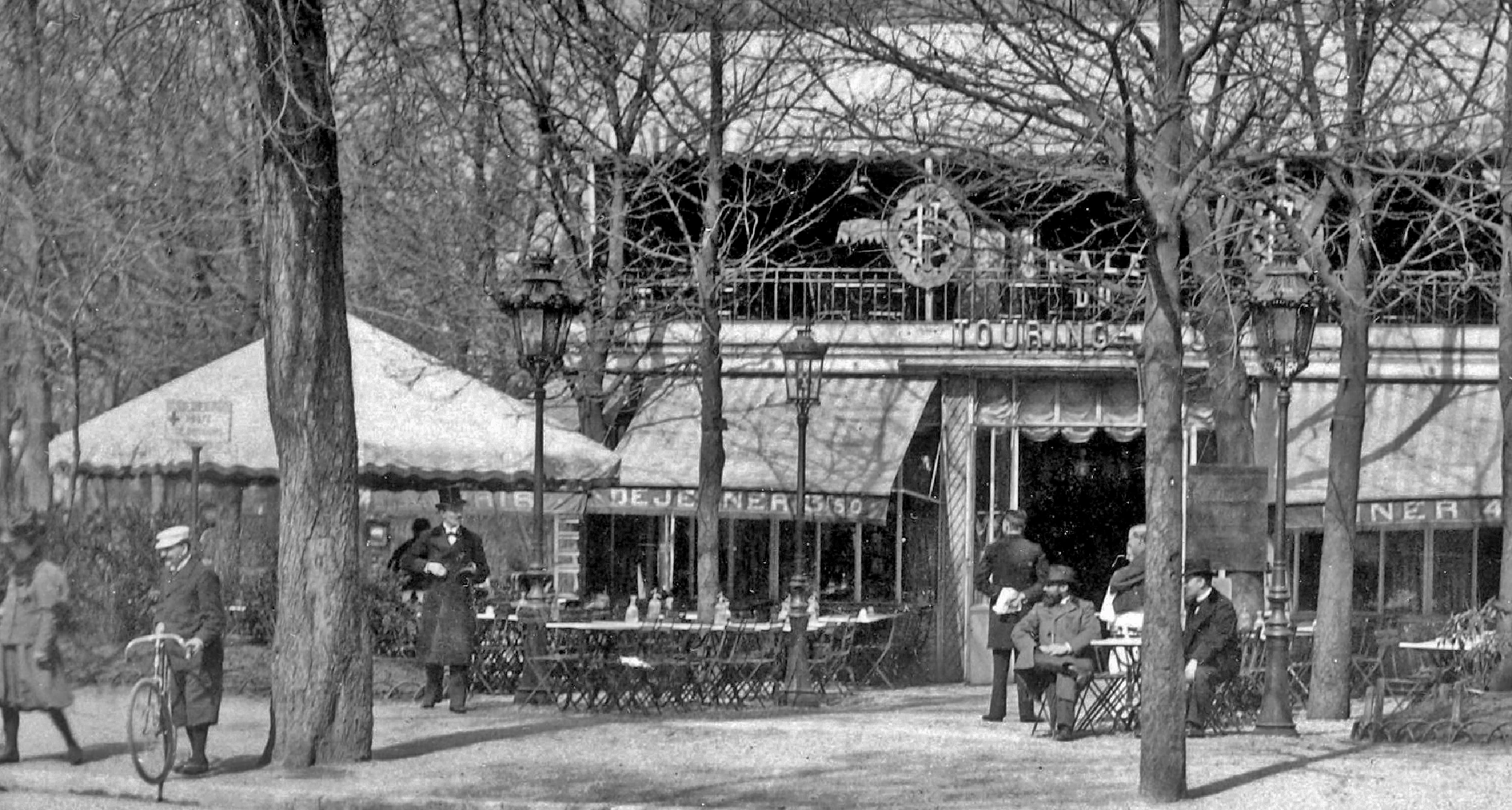
The Grand Seigneur, as de Vivie was also known, is best remembered for publishing the biblical “Le Cycliste” journal, which he founded three fertile years before the TCF was established. The journal—originally named Le Cycliste Forézien and then renamed Le Cycliste the following year—came to represent something worth far more than the paper it was printed on.

Few do a better job capturing this zeitgeist than Clifford Graves did in May of 1965:
Velocio’s influence grew, not because of his exploits on the bicycle, but because he showed how these exploits will shape the character of a man. Velocio was a humanist. His philosophy came from the ancients who considered discipline the cardinal virtue. Discipline is of two kinds: physical and moral. Velocio used the physical discipline of the bicycle to lead him to moral discipline.
Through the bicycle, he was able to commune with the sun, the rain, the wind. For him, the bicycle was an expression of a personal philosophy. For him, the bicycle was an instrument in the service of an ideal. For him, the bicycle was the road to freedom, physical and spiritual. He gave up much, but he found more.
Coincident to many communities of sun, rain and wind seekers forming and accepting standards for participation in recreational and sporting cycling events was the introduction of commercial products to support this nascent market’s needs. One particularly early and focused opportunist here was an industrialist named Jean-François Tron.
Tron was born in 1851 into a modest family in Cuneo, Italy. Cuneo was both a city and a commune located in Piedmont, Northern Italy, tucked neatly between six mountain passes at the confluence of the Gesso and Stura rivers. Cuneo was founded in 1198 by the local population, who declared it an independent commune at the time, thus freeing themselves from the authority of the region’s ruling bishops and marquises.
In more modern times, Cuneo has played host to several Giro d’Italia stages. In 2016, for the first time in Giro history, the race arrived in Sant’Anna di Vinadio sanctuary, the highest sanctuary in Europe at 2,035 meters, and the day after, on May 29, the race started from Cuneo. Since 1987 Cuneo has been the start and arrival point of the amateur international cycling race, “La Fausto Coppi.”
Tron’s family emigrated from Cuneo to Marseille, France, when Jean-François was still young. He lost his father sometime thereafter and was forced to start working in various trades. Always having an aptitude for mechanical things but never able to settle on any one trade, Tron bounced around various jobs and workshops until he was called upon for military conscription, which ended in 1888. Upon discharge, Tron dedicated himself to operating his own factory and procured a small stamping workshop in Paris just two years later.
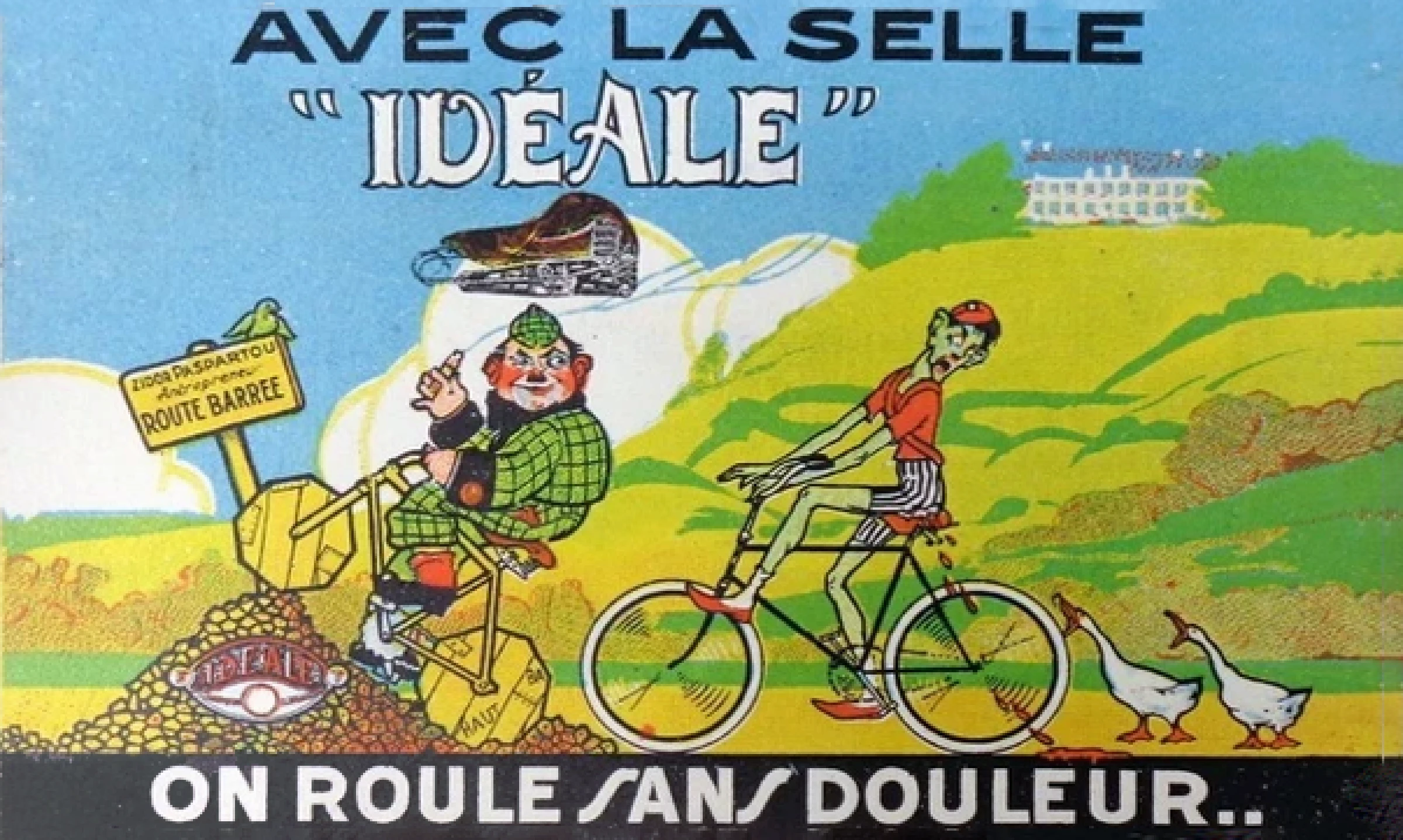
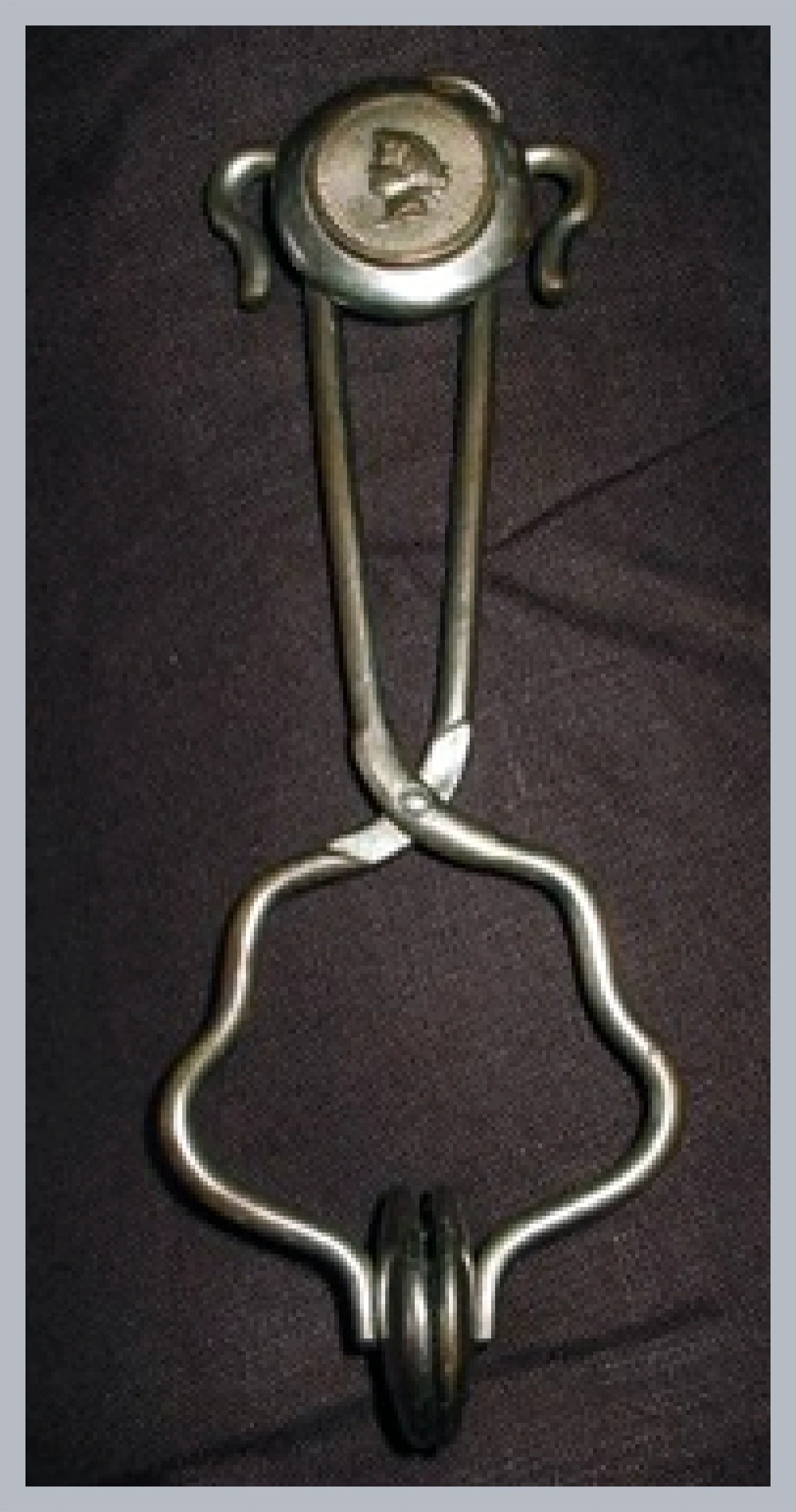
Tron and a single apprentice initially manufactured small metal parts, though these activities were unfruitful and short-lived. One misadventure here included a skirt-lifting device Tron invented himself, known as a “saute-ruisseau” in French or “jump-stream” in English. The device included a clip that allowed women to raise their skirts and fasten them to their waists to prevent them from getting dirty when crossing mud puddles or jumping shallow streams. Also known as a “suivez-moi jeune homme” or “follow me young man,” these devices undoubtedly led to more mischief than clean skirts.
Tron was eventually commissioned to provide one M. Noirot with metal chassis parts for early-generation bicycle saddles in a series of transactions that must have gone well. (M. Noirot is believed to be Maurice Noirot, leading fabric manufacturer, Chamber of Congress and Industry member, and erstwhile mayor of Reims.) The following year, Noirot’s rival, M. Bauriat, ordered 20,000 saddle chassis units that required special tooling by Tron. After just 2,000 units were delivered, Bauriat tried renegotiating the deal only to then back out of it, forcing Tron to start making complete bicycle saddles himself out of desperation and to realize any value for his hard work.


Tron and his financial partner Baillard established a strong reputation for making fine bicycle saddles after showing several well-made yet relatively inexpensive models at the first Salon Du Cycle international exposition. The inaugural cycling trade show was held in mid-January 1894 at the exquisitely appointed Salle Wagram in Paris’ 17th arrondissement. Helping cement this reputation was an incredibly lightweight racing saddle also shown at the exposition that weighed just 250 grams as documented in the January 27, 1894 edition of Les Sports Athlétiques, the official union publication of the French society of sporting athletics. Pretty weighty stuff for such a feathery saddle.

Production managed to grow only gradually in the face of formidable capital constraints and an undeveloped cycling market. Tron and Baillard’s steadfast commitment to value-driven performance helped see them through these challenges and led their business to stability and then prosperity. Tools like friction and eccentric presses could be purchased, as could enameling and nickel-plating equipment, helping to distinguish saddles produced by “Tron & Baillard” from all others. Despite their shared hardship and success, though, Tron and Baillard parted ways in the late 1890s for unknown reasons.
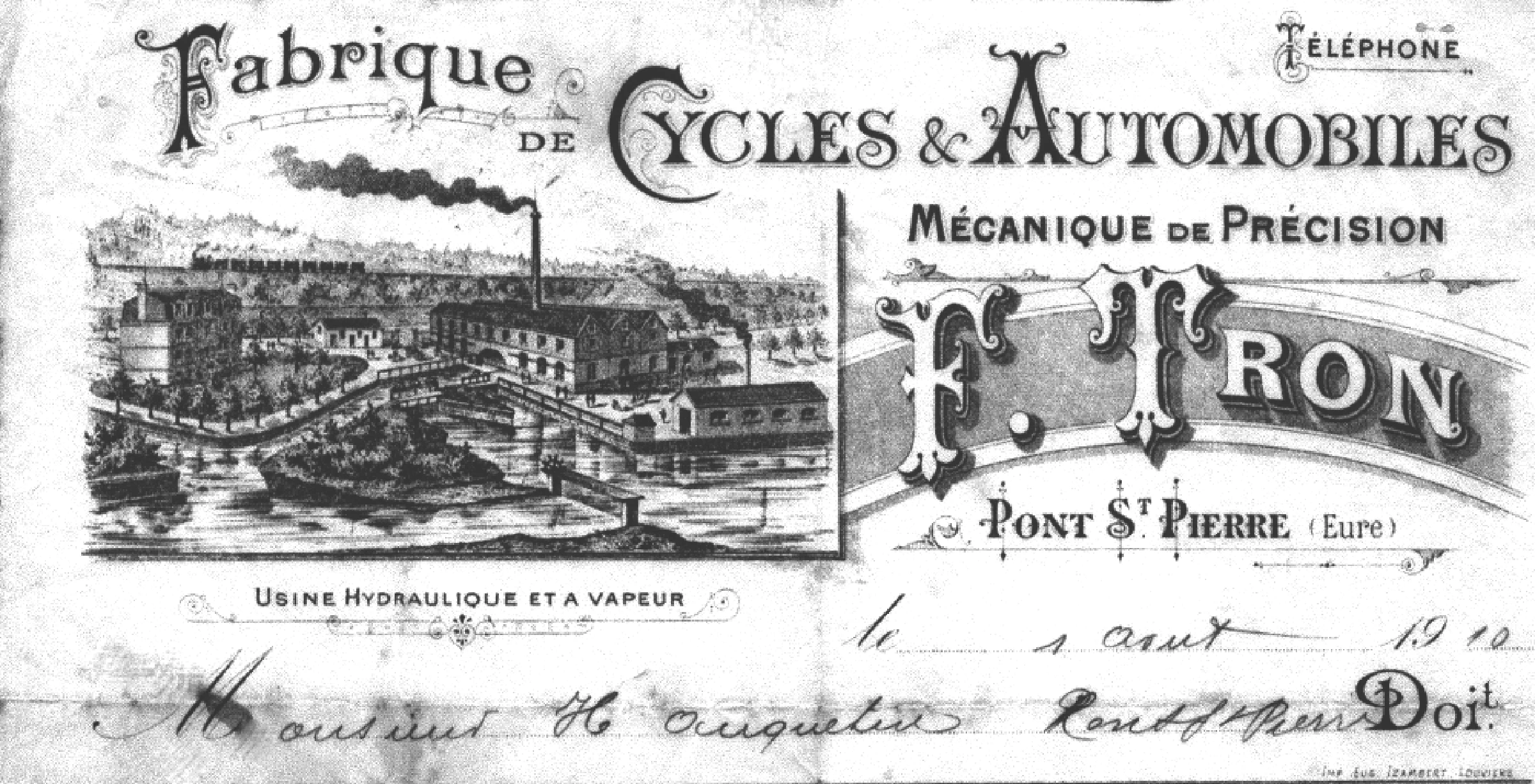
Some 10 industrious years after being discharged from the army, a now independent Tron—professionally and financially—packed up the atelier in metropolitan Paris and relocated to minuscule Pont-Saint-Pierre. His old shop was undersized and underpowered, and its expiring lease served as a clarion call for change. His new shop in Pont-Saint-Pierre, hidden in the department of Eure and the region of Haute-Normandie in northwest France, addressed both of these problems with a renewed sense of optimism. Of potential.

What had been a workshop was now a factory, on the site of a former wool spinning mill driven by hydraulic power that Tron and team adapted for saddle making purposes. Situated near the confluence of the Seine and Andelle rivers, the quaint village of Pont-Saint-Pierre is located in the county of Lyons-Andelle. Lyons-Andelle is itself nestled between the old French Vexin and Rouennaise regions.
Some 100km northwest of Paris toward the sea, the place is full of greenery and has long been a haven for peaceniks and progressives. Today, the Andelle canton has 35 communes with 21,659 inhabitants (up from 19 and 11,000 respectively since 2018) who share a robust range of self-supported collective services. Pont-Saint-Pierre is a member commune whose population represents the entire village. When last officially counted, there were 1,155 inhabitants of Pont-Saint-Pierre (down 8 since 2018). For Tron, it must have felt like a 50-year journey back home from his old childhood commune in Italy to his new adulthood commune in France.
With saddle-making operations relocated to this ideal countryside community by 1901, Tron and company, now renamed “F. Tron & Cie,” were almost ready to enjoy three decades of prosperity. That prosperity would include the marriage of Tron’s daughter to the aristocrat, Marcel Berthet, and conversion of the family business to a Société Anonyme, with both occurring in 1927. The first event would provide Tron with an eventual succession path for his company. The second event allowed joint stock ownership in the company and thus the means to fund important capital build-outs and other improvements that allowed it to scale considerably faster than if financially constrained otherwise.
A pair of early challenges almost derailed all of this growth and prosperity. The wool mill’s owner wanted to sell his property and not lease it as Tron could only afford at the time. An associate of Tron’s from Paris stepped in and ostensibly purchased the property from the owner to then lease it back to Tron. Once finally in the old mill, three of the structure’s four floors needed removal for safety reasons. The ground-level floor was repaired and a single floor built above it. Things were finally set to make more Idéale saddles. Many, many more Idéale saddles, by historical account.
The first few years after moving from Paris to Pont-Saint-Pierre were difficult ones for Tron. His company was saddled by large debts and mounting machine costs resulting from growing demand for its products and consequent need for additional manufacturing capacity. Some 40 or so workers were employed by the company at the time, which deviated briefly from producing bicycle saddles to also producing automobiles in 1904. (Ebykr readers will immediately recognize the folly of this decision, which was the downfall of many bicycle companies in the early to mid-20th century.)
Compared to bicycles, F. Tron & Cie automobiles featured relatively luxurious seating for their single passenger. Equipped with aforementioned De Dion Bouton engines, these automobiles had articulated steering wheels that made them easier for drivers to get in and out of than in other models. So great was the auto’s initial appeal that even Baron Levasseur ordered one.

Thankfully for us cyclists, Tron and company’s better-established “Idéale” bicycle saddle efforts endured far longer than its automobile efforts did, which faded into relative obscurity as a burgeoning early automobile industry beat the company and its motorized efforts off the starting line. If only the same were true for other bicycle-turned-motorcycle-or-automobile manufacturers who found themselves at this same crossroads in the early to mid-20th century, like Adler and Bianchi and Clément. What sublime bikes we would all be riding today!
Tron purchased an unoccupied factory in 1908 located immediately next door to his initial factory, but not before some difficulties with his lender were resolved. Four years later, Tron would install a water turbine at his company’s newer factory, after which he built two special presses for leather treatment and embarked upon serious leather tanning studies. Bringing this knowledge in-house seemed integral to the development of durable, waterproof saddle tops that remained comfortable enough to ride, something Brooks of England typically followed Idéale’s lead on over the years.
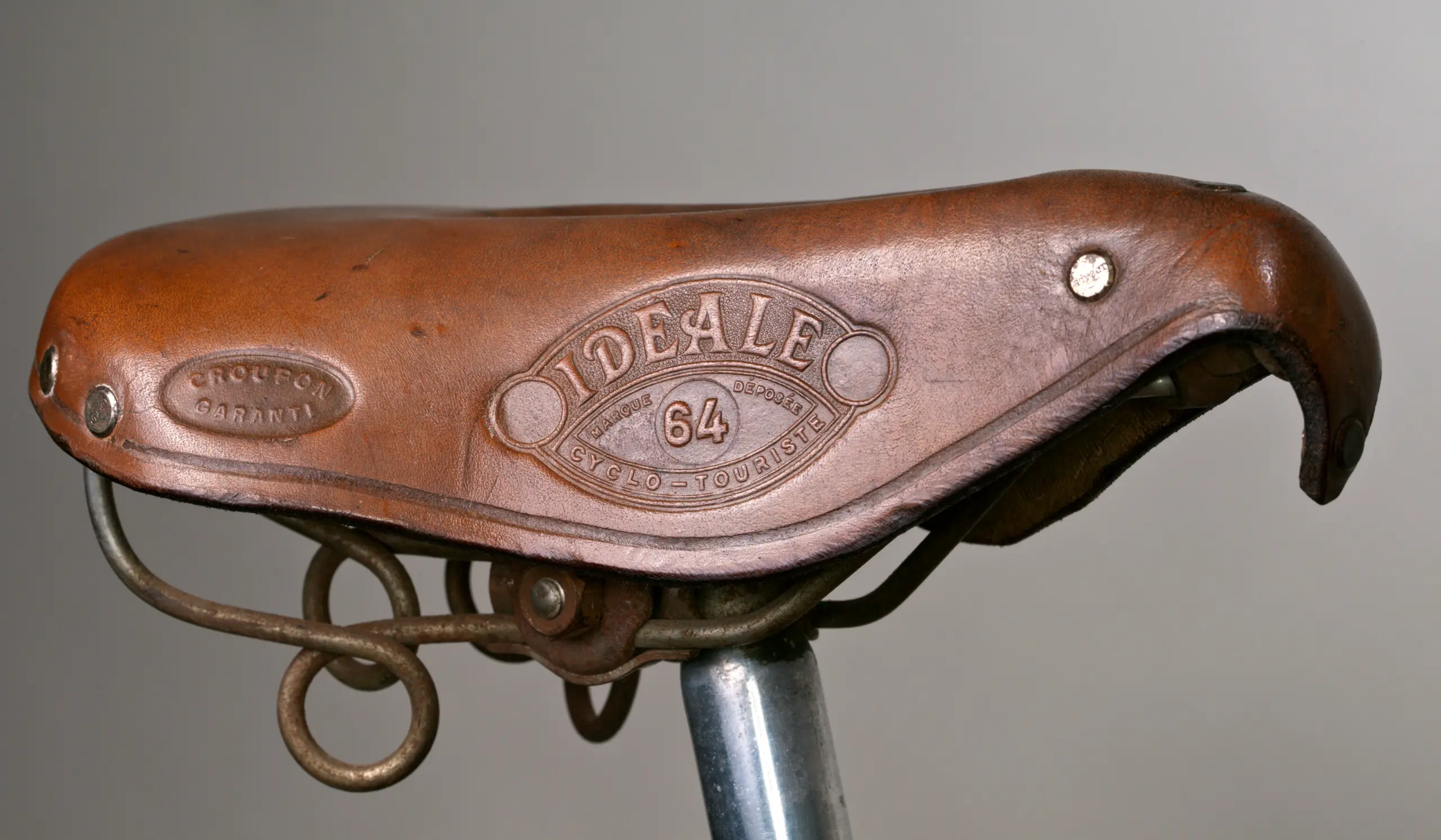
To ensure the highest quality for their legendary tops, Tron & Berthet maintained a rigorous sourcing strategy, acquiring hides from two specialized suppliers located in the North and South of France. For their premier ranges, the factory utilized only the “croupon,” which is the densest and most resilient portion of the hide found along the animal’s back and hindquarters. Expert sorters at the Pont-Saint-Pierre factory had to possess an intimate knowledge of the hide’s topography, as the leather closest to the spine offered a firmer structure, whereas sections near the flanks were softer and more prone to stretching. This meticulous selection was driven by a requirement for a uniform thickness of 5mm for their finest grade cowhide.
The technical precision of this thickness was a matter of structural life or death for the saddle. Leather that was too thin would inevitably stretch and sag under the weight of a rider, while leather that was too thick suffered from fiber breakage during the high-pressure forming process, leading to immediate failure. This necessitated a strict hierarchy of material use where only the prime cuts were reserved for professional competition models, with the remaining portions of the hide being diverted to the production of children’s saddles. To further enhance these natural materials, Jean-François Tron conducted deep tanning studies beginning in 1912 as mentioned, eventually leading to a proprietary, scalable process that waterproofed the leather during manufacturing and helped it maintain its shape regardless of weather.
The agricultural landscape of Europe shifted significantly following World War II, presenting a major challenge to Idéale’s traditional standards. As cattle breeds were modified to prioritize accelerated food and meat production, the structural characteristics of the hides began to change. These modernized breeds produced leather that lacked the specific fiber density and maturity required for high-end saddle making. Consequently, sourcing hides that met the “Idéale standard” became an increasingly difficult and prohibitively expensive endeavor, contributing to the mounting pressures the company faced in its final decades of operation.
For generations of cyclists, the primary weakness of the leather saddle was its vulnerability to the elements. While British-made Brooks saddles were frequently considered the benchmark for quality, their early models were notorious for absorbing rainwater, which inevitably led to premature sagging and a loss of their intended form. In contrast, Idéale established its legendary reputation by engineering tops that remained resilient even in the face of the “sun, rain, and wind” celebrated by the philosophy of Vélocio.
This resilience was the result of intense leather tanning studies initiated by Jean-François Tron. At the Pont-Saint-Pierre factory, Tron utilized specialized presses and unique water-powered machinery to integrate a proprietary “secret process” directly into the manufacturing stage. This breakthrough involved sophisticated conditioning techniques utilizing sumac and specific tannins to ensure the leather fibers remained waterproof without sacrificing the flexibility required for a comfortable seat.

Tannins are naturally occurring polyphenolic compounds derived from plant tissues – most commonly tree bark (oak, chestnut or mimosa), leaves and fruits. Raw animal hides are mostly protein (collagen) and water. Without treatment, they rot when wet or become brittle when dry. Tannins bind to the collagen fibers, displacing water and coating the fibers. This process, known as vegetable tanning, permanently alters the hide’s protein structure, making it resistant to decomposition and bacterial growth.
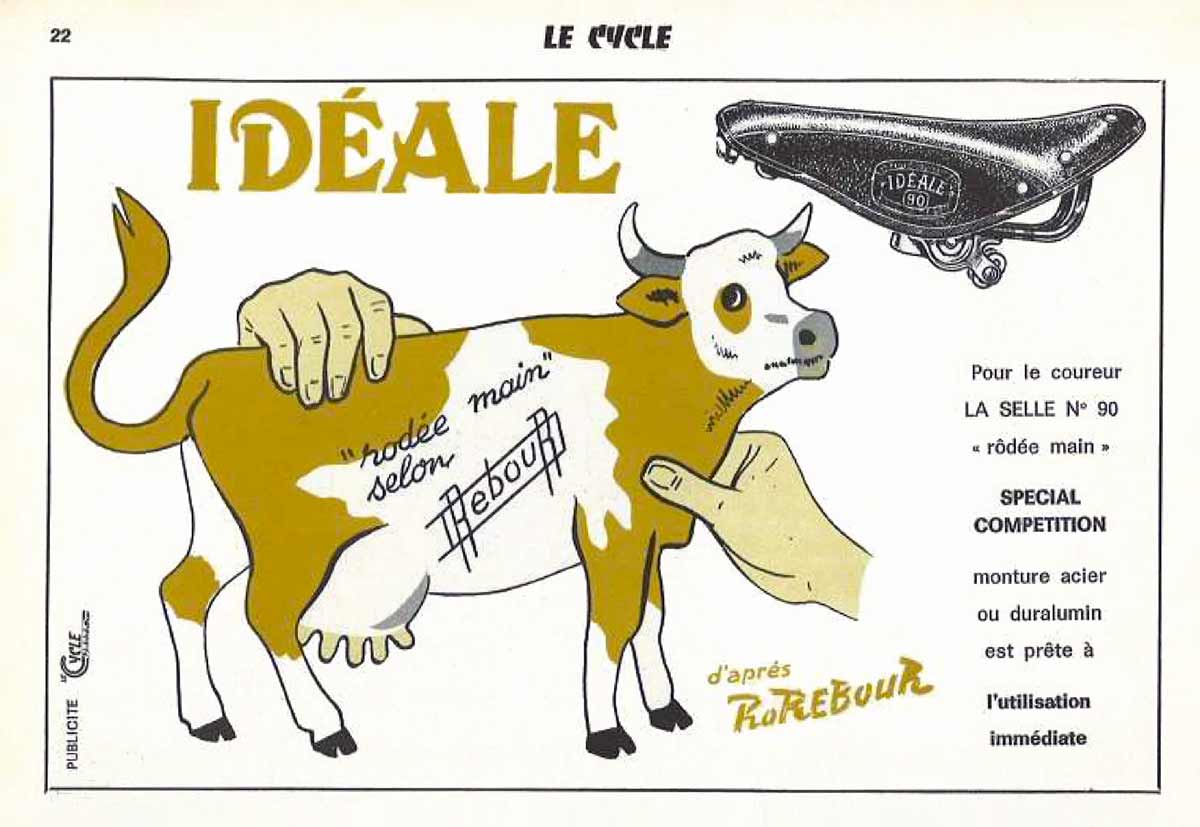
Beyond mere weather resistance, these chemical advancements allowed Idéale to solve the most dreaded aspect of leather ownership: the penible corvée de rodage, or the painful break-in period. By combining their secret tanning recipes with the factory-led Rodée Main (hand-broken) process years later, Idéale produced professional saddles like the No. 90 that were ready for racing or touring from the moment they were purchased.
This specialized treatment provided the equivalent of many miles of riding right out of the box. It effectively spared the rider from the long kilometers of discomfort usually required to soften a high-quality hide, ensuring that the saddle remained a comfortable fit for both professional racers and long-distance cyclotourists alike.
World War I forced significant changes onto Tron and company. The years between 1914 and 1918 were spent servicing the war effort by manufacturing shell bodies for use in field artillery. They were also spent making bicycle saddles despite the challenging environment for sourcing raw materials and having services performed, like tanning leather using the company’s newly discovered, proprietary methods.
The early 1920s were good years for many Europeans, with Tron and his employees no exception. Bicycles and bicycling proliferated after the Great War, and riders of all types required appropriate saddles to race, recreate and roam about on. Old machine tools were repaired and new machine tools were acquired. Saddle production at F. Tron & Cie rose to a robust 200,000 units in 1922. By then, Idéale saddles were well known to cyclists throughout France, but little known to cyclists across the English Channel or beyond – despite period marketing materials having calls-to-action in French, English, Spanish, German and even Mandarin, Chinese.

The production demands put upon Tron’s neighboring factories proved too great over time. Various enlargements and improvements led to the construction of an altogether new factory in 1926. This undertaking would prove to be Jean-François Tron’s swan song. It would also serve to cement his legacy as one of cycling’s greatest contributors and successful industrialists.
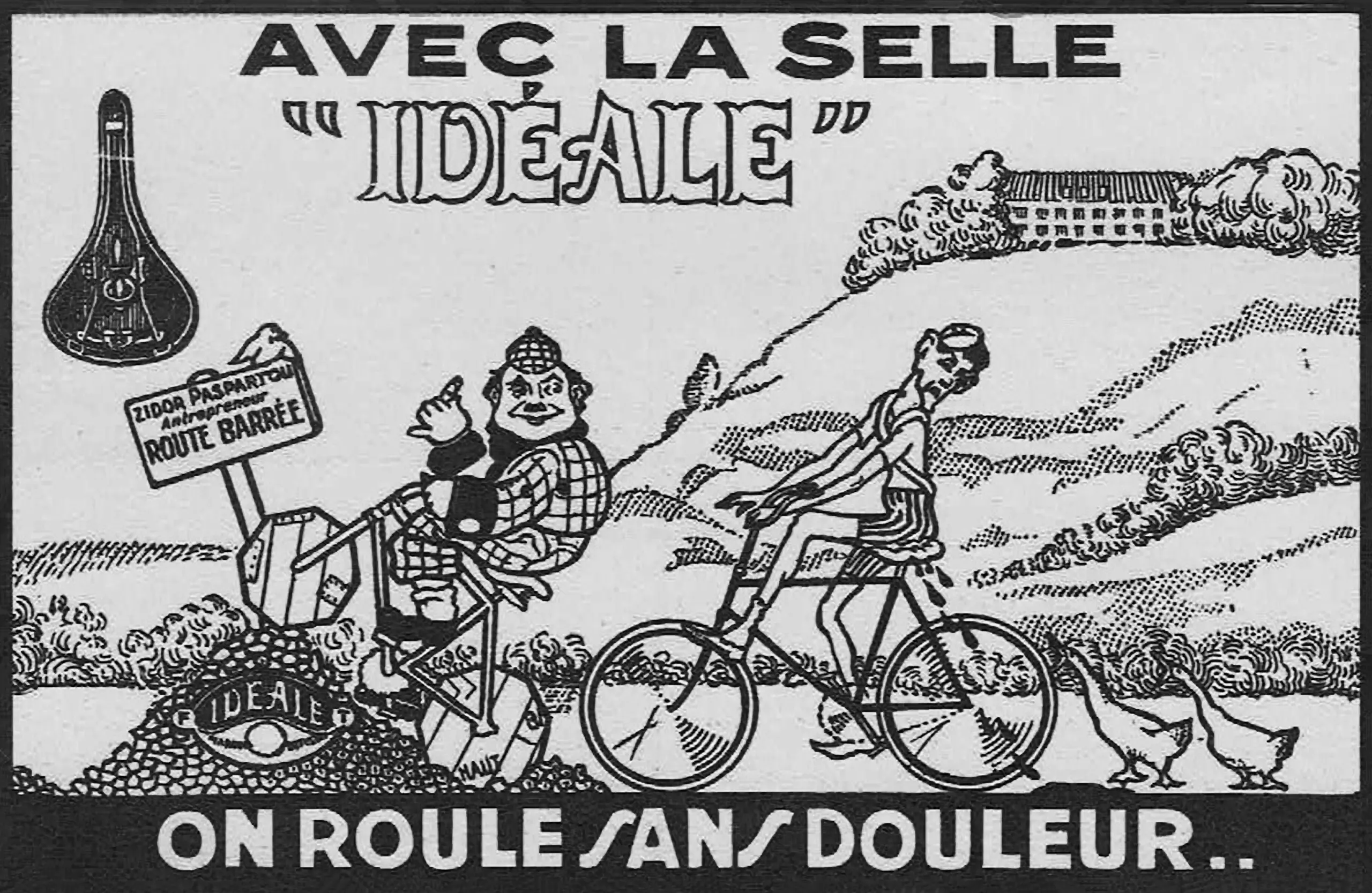
Tron died in 1931 with his namesake company positioned for further success. A decade earlier, a respectable 200,000 Idéale saddles were being manufactured, distributed and sold each year. A half-decade later in 1936, that figure grew to a staggering 500,000 units. The mid-1930s were likely the most productive years ever for the company. Jean-François Tron can take posthumous credit for this achievement.

So can his daughter Jeanne and son Jean, who assumed oversight of their father’s company upon his death. Both were familiar with its daily operations and suitable candidates to assume immediate responsibility for designing, manufacturing and distributing Idéale saddles. And so they did for a couple of years, providing a tremendous amount of continuity in what must have been turbulent times for the Tron family and its interests.
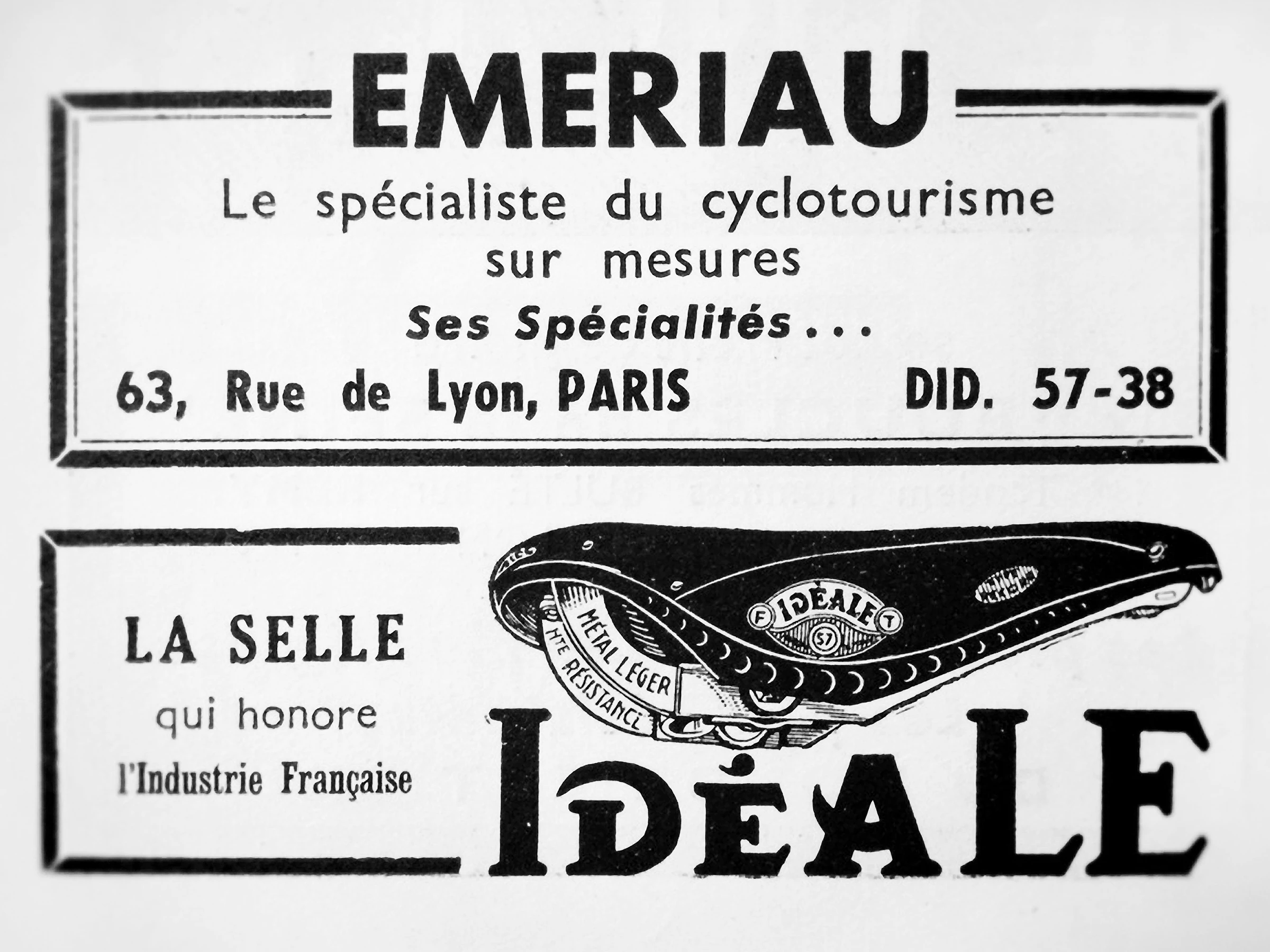
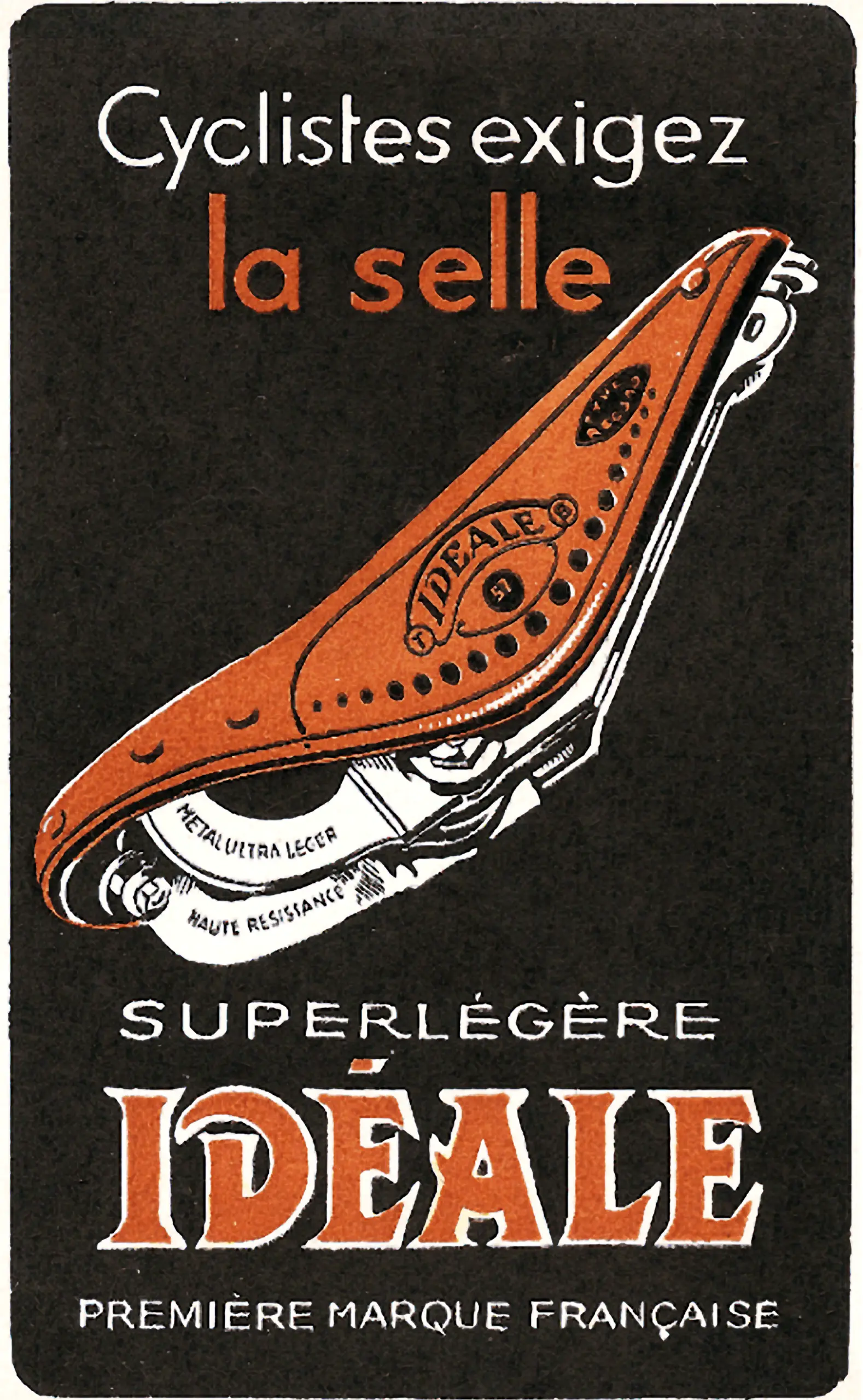
Shortly afterward in 1933, Jeanne’s husband, Marcel Berthet, was handed the company’s reins. With Idéale models now including the venerable No. 57 Record and feathery No. 54 Duralumin—some 250 grams lighter—Jean-François Tron bestowed his son-in-law with the far-ranging product line and distribution network he himself had assembled the constituent parts for and always sought.

A well-established sportsman and all around bon vivant, Berthet also had a keen understanding of cyclists’ buying habits and took the company upmarket while repositioning it as maker of the most exquisite bicycle saddles worldwide. Renamed Tron & Berthet S.A. and now employing some 220 women and men, the Idéale brand was reborn and recast to live another half-century.
Despite selling millions of saddles under his leadership, Marcel Berthet remains far better known for his cycling exploits than business acumen. Berthet is the first cyclist generally regarded as having reached 50km in the prestigious hour record and was official UCI hour record holder on three separate occasions.

He set his first record in June 1907 at 41.620km, second in August 1913 at 42.741km and third in September 1913 at 43.755km. Some 19 years after setting his final UCI record, a 47 year old Berthet built and piloted a sleek bicycle named the Vélodyne Streamliner to a new hour “world record” under less restrictive IHPVA rules.

During that November 1933 attempt, he covered 49.992km in what was his second of two efforts that year, this one at the prestigious Monthléry motor speedway. His Vélodyne bicycle was constructed of aluminum—with reinforcements made of spruce and magnolia—and covered in a glorious fabric skin.
Apparently, its hypnotizing appearance was convincing enough for period journalists to declare his shortfall of .008km (or eight meters) meaningless in the greater context of sporting achievement. So suggest records of period press clippings, at least. The bicycle certainly looks fast – perhaps even helping him race to the top position at F. Tron & Cie that same year.
Between that fine hour in 1933 and his final one in 1953, Marcel Berthet bore witness to the rise and fall of the Idéale brand. With World War II striking at the heart of his 20-year leadership term, Berthet experienced two distinct boom-bust cycles at his beloved company. These seemed to strengthen his will to succeed and provide him with the additional resolve and versatility necessary to do so. In these ways, Berthet’s efforts in support of Tron & Berthet S.A. paralleled his efforts in support of the hour record. Right down to the shortfall at the end.
Over the years, Berthet was frequently forced to adapt his company’s approach to saddle-making in response to unreliable supplies of critical raw materials and saddle components. Unreliable supply chains may have contributed to Tron & Berthet S.A. seeking down-market product offerings compared to its premium up-market Idéale offerings prior to World War II. Customers and their evolving purchasing habits may have played a part in this, too.
By the mid-1930s, Tron & Berthet S.A. was addressing the bicycle saddle market and its diversifying segments via four distinct brands of saddles: Idéale, Elaedy, Nortex and Lion. Idéale was the company’s preeminent brand and its saddles featured “croupon” leather tops made from the strongest, thickest portion of the hide covering the back and hindquarters. As stated on the modern Idéale web site, “There are differences in thickness of a few tenths of a millimetre on a croupon, and differences in structure: the part closest to the back is firmer, denser, the part towards the flank is softer.” One’s weight, riding frequency and riding style determine which cut is most suitable for their perfect saddle.

Elaedy saddles featured what Tron & Berthet S.A. called, “1st choice” leather tops, sitting somewhere between the mid and upper markets. Nortex saddles had “good quality” leather tops and a broad range of affordable styles targeted at the lower market. (Note that “Nortex” brand saddles are distinct from the “Norex” molded cover, Idéale branded saddles found in later company catalogs.) Lion saddles were made for children and possibly recreation-level adults, too.

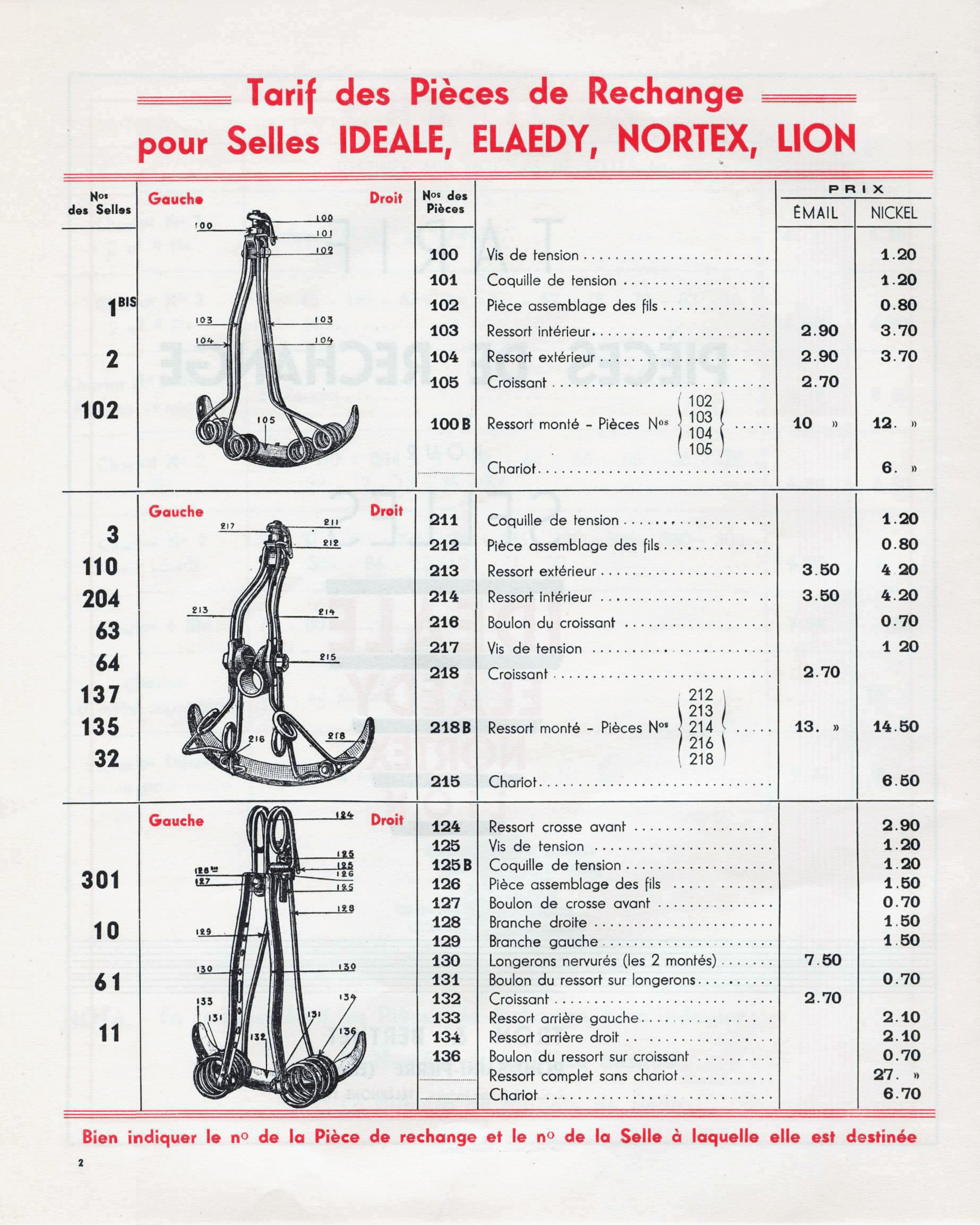
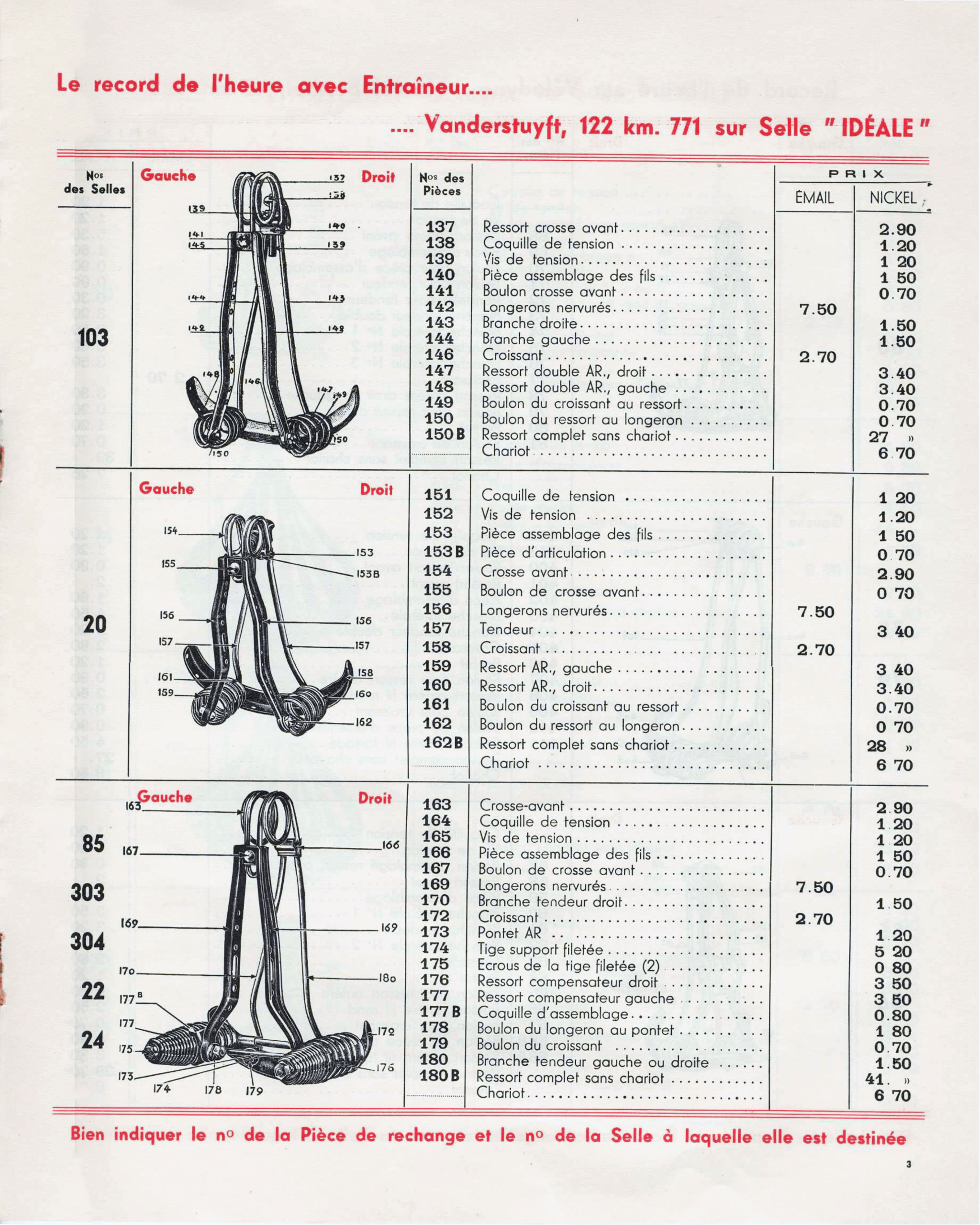
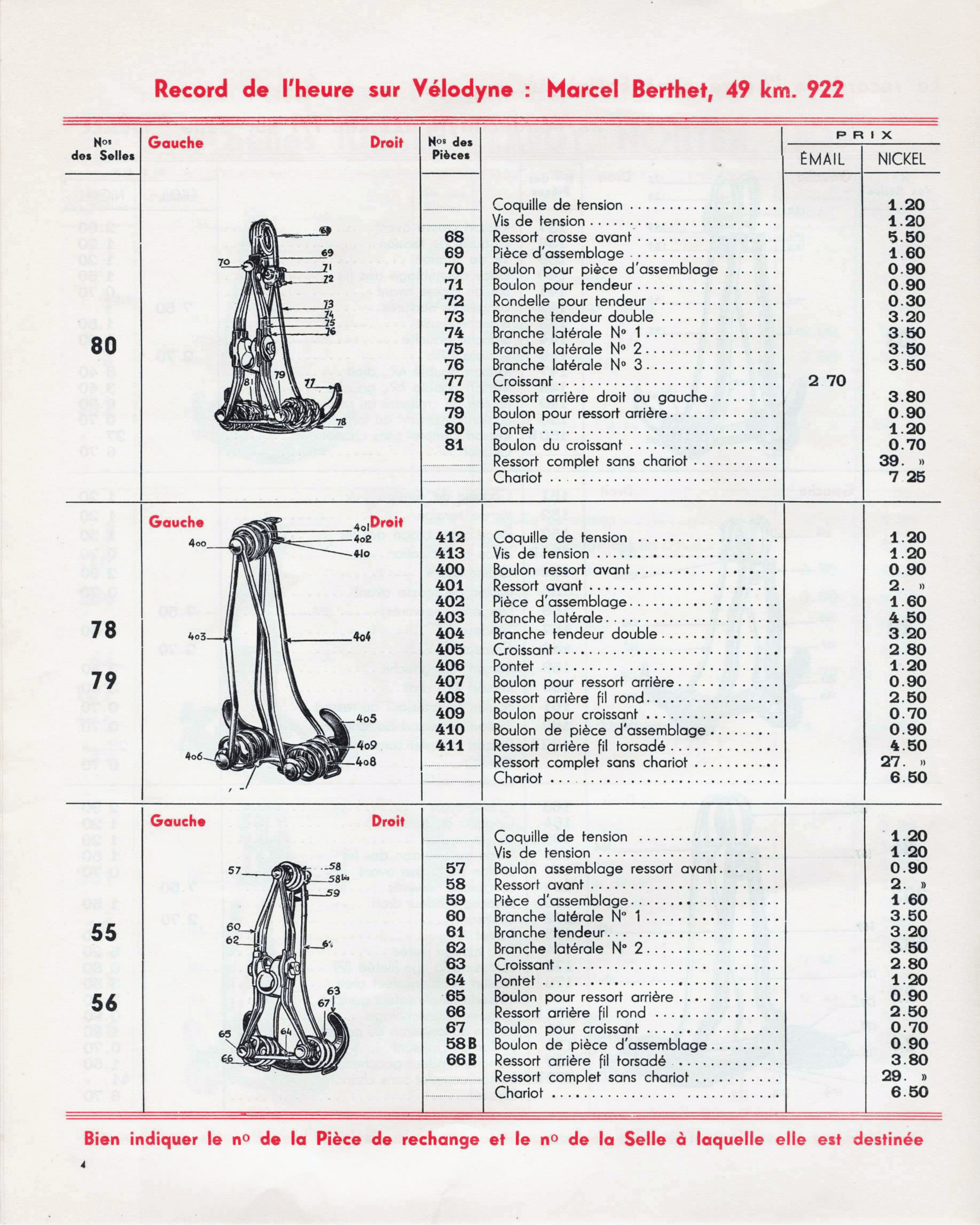
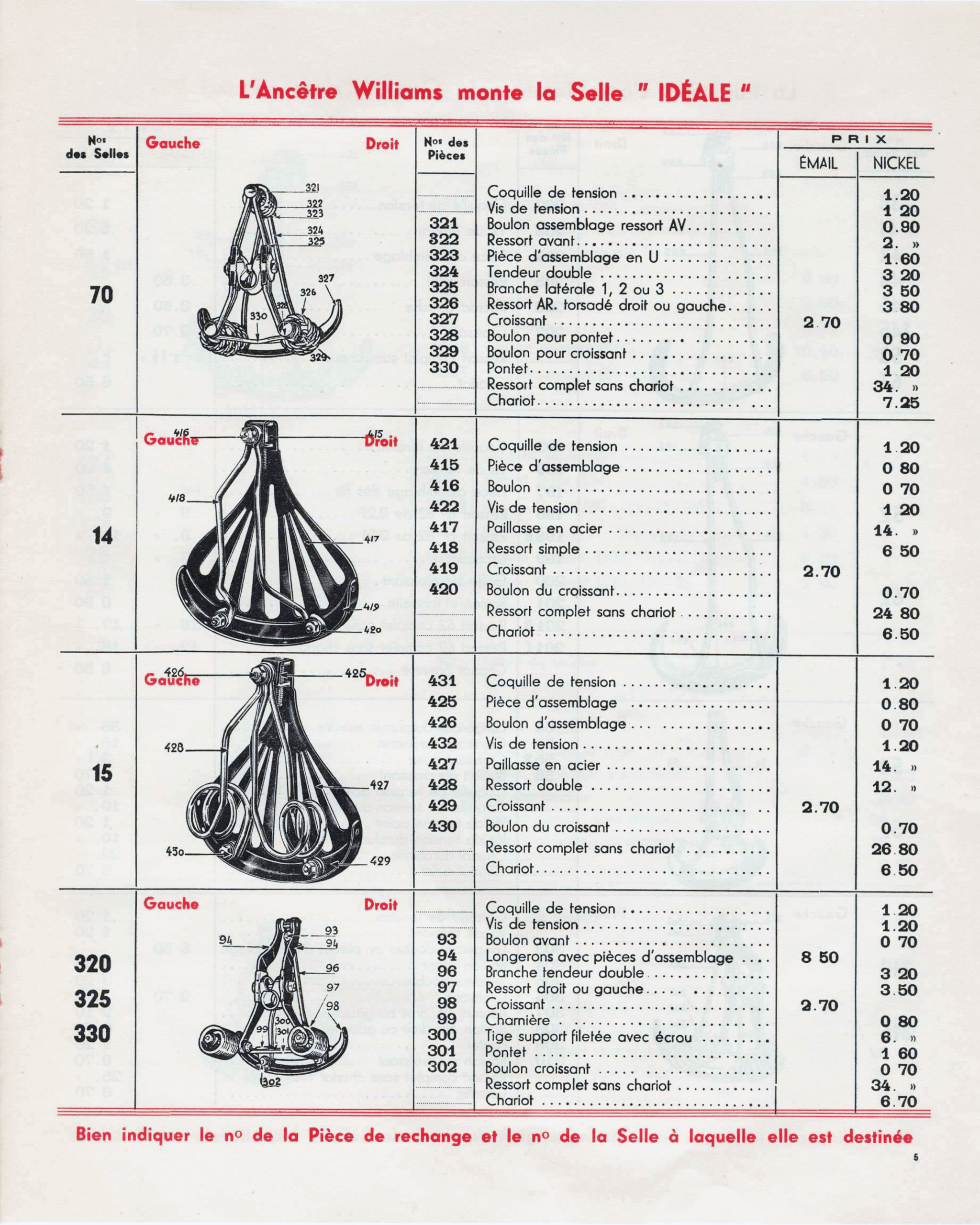
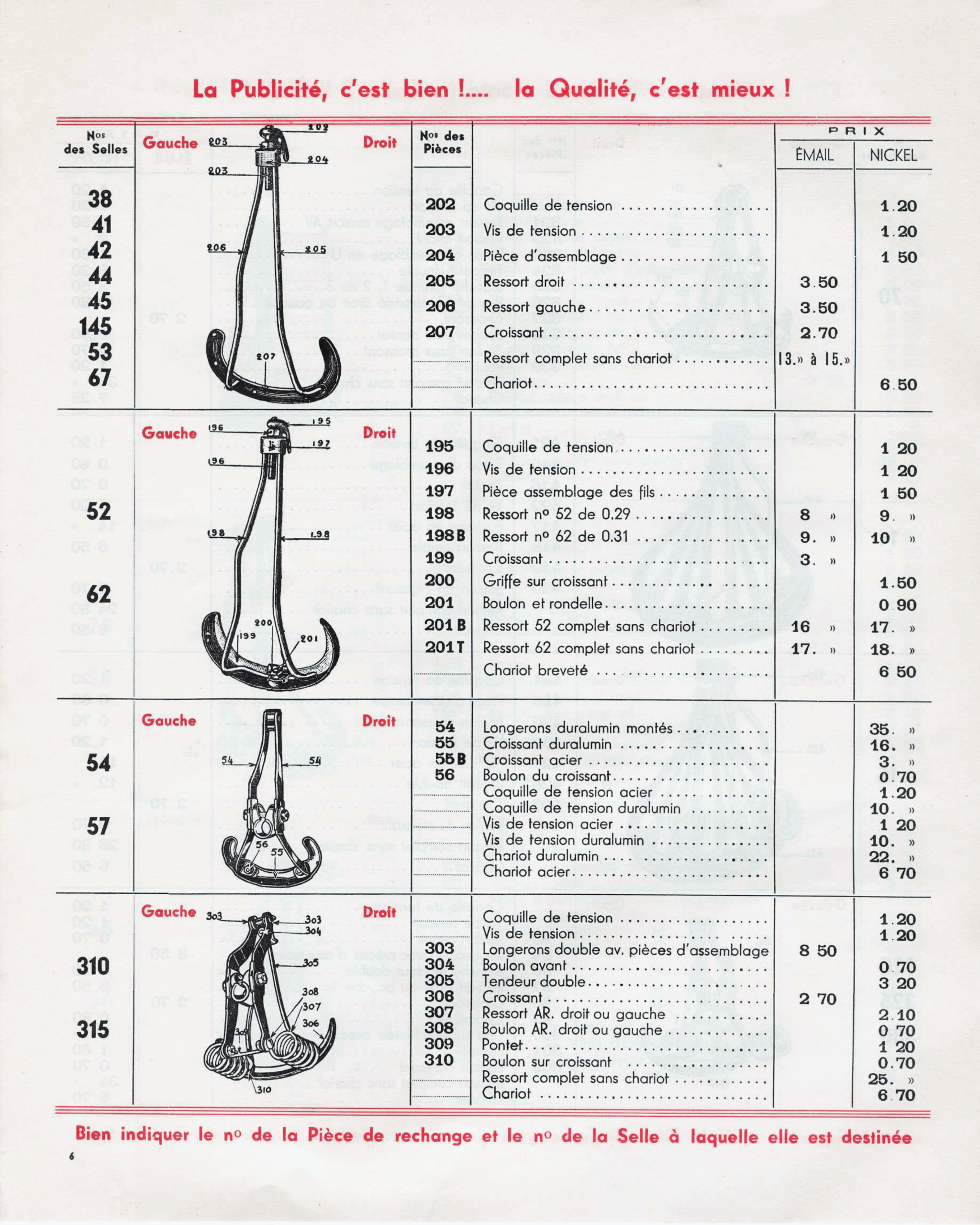
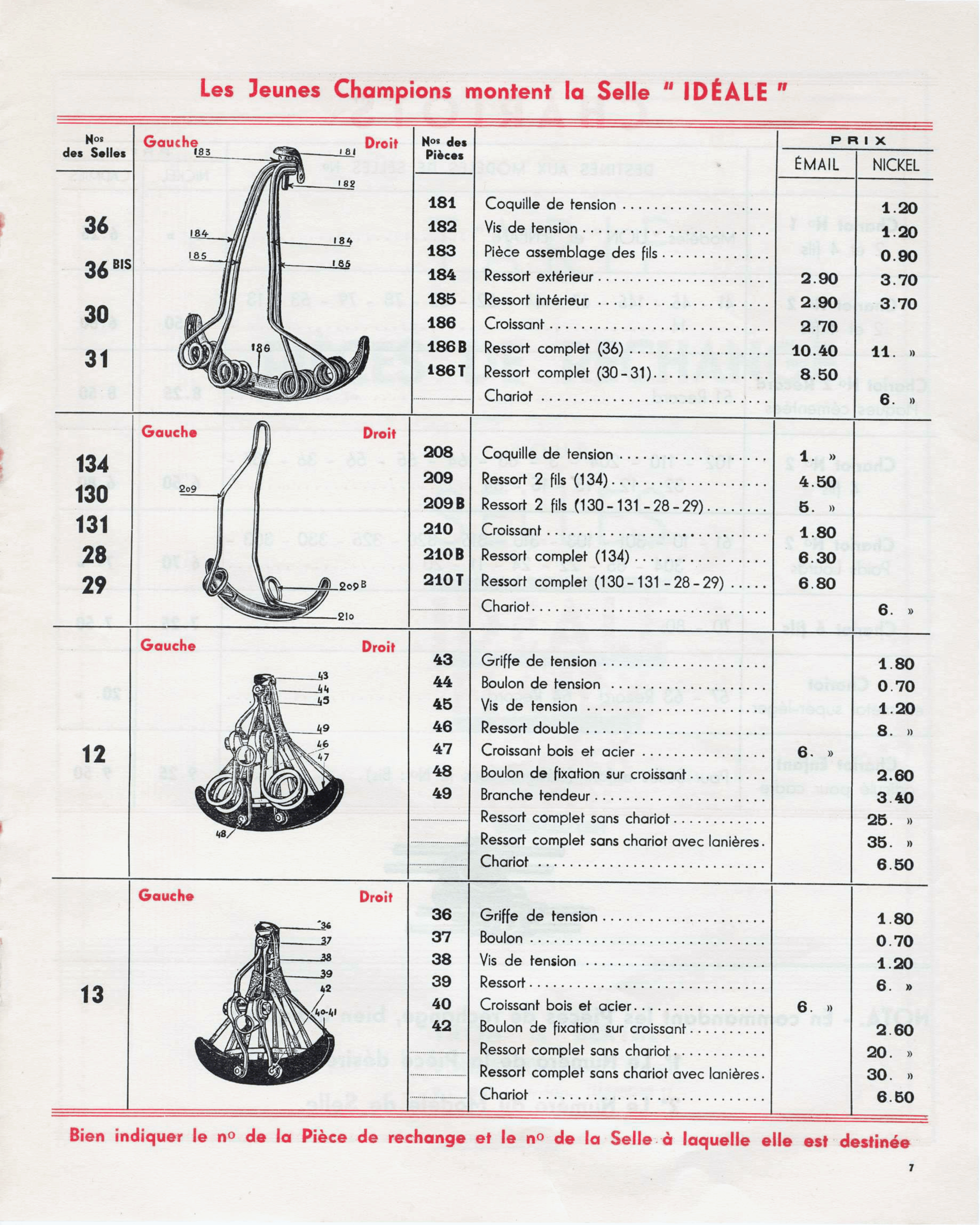
With leather supplies costly and scarce before World War II and even more so after, alternatives needed to be found. This led to the development of a wide range of Idéale Dunlop saddles by the mid 1930s – the result of a partnership between Tron & Berthet S.A. and Dunlop Rubber Company, the esteemed British materials manufacturer. The saddles themselves featured rubberized tops that were supple yet weatherproof—to tunable, varying degrees—and could be assembled using the same fittings used on leather Idéale saddles. They also looked a lot like leather, as proudly proclaimed in Idéale marketing materials.

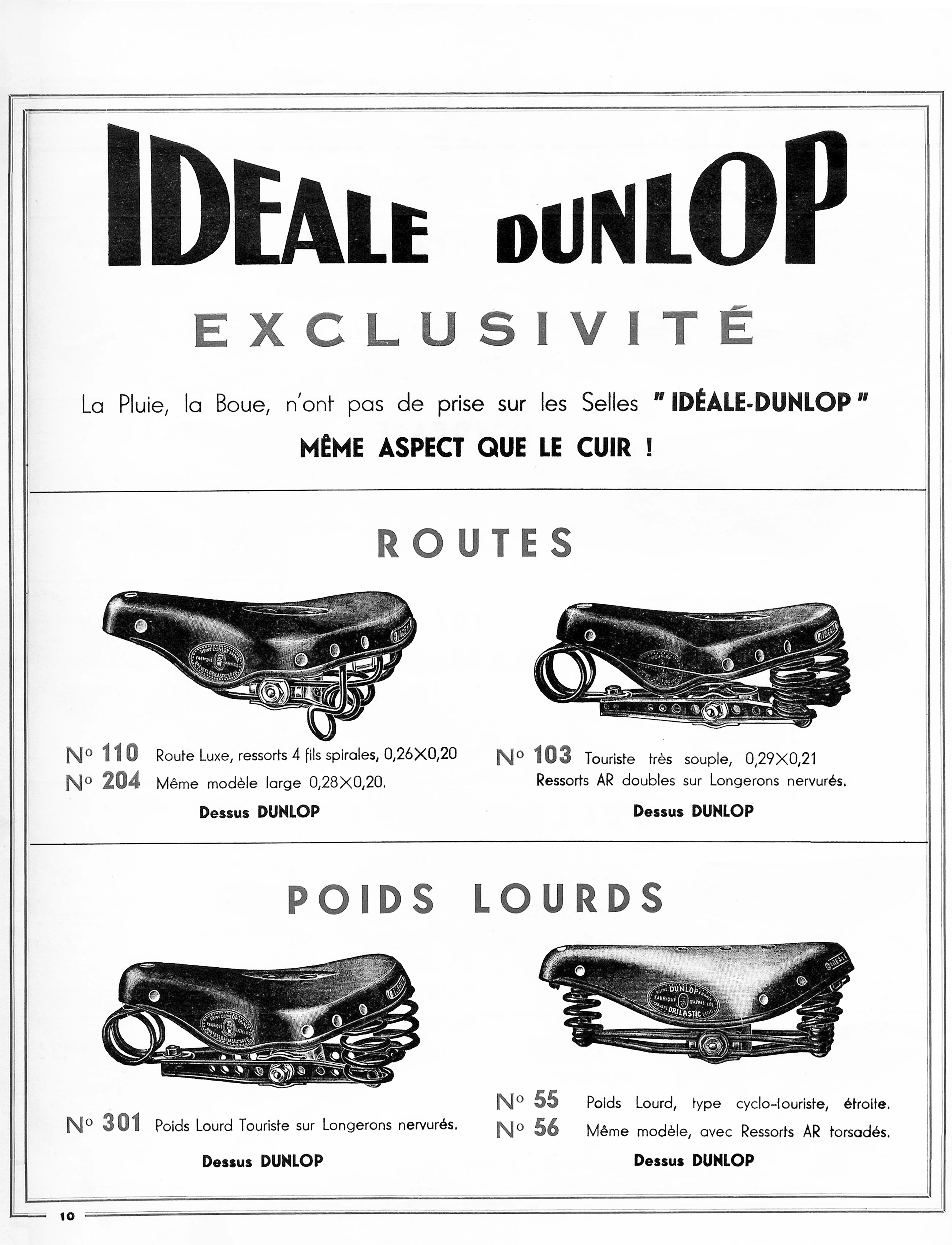
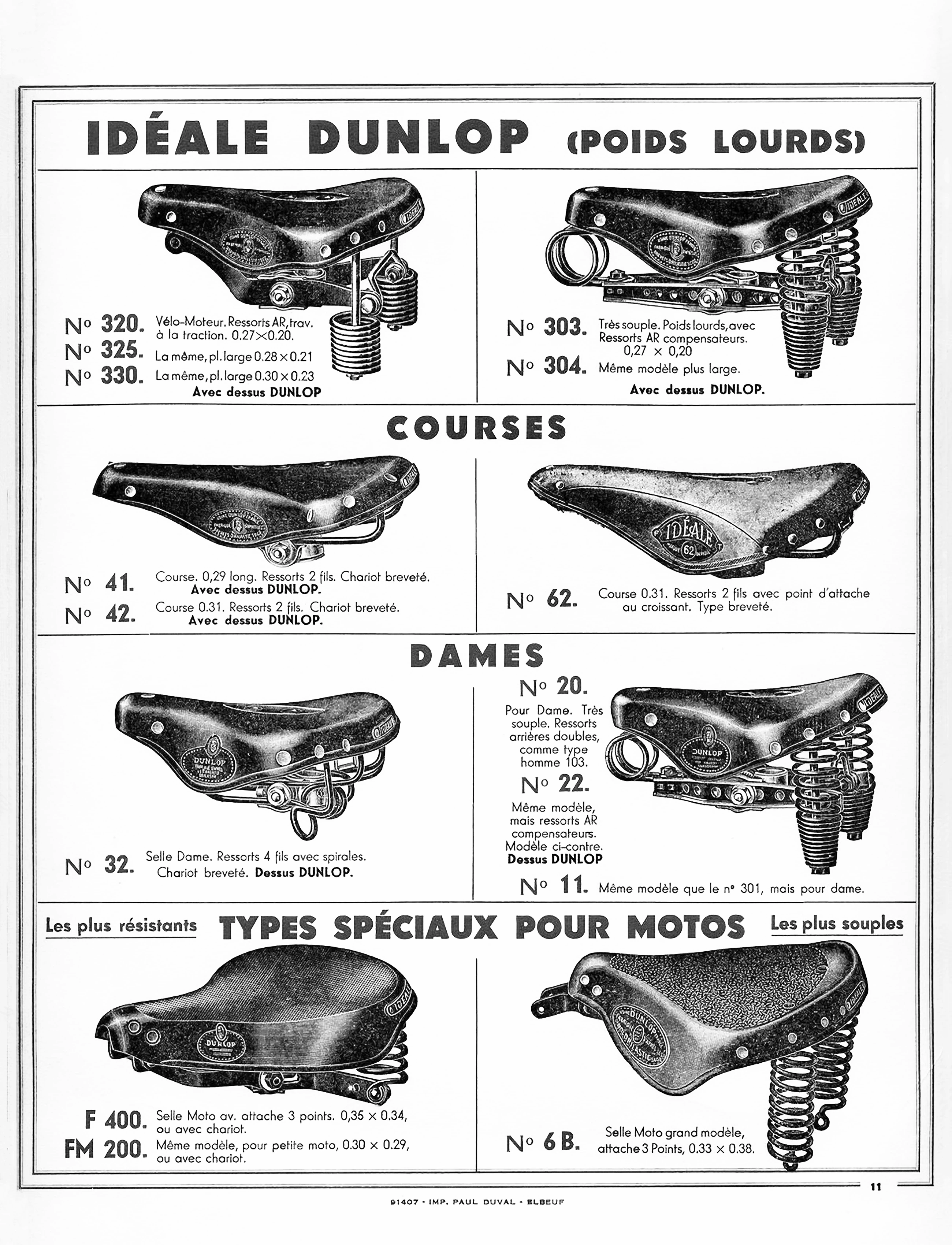
Idéale catalogs from circa 1936 show 12 different saddle models with Idéale Dunlop tops, including variations for both men and women for use on both smooth roads and bumpy paths. Of particular note here are a pair of beefy, double-sprung saddles made for motorcycles – the F400/FM200 with its weather resistant top and the number 68 with its supple top. The 1939 Gentil & Cie catalog also shows several Idéale Dunlop models, including model numbers: 32, 41, 103 and 110, a Road Luxe model that featured four vertical springs and a demountable, first choice leather top.
Cost and scarcity may have also played roles in Tron & Berthet S.A.’s outsourcing one of the most important components used in the production of Idéale saddles: the legendary, ultra-lightweight Duralumin chassis found in the company’s top saddles. A Paris-based company named Cégédur was responsible for producing at least some or perhaps all of these chassis. Astute readers will recognize this name from the stamped inscriptions found on Idéale saddles made with Duralumin chassis. This chassis component did more to differentiate Idéale saddles from their less innovative counterparts than just about any other.

Cégédur was established in 1912 by the French aluminum and copper industries as a single source provider of various products made from Duralumin, a trade name for one of the earliest age-hardenable aluminum alloys. Cégédur made Duralumin stems, hubs, chainrings, crank arms, pedal cages and other bicycle components. It also made Duralinox handlebars, rims, fenders, chain guards and small bicycle accessories like: handlebar end plugs, light housings, horns, pumps and racks. The Cégédur name stood for, “Compagnie générale du duralumin et du cuivre,” and the conglomerate was very successful in addressing its core mission: to popularize the use of duralumin in a wide variety of consumer and industrial products.
Idéale established itself as the most emblematic brand of French bicycle saddles ever, transitioning from a small stamping workshop founded by Jean-François Tron in 1890 to a global leader in high-performance cycling components by 1970. The company’s success was built on a commitment to technical innovation, such as the proprietary “secret process” for waterproofing leather and the development of ultra-lightweight chassis materials like Duralumin and Titanium.
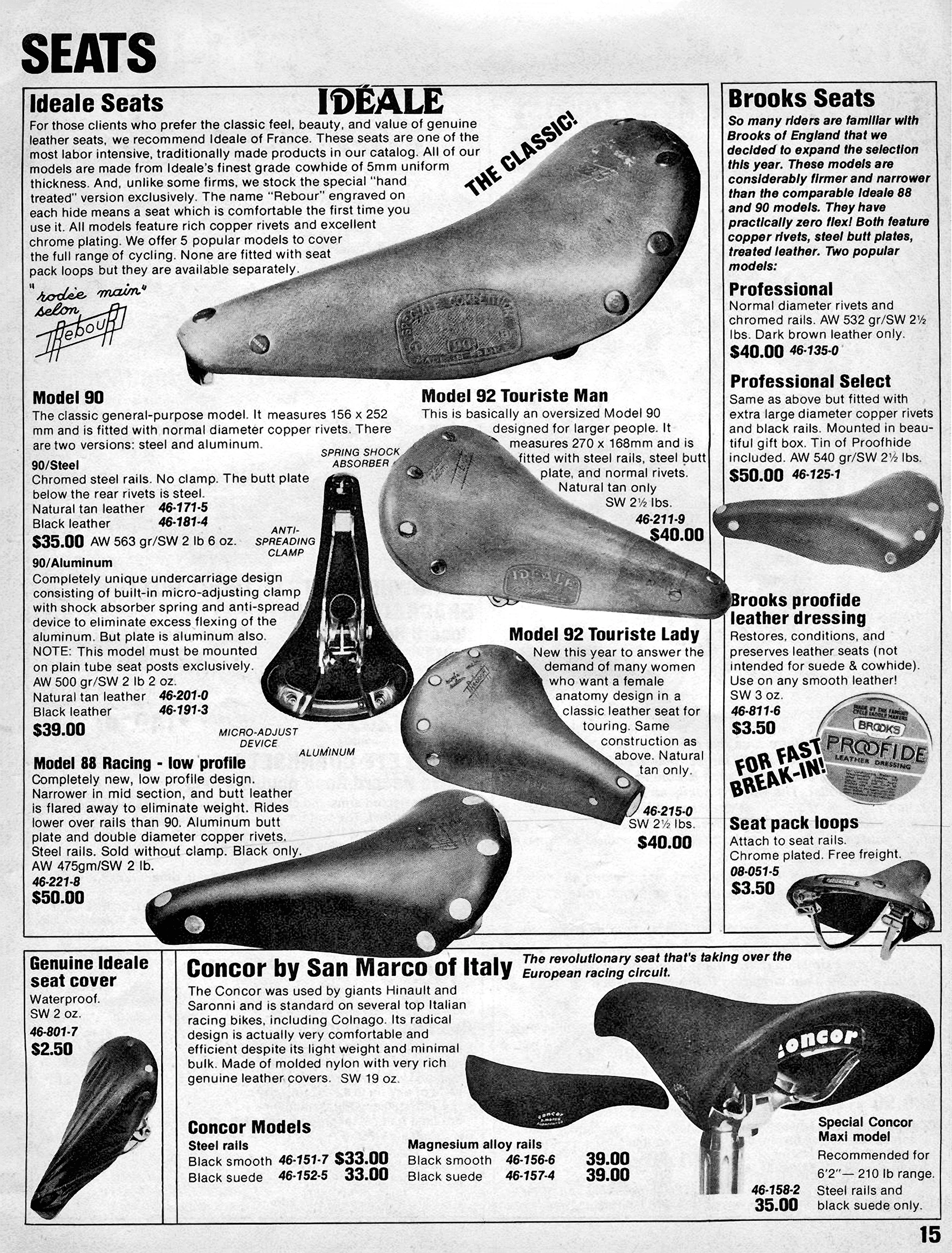
The most popular models represent the brand’s evolution from traditional leather racing saddles to modern synthetic performance designs, often featuring the renowned “Rodée Main” (hand broken-in) treatment devised by Daniel Rebour in 1969 to eliminate the painful break-in period and accompanying saddle sores.
| Model No. | Category | Top Material | Rail Material | Weight | Technical Details & Notes |
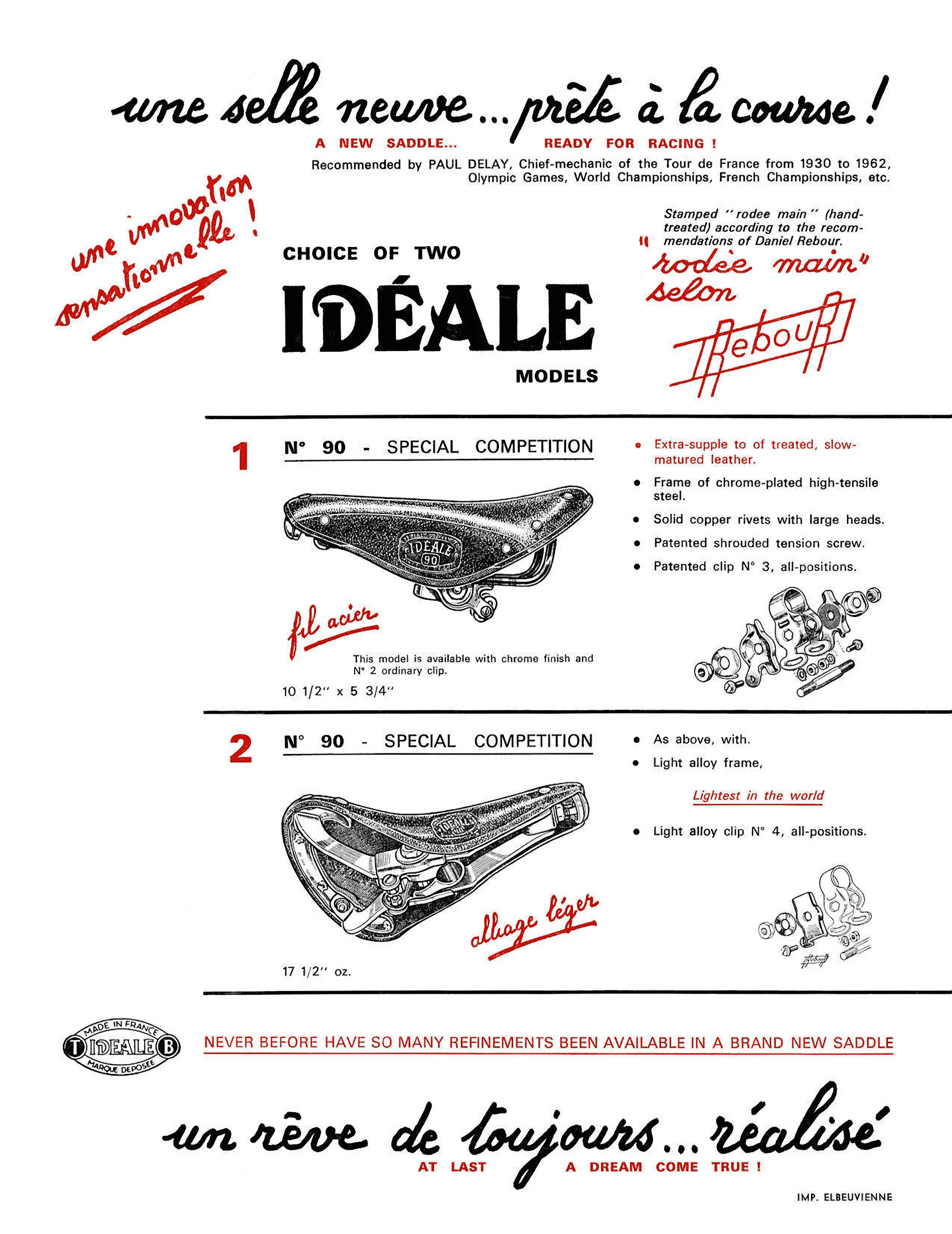
| 90 Spéciale Compétition | Professional Racing | Extra Supple Treated Leather | Steel or Duralumin | 500g – 735g | The brand’s flagship; features large copper rivets and the patented “Rodée Main” Rebour treatment. |
| 80 Record | Sport / Club | Extra Quality Leather | Steel | 750g | A “saddle back” shape with a cambered back plate; widely considered the French equivalent to the Brooks B17. |
| 57 “Critérium des Alpes” | Professional Racing | Treated Leather (Oak Bark) | Duralumin | ~430g | An ultra-lightweight “super-allégée” model featuring perforated wings for maximum weight savings. |
| 92 Diagonale / Touriste | Touring | Rebour-Treated Leather | Steel | 750g | Designed for long-distance comfort with a 2cm wider cantle plate than the No. 90. |
| 88 Competition Spéciale | Racing / Long Distance | Softened Leather | Steel | 500g | Features a low profile design and large-diameter copper rivets; preferred for its “unsurpassed comfort”. |
| 2004 “La Randonneuse” | Performance | Rislan + Leather | Steel or Titanium | 425g – 645g | A modern hybrid with latex foam padding; used successfully in the Tour de France; Titanium version saves 43% weight. |
Idéale bicycle saddles were occasionally modified to mount directly to a seat post to maximize weight savings. This was made possible by welding the saddle to the seat post or by using a special seat post designed to forgo the need for a clamp. Duralumin or even titanium under-carriages as featured on some late-model saddles like the 88, 90, 2003 and 2004 would be expected here, to be sure.

In extreme cases of weight frugality, Idéale saddles could even be mounted directly onto an extended seat tube, thus refining the seat tube, seat post collar, seat post, saddle clamp and saddle into one unified structure. “Très légère” indeed, for one very special rider per each very custom-tailored setup.
Despite the wide appeal of its varied leather tops and chassis designs, Tron & Berthet S.A. ultimately fell victim to lower-priced, plastic-based competition (think Cinelli, Concor, Milremo and Rolls) and waning interest in French cycling products after a devastating World War II. Manufacturing nevertheless continued until 1980 (or perhaps 1981) under the management of Pierre Berthet, only known grandson of Jean-François Tron. Pierre Berthet had assumed leadership of his family’s saddle-making business in 1969 and helped increase its presence in foreign export markets that included Japan and the United States.
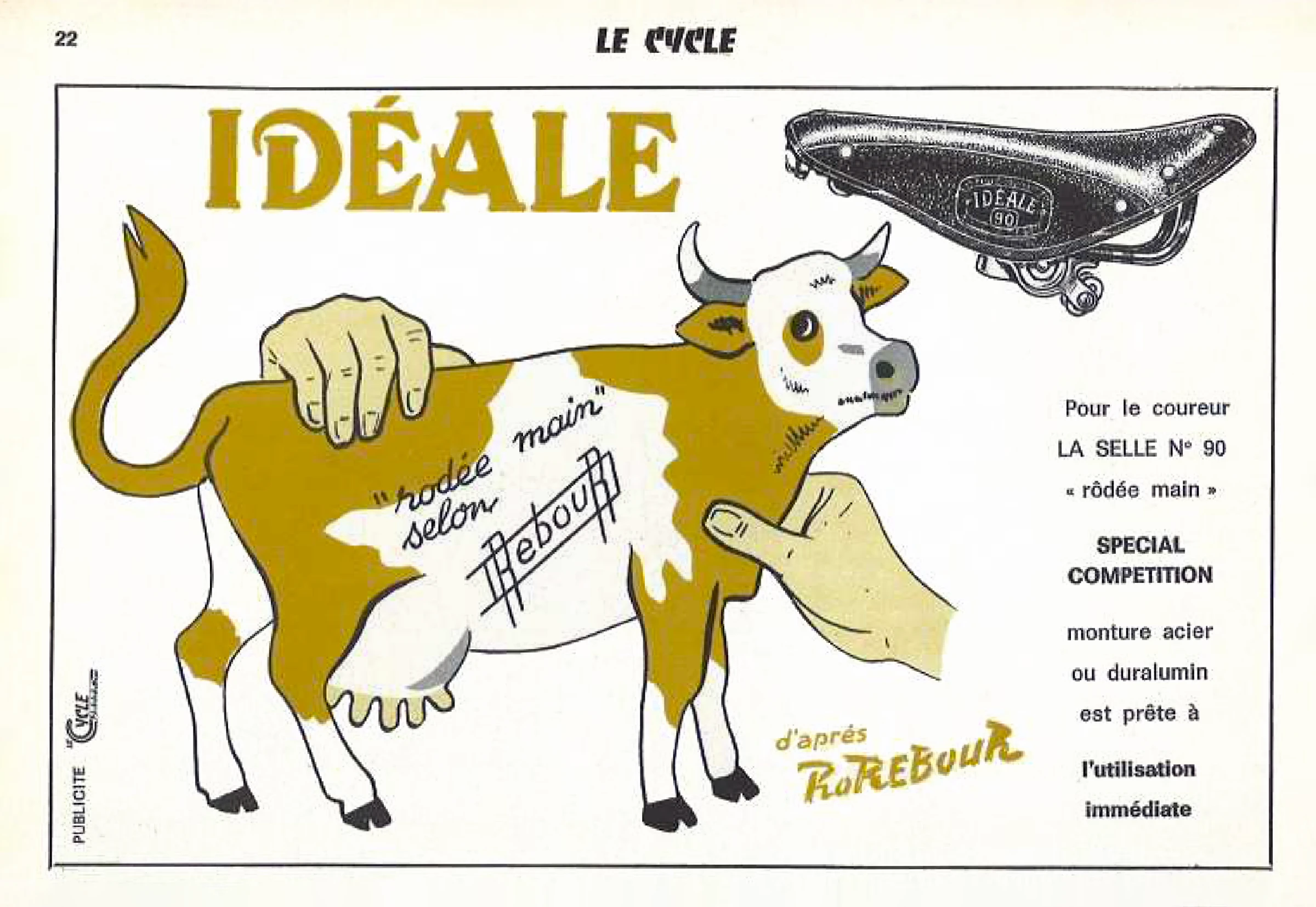
This was partly accomplished by introducing the “Rodée Main” (hand-broken) top treatment process that same year, which could be the most significant technical achievement in the history of the leather bicycle saddle. Developed by the eminent cycle technician and illustrator Daniel Rebour, this method resolved the inherent conflict between leather durability and rider comfort.


Traditional leather saddles required an arduous “breaking-in” period where the rider’s anatomy provided the force necessary to supple the hide. In contrast, the Rebour process performed this conditioning at the factory level. Before the leather top was fitted to the frame, it underwent a manual suppling treatment. This simulated the equivalent of thousands of miles of riding, ensuring that every fiber was softened without the risk of the saddle top becoming misshapen or sagging through improper initial use. Which as many of us know all too well, really sucks.
Here is a quick breakdown of standard leather saddles vs. those with the Rebour “Rodée Main” treatment:
| Feature | Standard Leather Saddle | Rebour ‘Rodée Main’ Treatment |
| Breaking-In Period | Lengthy; often requires 500+ miles to reach comfort. | Immediate; “No Breaking-In” required upon purchase. |
| Leather Flexibility | Rigid and stiff; dependent on rider weight to conform. | Extra supple; factory-suppled to every part of the hide. |
| Risk of Misshaping | High; intensive early use on stiff leather causes uneven wear. | Low; uniform factory suppleness ensures consistent shape. |
These advancements and the company’s increased presence in foreign markets allowed it to employ 110 people in 1975, pumping out pre-softened saddles for riders in most major cycling markets worldwide. Six years and another misadventure into making (remember those automobiles?) metal storm grates later, Tron & Berthet S.A. would produce its last “original” Idéale saddle in Pont-Saint-Pierre – an Idéale Profil TB1.
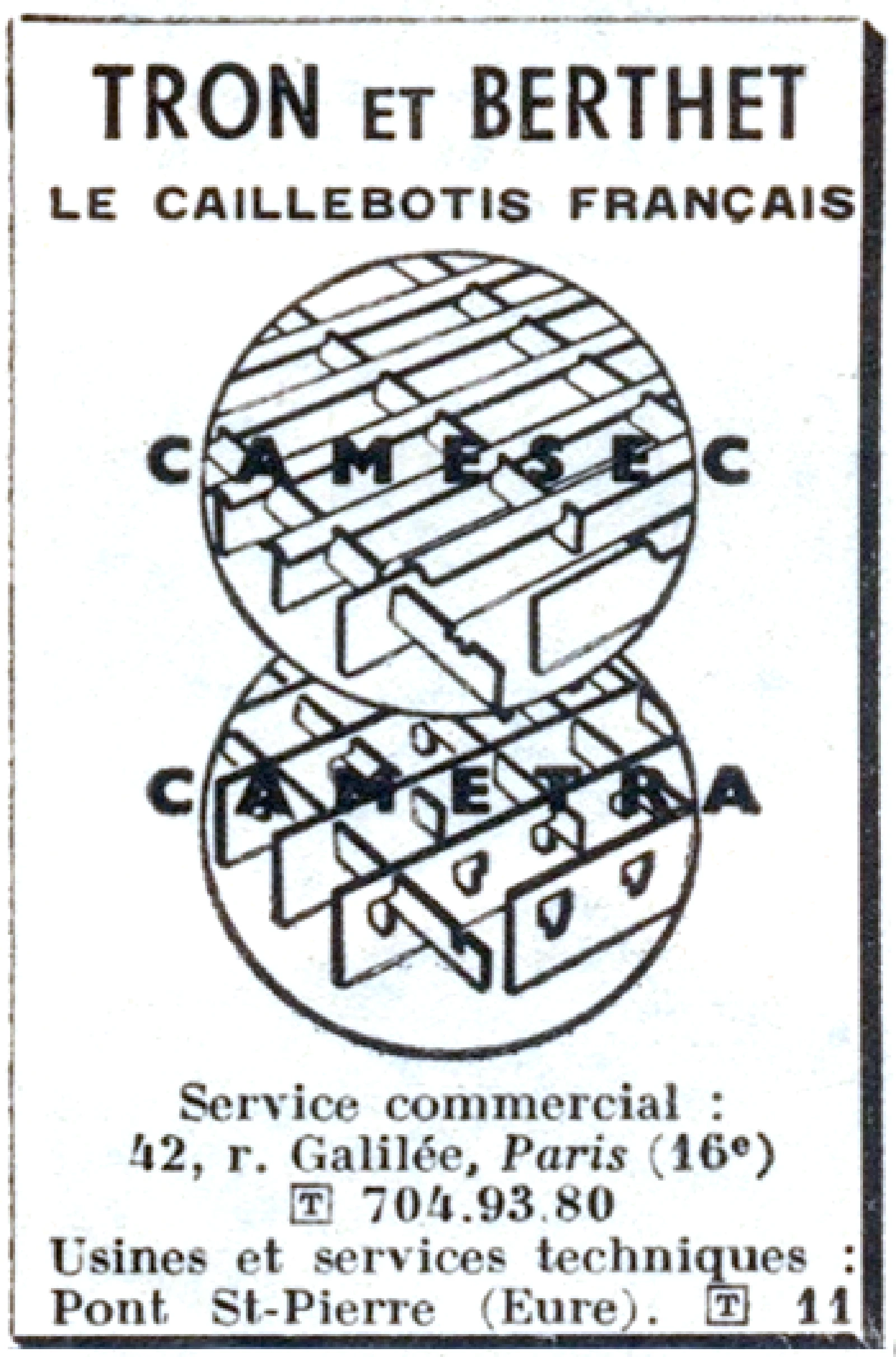
The company’s demise was not for lack of market access or breadth of offerings. In its latter years, Tron & Berthet S.A. participated briefly in two collectives of companies that offered complete groups of components. First was the Sélection Tricolore Course (STC) and then came Geffac, neither of which lasted very long. Even in its final year of operation, Tron & Berthet S.A. offered a robust 29 saddle models across three distinct market segments: leather racing; Rislan plastic racing; and utility, road and children. A total of 42 employees remained in 1981 when the company was placed in compulsory liquidation and filed for bankruptcy. Despite its rich 91-year heritage, creditors rarely go poor.


The last known Idéale advertisement showing an address in Pont-Saint-Pierre was in the March 1982 issue of Le Cycle, where it promoted the Diagonal 92 and Cyclo 75 models. The first known Idéale advertisement showing the relaunched brand’s new address in Pontault-Combault was in the October 1985 issue of Le Cycle. The factory remaining in Pont-Saint-Pierre is believed to have operated until 1986 or possibly 1987 under new ownership.

The Berthet family had sold the company and Idéale brand to an outside group with plans to update the product line and mass produce its leather saddles. It took just six months for the new owners’ mechanization plans to fall apart, with their having little appreciation for how leather needs hand-working to bring out its best qualities, until it was too late to change their company’s direction and its underlying business model.

Today, Idéale saddles and accessories are celebrated for their longevity and variety. Their most enduring qualities, though, still have to be their distinctly superior weight, quality build characteristics and overall butt feel compared to virtually all other leather saddles, classic or contemporary. Indeed, most Idéale saddles are pleasant to sit on for long turns on the pedals.

For the better part of a century, the Idéale nameplate was affixed to and synonymous with the lightest saddles available. From breakthroughs in leather conditioning techniques involving sumac and tannin to wonderfully efficient undercarriage designs made of aluminum and even titanium, everything the Idéale brand stood for and now continues standing for is well-earned.

Improving the primary interface between bicycle and bicyclist would suggest lasting fame and fortune for anyone capable of pulling off this feat of historic proportions. Among bicyclists, improving the saddle is akin to building a better mousetrap, as Tron and two generations of Berthets continued doing for 91 wonderfully expansive, explorative years.
Sometimes even the cleverest of mice fail to escape their own mousetrap, though, leading one to wonder what might have been had Idéale only thought beyond the seat of its pants. Moving faster and further into manufacturing plastic (or at least leather-covered plastic) bicycle saddles, making saddles for motorcycles earlier and more committedly, diversifying into other bicycle accessories like bags or even clothing – these are the things that might have saved Tron & Berthet’s beloved Idéale brand. Or just continuing to make the very best, hand-made leather bicycle saddles possible and right-sizing the company to better align with actual market demand.
Enter Frédéric Ducès. A true keeper of the flame, Fred discovered Idéale saddles in 2010 while outfitting his trusty randonneuse nearly 30 years after the the last TB 1 left Pont-Saint-Pierre. Instead of typing “Ebay” in his web browser like most of us, he reached out to the Berthet family and then posted a “wanted” notice at the Town Hall in Pont-Saint-Pierre. The Idéale saddle brand formally relaunched in 2013 and Fred continues producing one saddle per day—currently the “90” Spéciale Compétition—in lovely Toulouse, France, near the picturesque banks of the River Garonne.
Modern production at the Toulouse atelier remains a labor-intensive affair, defined by a commitment to 100% French sourcing and the preservation of the patented “Rodée Main” softening process. Each modern saddle begins with extra-slow vegetable-tanned leather from the historic Gal tannery, which is then subjected to 17 distinct manual operations. Central to the Idéale brand’s identity is the mechanical “breaking-in” technique taught to Ducès by the last keepers of the Rebour tradition, allowing the leather to offer immediate comfort without sacrificing the legendary longevity for which the “Croupon Garanti” mark was famous. By pairing these heritage leather-working methods with modern refinements like optional titanium rails, the contemporary Idéale company provides a bridge between the heroic age of the randonneur and the discerning requirements of the modern cyclist.
Whether you’re breaking in a Model 90 or preserving a genuine ‘Rebour’ hide, your experience is invaluable. Join our technical thread to share preservation tips and date-code discoveries.
https://histoireduvaldepitres.blogspot.com/2017/12/tron-et-berthet-la-selle-ideale.html
https://grubb1937.blogspot.com/2014/02
http://velovintagefrancais.e-monsite.com/pages/matos/ideale.html
http://www.conceptcarz.com/vehicle/z10259/De%20Dion_Bouton/default.aspx
https://fampeople.com/cat-paul-de-vivie
http://www.randonneurs.bc.ca/history/cyclo-tourism_velocio_clifford-graves.html
http://www.bikecult.com/bikecultbook/groups_all.html
https://en.calameo.com/books/0005441137daafd523e6e
http://www.pont-saint-pierre.fr/
https://fr.wikipedia.org/wiki/Maurice_Noirot
http://fr.wikipedia.org/wiki/Pont-Saint-Pierre
http://fr.wikipedia.org/wiki/Marcel_Berthet
http://en.wikipedia.org/wiki/Hour_record
Other Idéale References:
http://www.cyclepublishing.com/cyclingbooks/his13.html
Special Thanks
Frédéric Ducès of Idéale Saddles
Vincent Toubeau of “A la recherche des temps perdus” (“In search of lost time”)
 Idéale
Ebykr documents this marque across the archive. Here is the rest of it.
The Ebykr Digest
New articles, timelines, catalog finds and registry activity — assembled from the archive once a month. Your address is never shared.
Double opt-in. One email per month. Unsubscribe at any time with one click.