“I am a man who goes straight to the point… And, by force of habit, I never look back and count the years I have spent making frames.
I prefer to look ahead because, after working for half a century, I am still convinced that the bicycle has room for improvement. And just as I have done up until now, in the future, too, I want to contribute to the evolution of this fascinating vehicle, which is at the same time so simple and so complicated.”
Ugo de Rosa
Forging your destiny in steel at the tender age of eighteen would condemn most any spirit to lifelong antipathy. Not Ugo De Rosa, who by 1952 had already spent a full five years tinkering fruitfully in a relative’s workshop. For the likes of De Rosa and his rare breed, making bicycles extends beyond instinct into the preternatural.
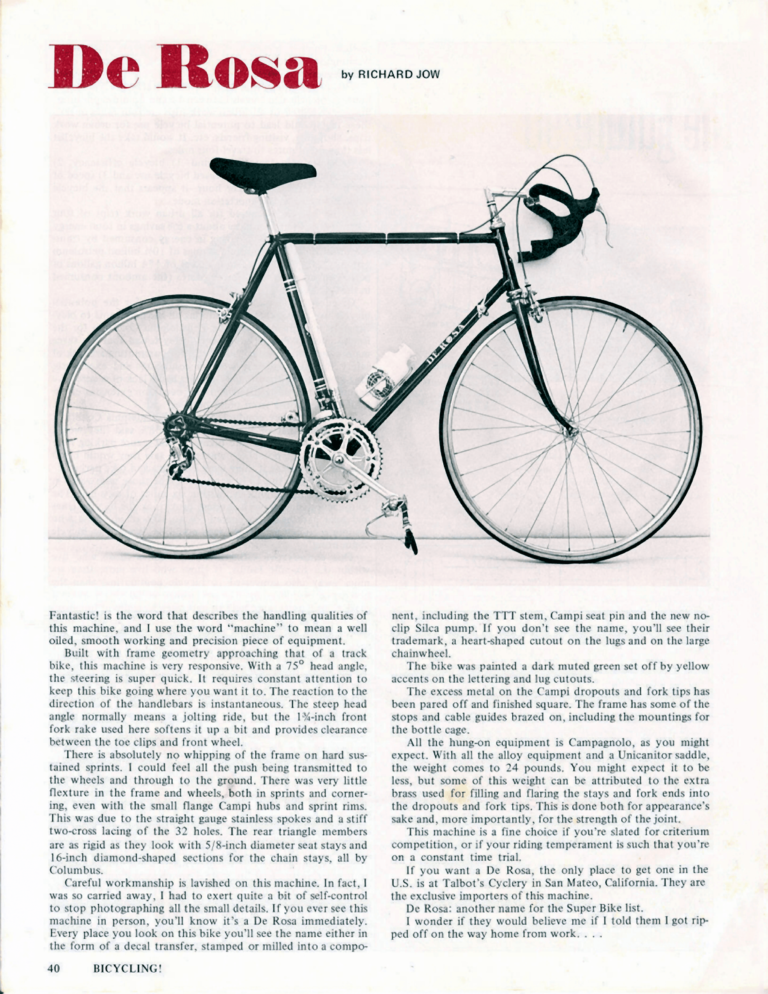
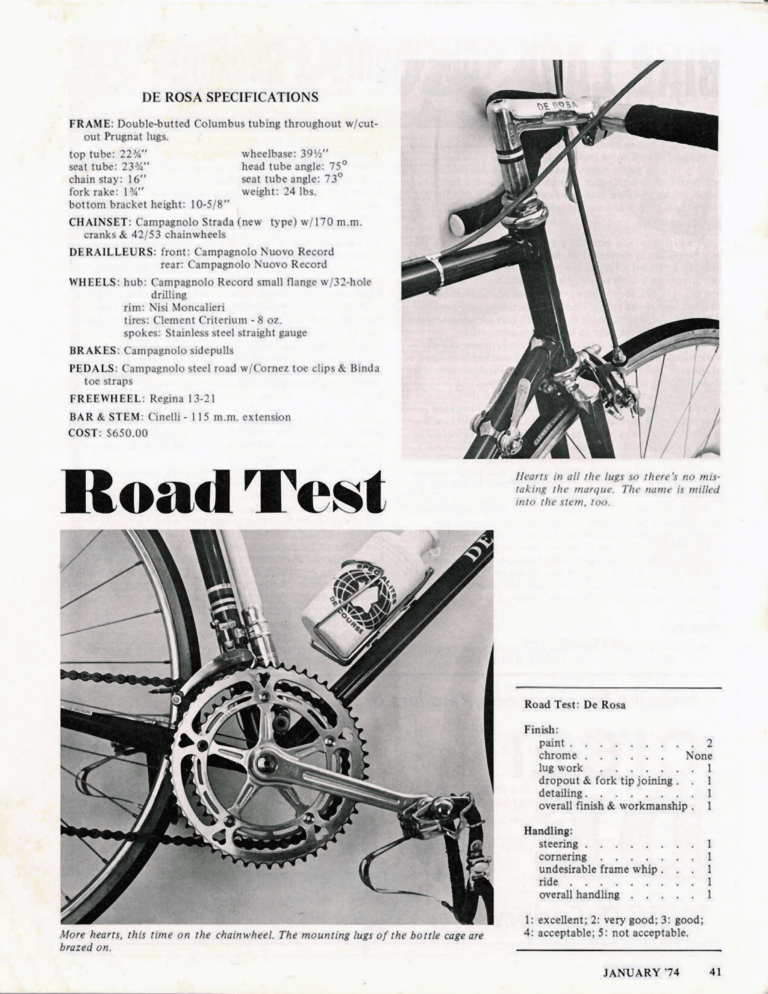
Bicycling! magazine’s 1974 road test and profile of a De Rosa, spotlighting the marque’s signature heart-shaped cutouts on the lugs and chainwheel.
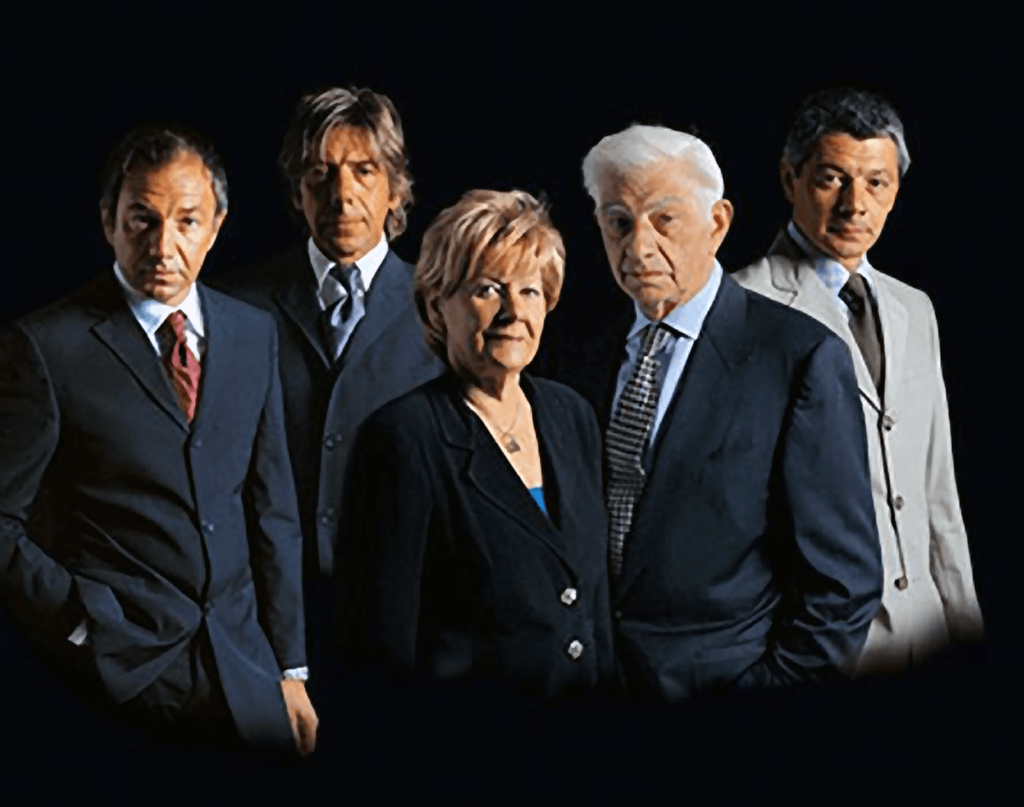
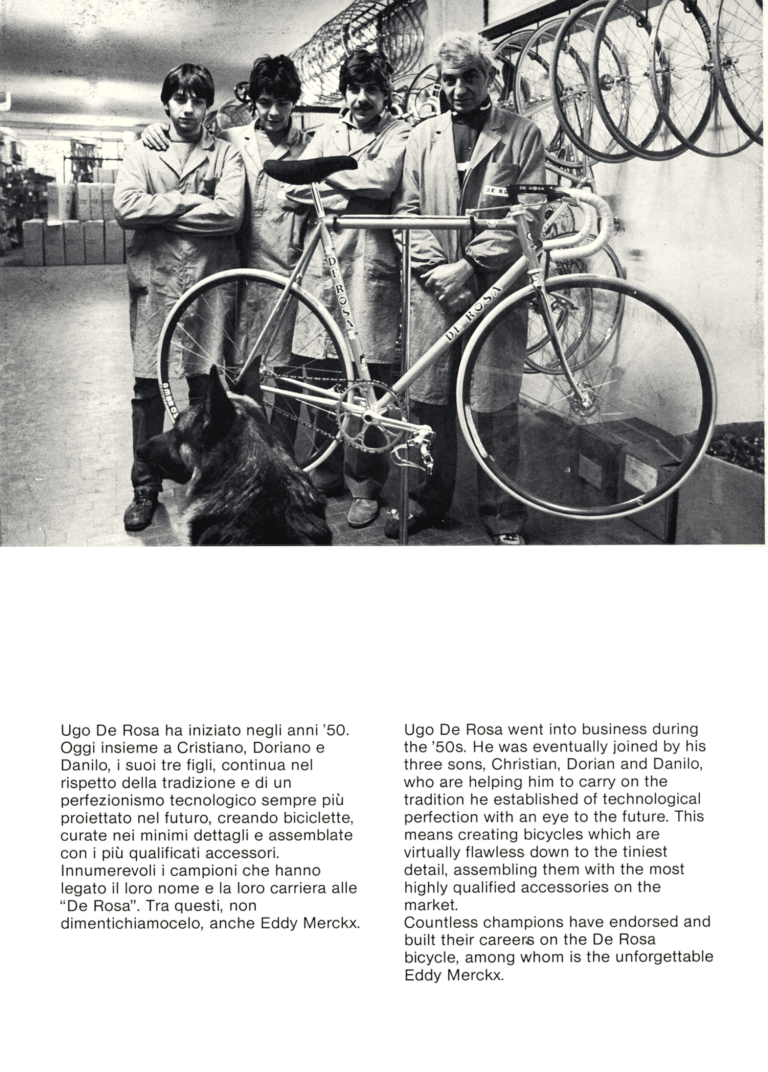
Every element of these masters’ lives reflexively orients around bicycle designs and materials, and a contemptuous refusal to obey their physical limitations. The De Rosa legacy was founded in pursuit of this purity, first by Ugo and then by Mariuccia, his wife. A generation later the family name is carried proudly by three sons — Danilo, Doriano and Cristiano — who continue refining what their father so splendidly refined himself.
The De Rosa family, whose generations have carried the Milanese firm forward since Ugo De Rosa founded it in 1953.
Characterizing the De Rosa name as having withstood the test of time would somewhat disservice the weighty contributions these five individuals have made. Their efforts have helped the De Rosa brand maintain its pioneer status in the art and science of bicycle building for over 50 years. The full truth of their accomplishments lives somewhere outside these ephemeral labels while remaining immediately recognizable by anyone fortunate enough to have ridden a De Rosa.
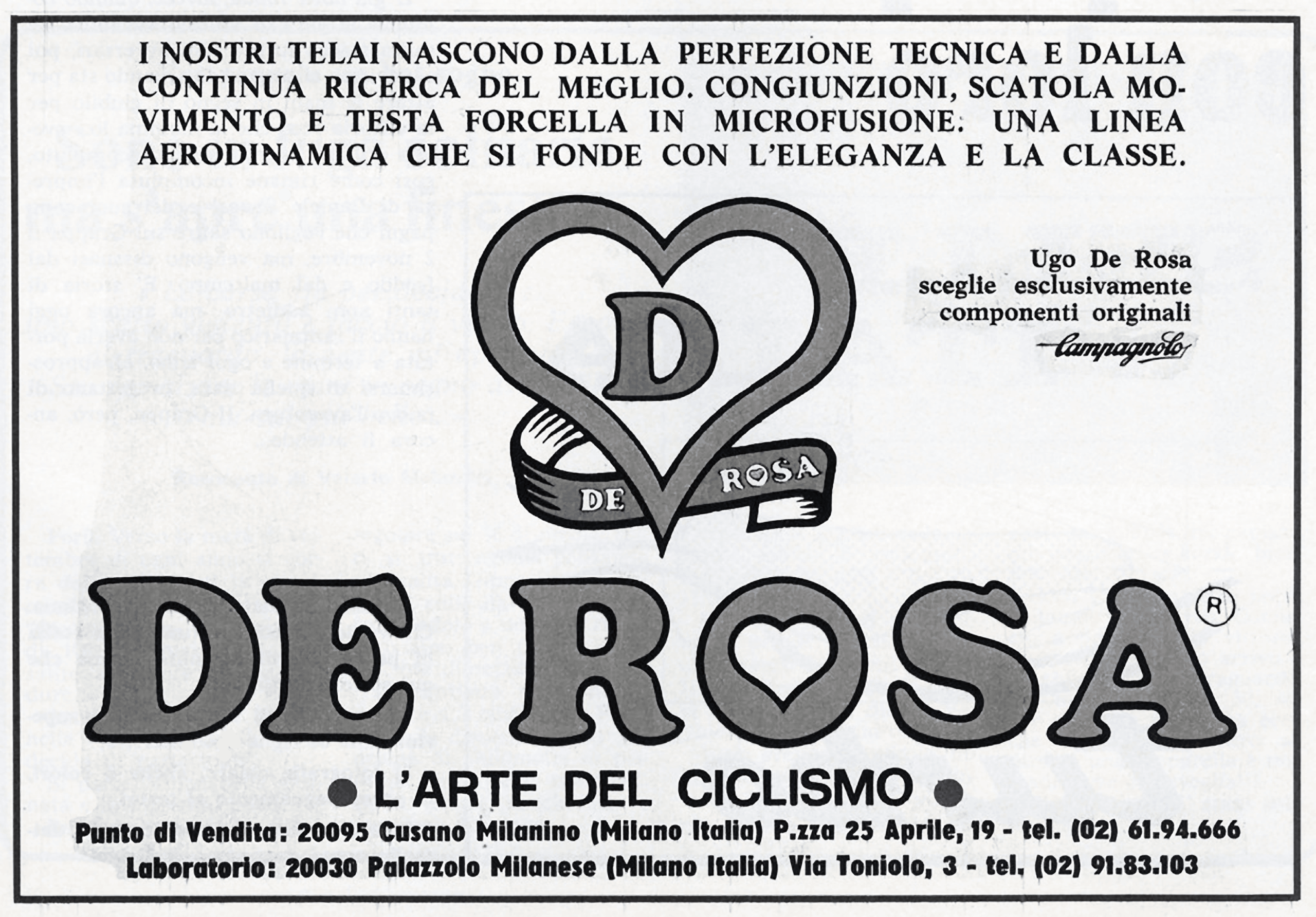
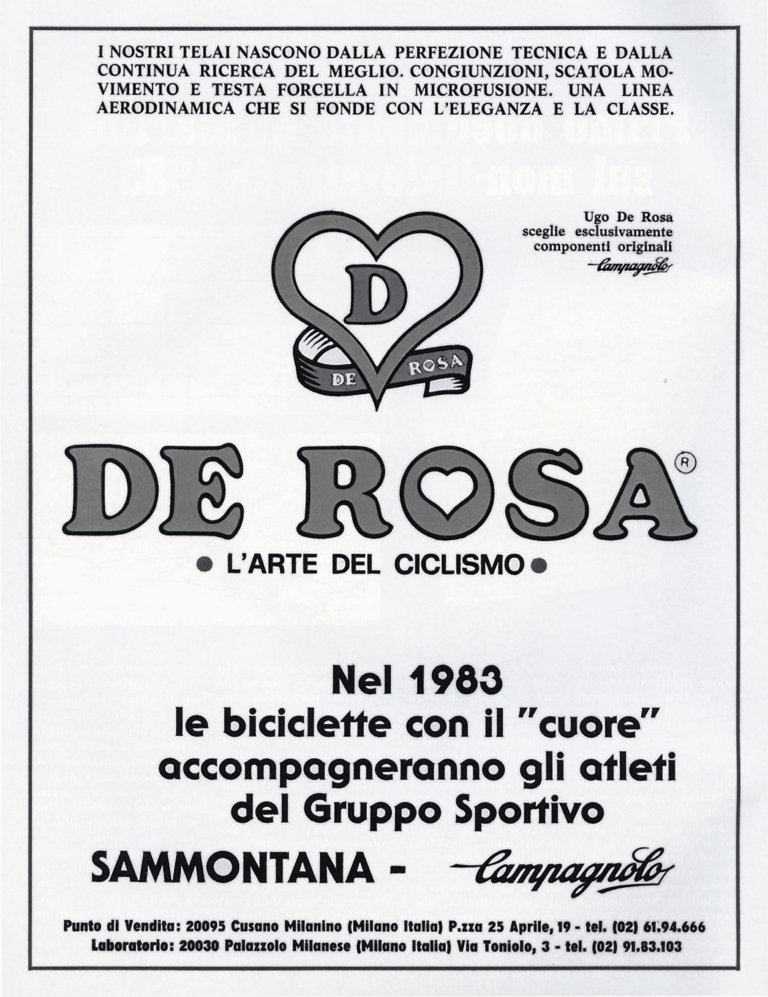
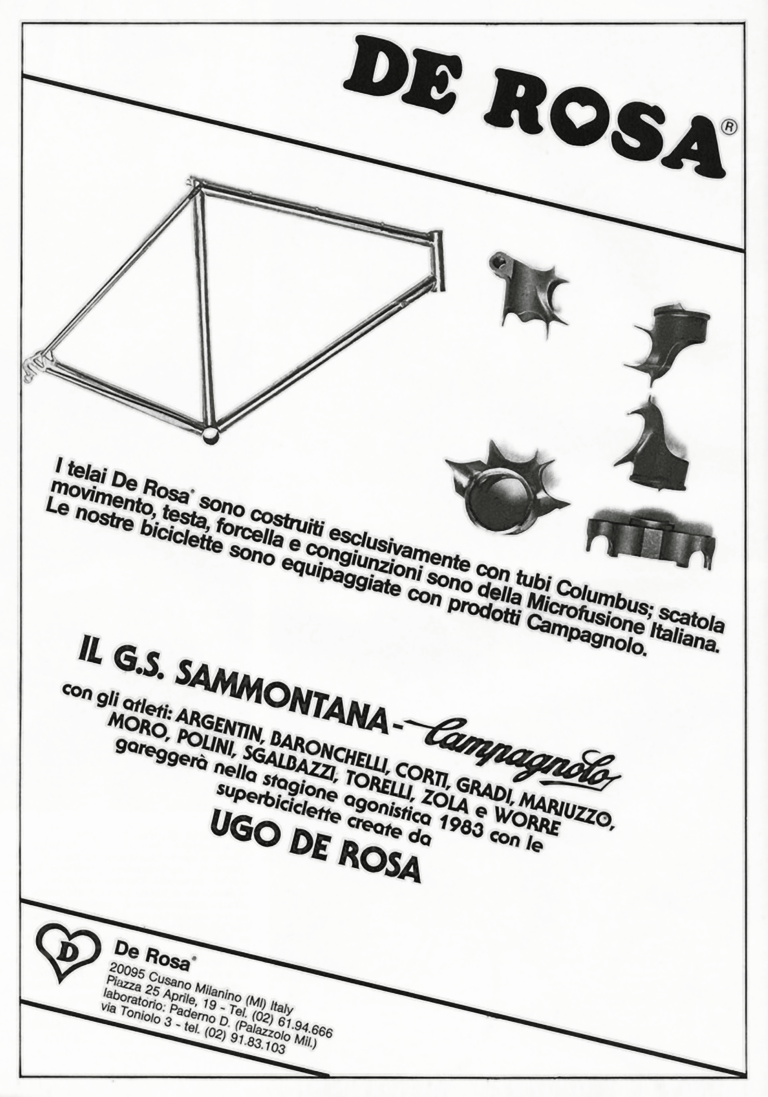
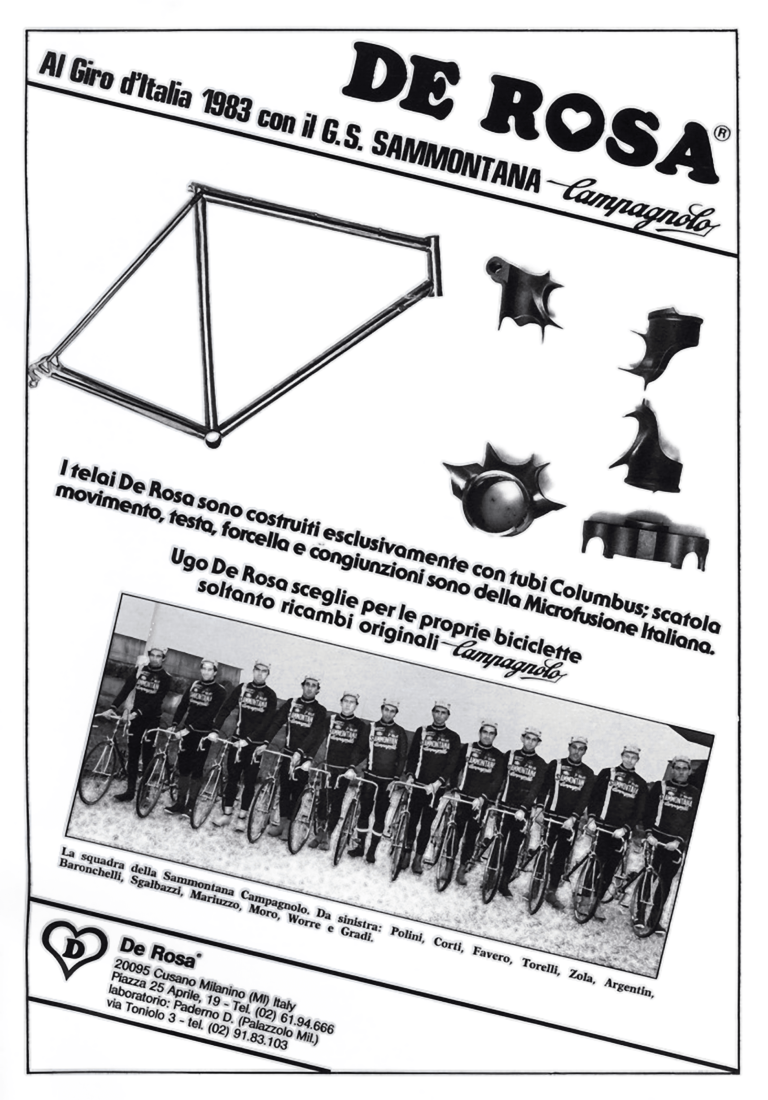
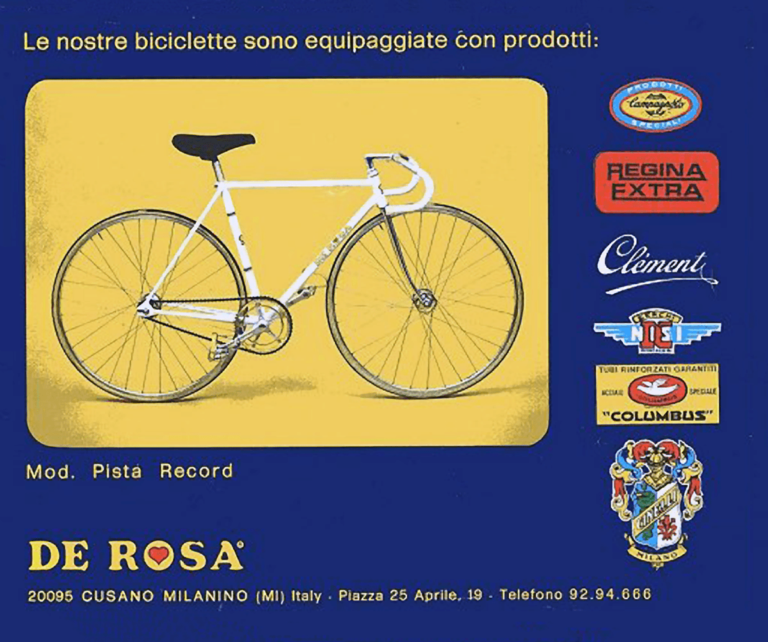
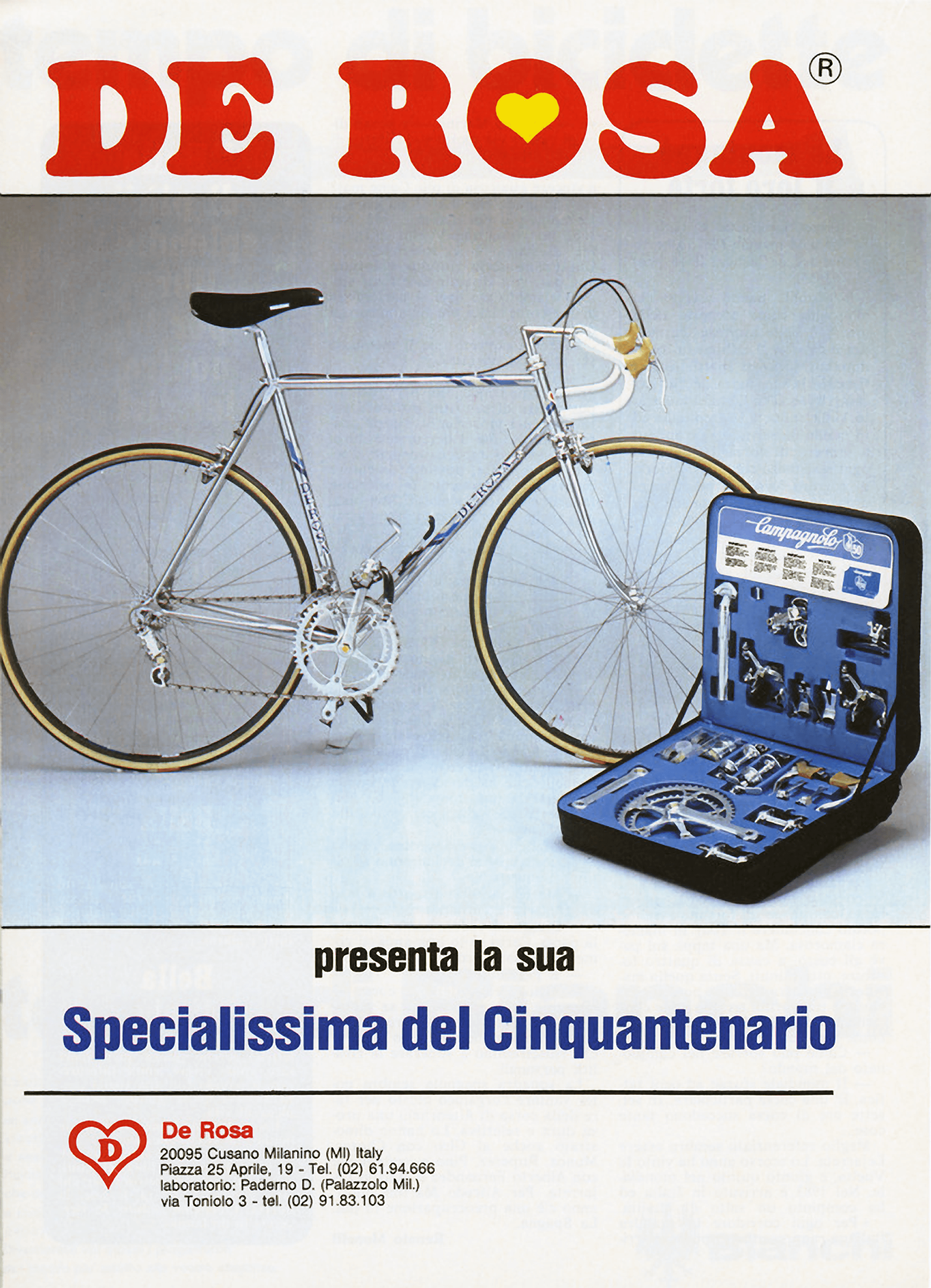
A 1982 De Rosa advertisement touts frames built with Campagnolo components, the pairing Ugo De Rosa insisted on for his shop near Milan.A trio of 1983 De Rosa ads built around the Gruppo Sportivo Sammontana-Campagnolo team and the Giro d’Italia, touting the marque’s cast lugs and Columbus tubing.
From a Milan Workshop
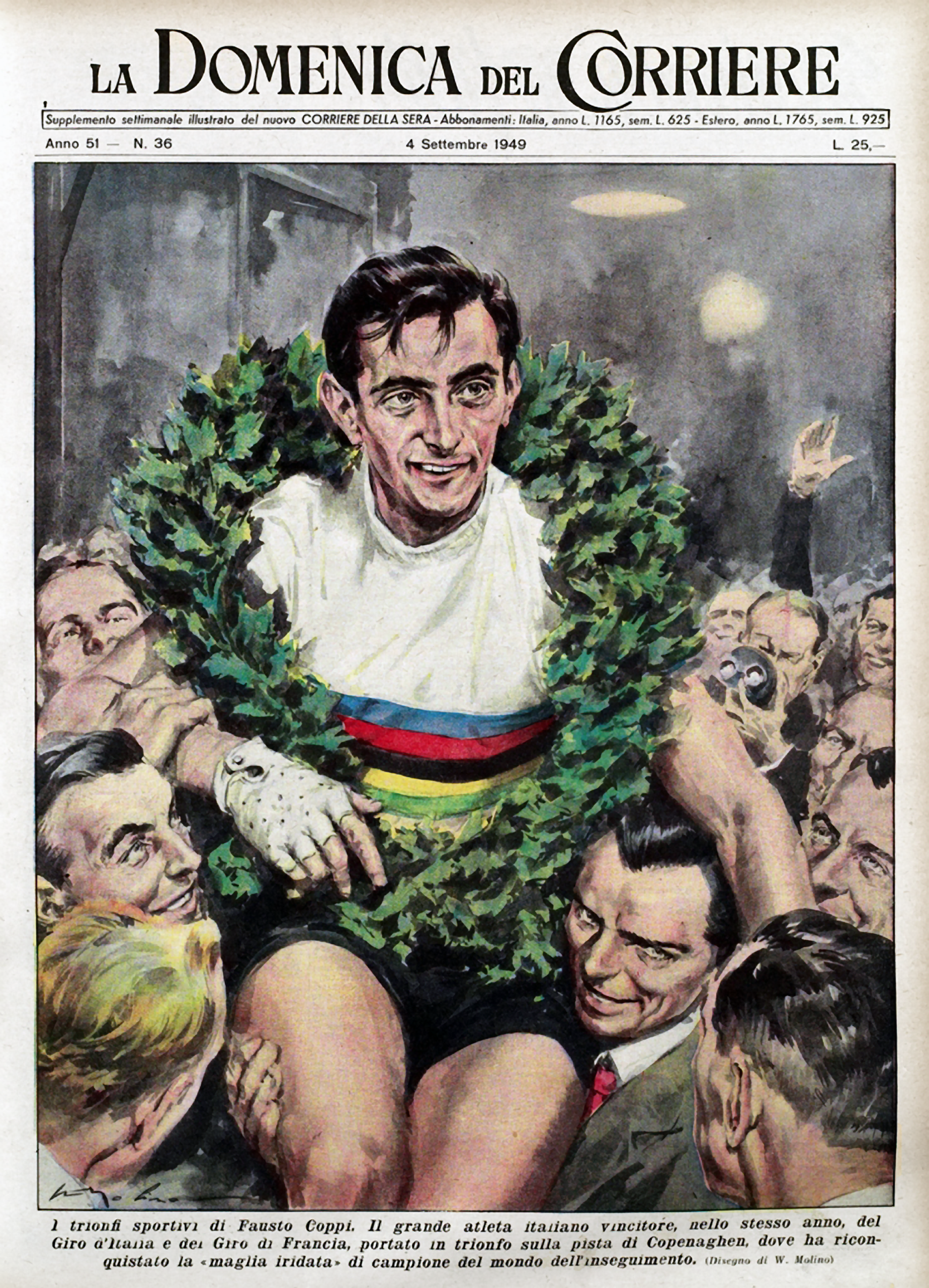
Born in Milan during the winter of 1934, Ugo De Rosa attended a technical school where he pursued mechanical engineering studies as a teen. Inspired by the popular Sunday magazine “Domenica del Corriere” and its Walter Molino illustrated covers celebrating the legendary exploits of Gino Bartali and Fausto Coppi, De Rosa started working in his uncle Filippo Fasci’s workshop in 1947 at the tender age of thirteen.
Walter Molino illustration of Fausto Coppi crowned world pursuit champion, La Domenica del Corriere, 4 September 1949 — the kind of cover that first stirred a young Ugo De Rosa toward cycling.
There he dreamed of building his own bicycle and riding it to victory. He also repaired and assembled bicycles while getting his first lessons in a structured work environment. And history has taught us they were valuable ones.
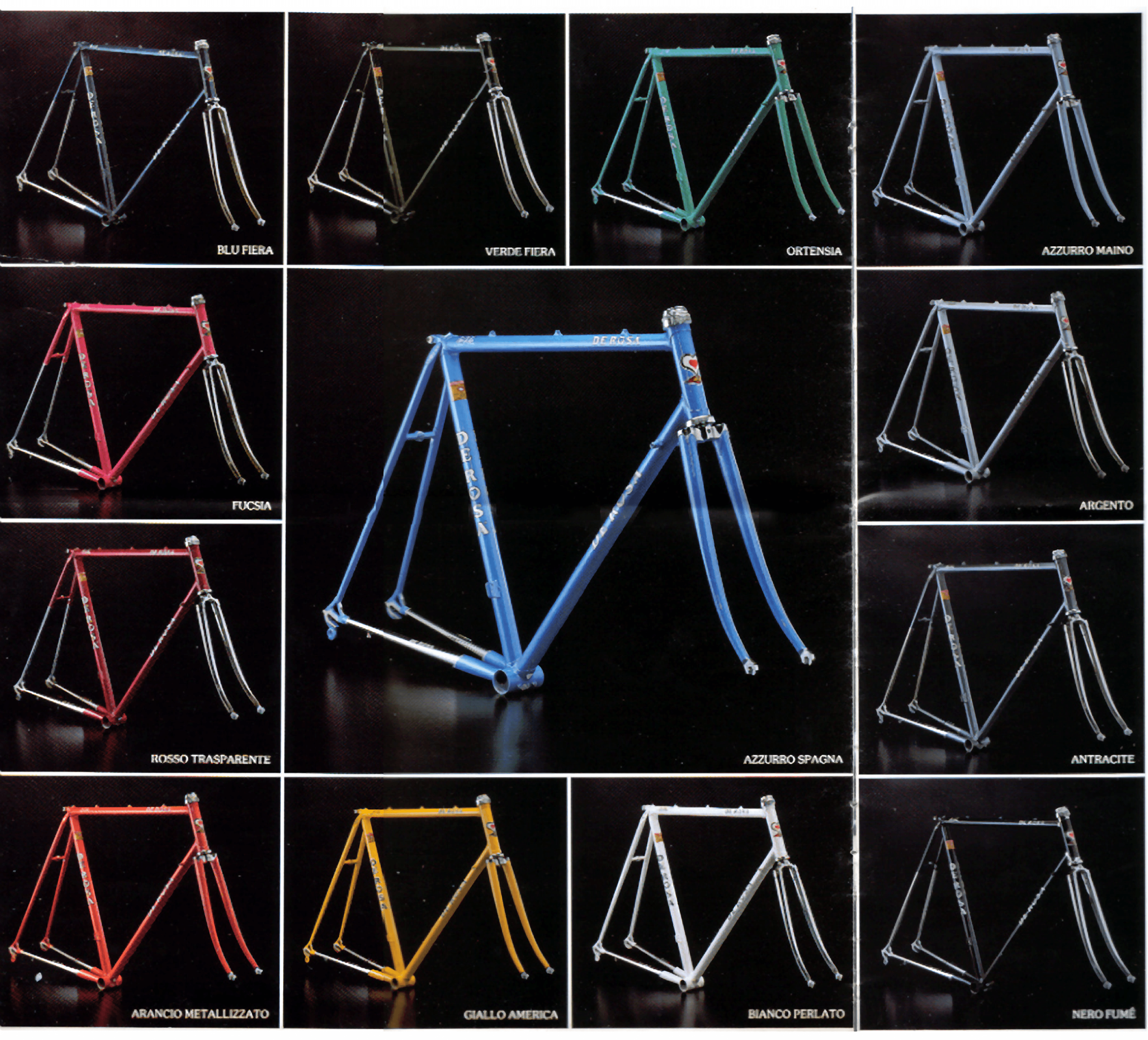
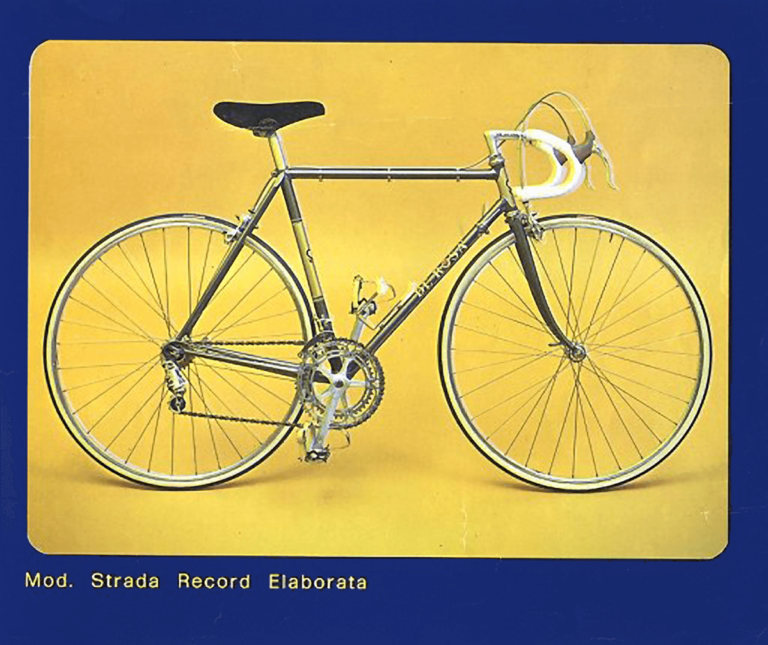
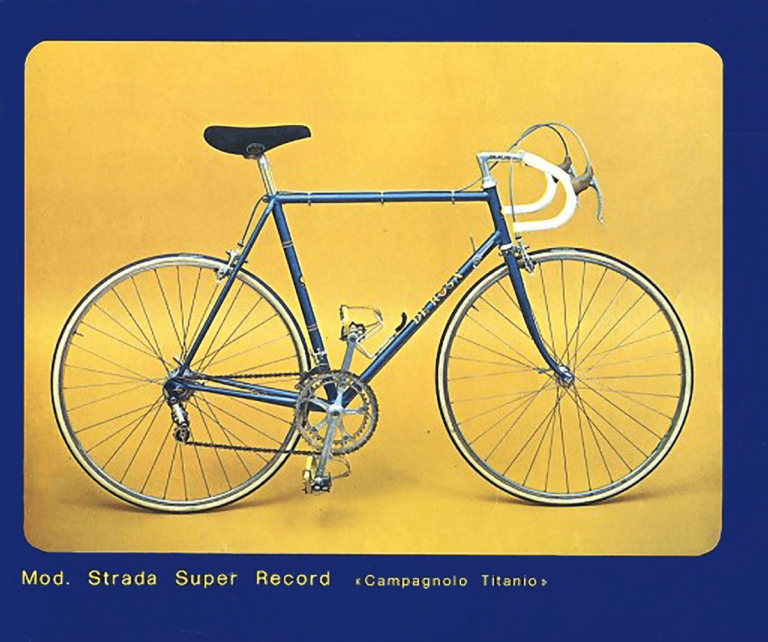
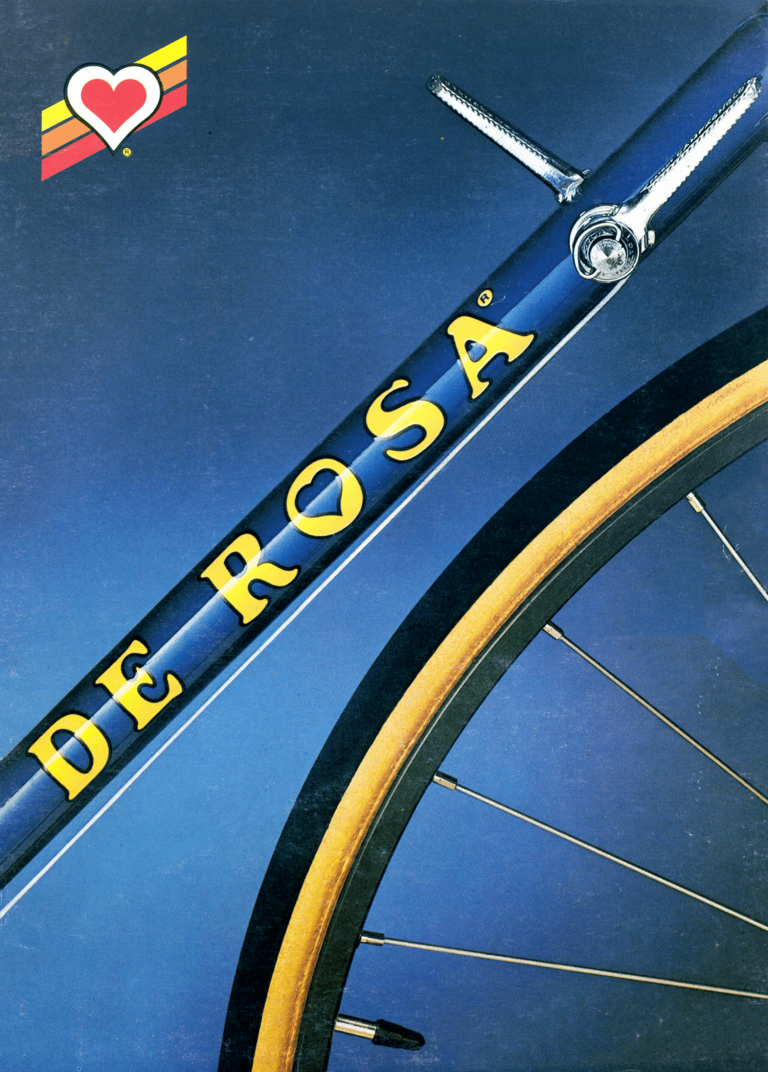
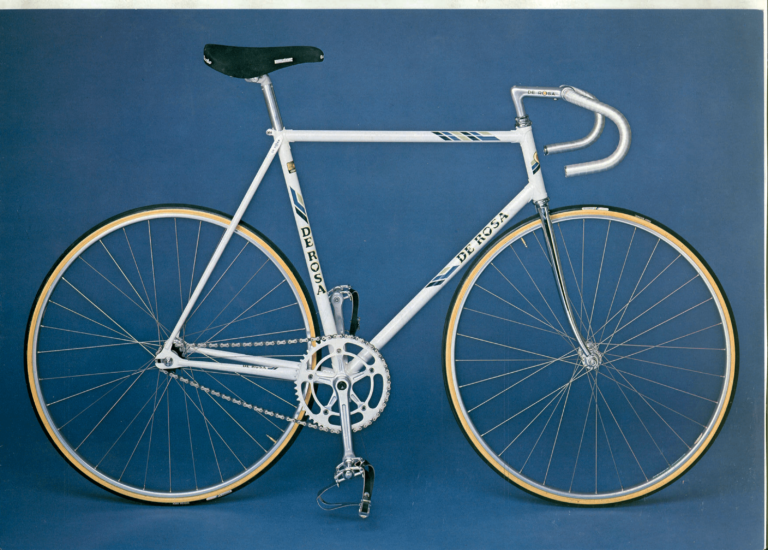
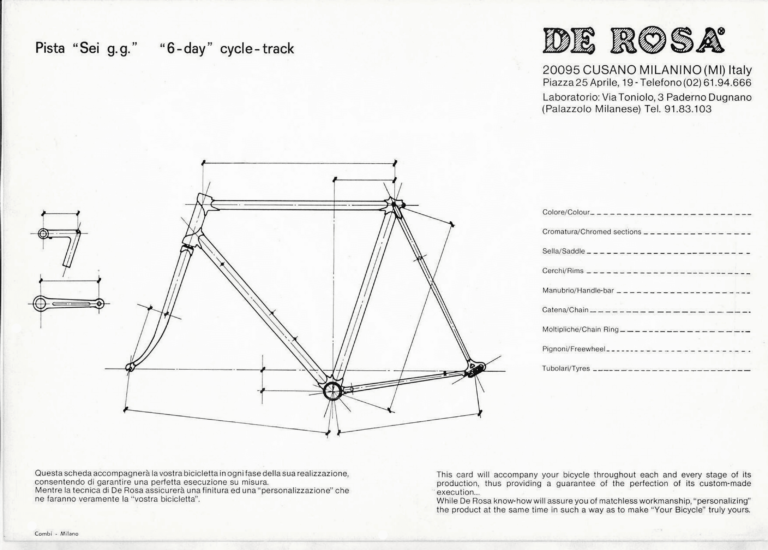
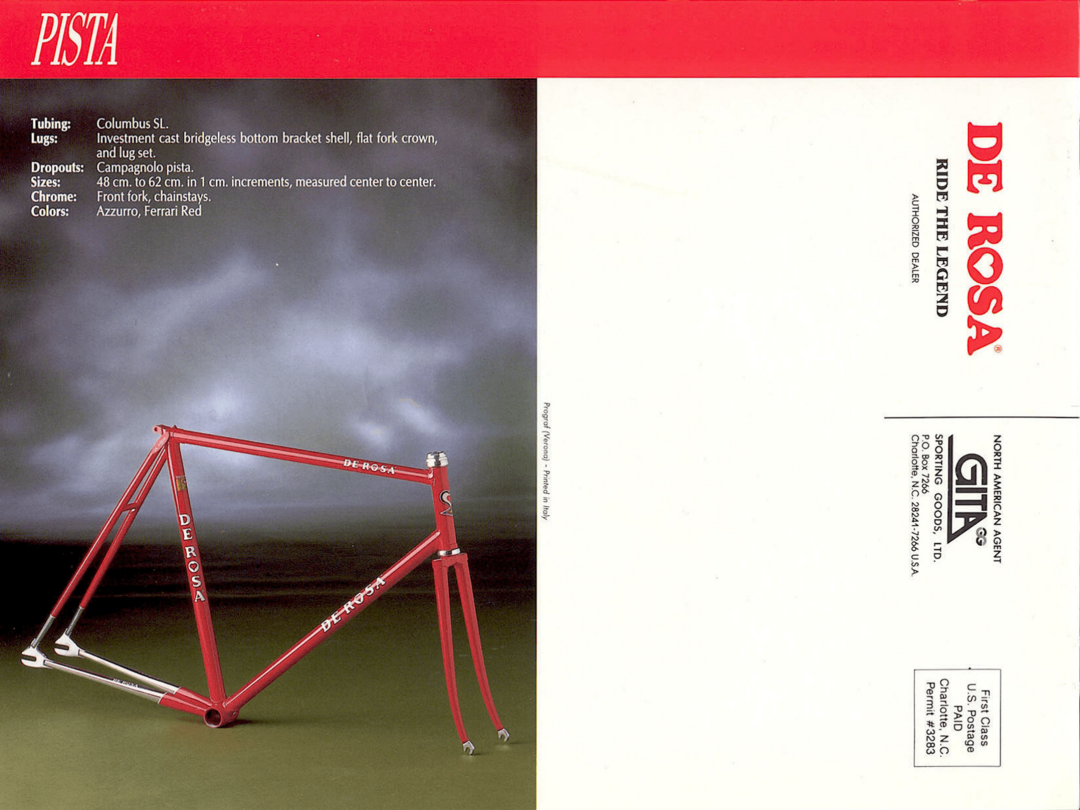
The cover of a 1984 De Rosa mini catalogue, its heart-and-ribbon logo flanked by the flags of the markets it reached.Product pages from the 1984 De Rosa mini catalogue: the Strada Record Elaborata, the Campagnolo Titanio-equipped Strada Super Record and the Pista Record track frame.
All of Europe was alight with hope after the Second World War. The prospect for change was palpable and helped inspire a generation of doers, including the chief quaternity of classic lightweight Italian bicycle builders: Cino Cinelli, Ernesto Colnago, Alberto Masi and Ugo De Rosa.
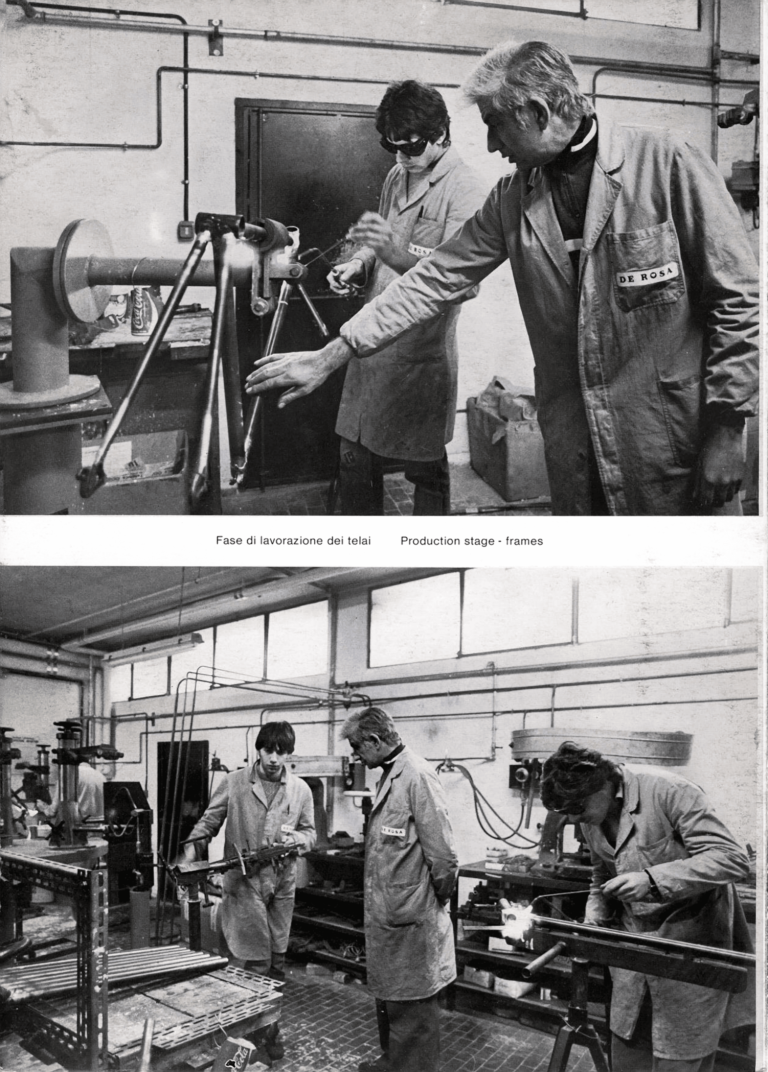
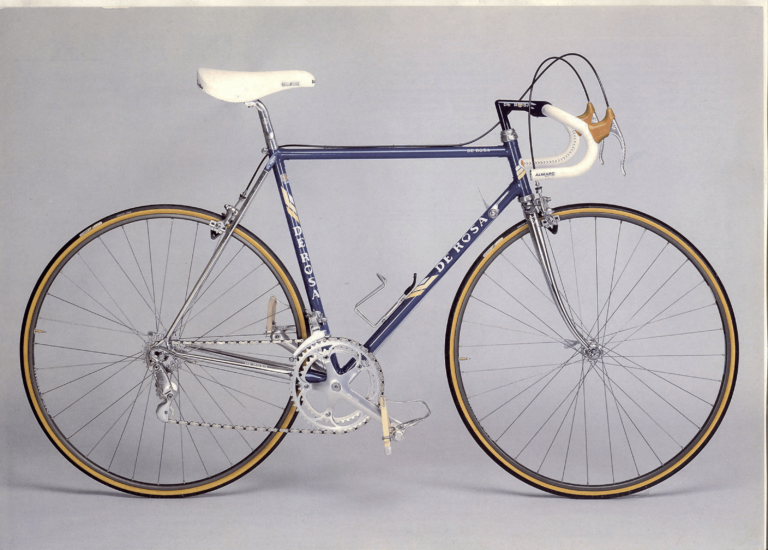
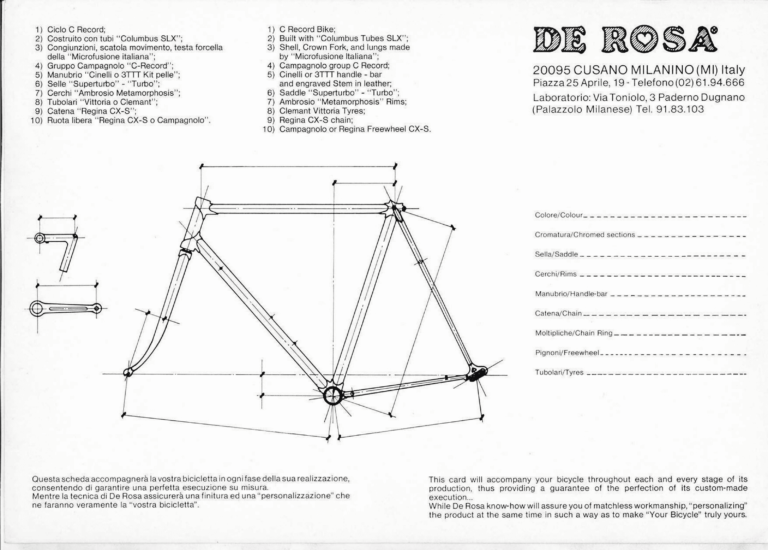
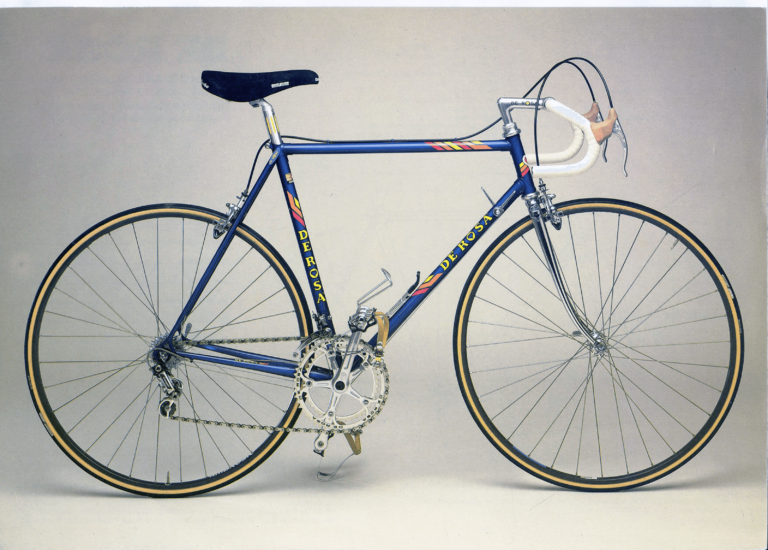
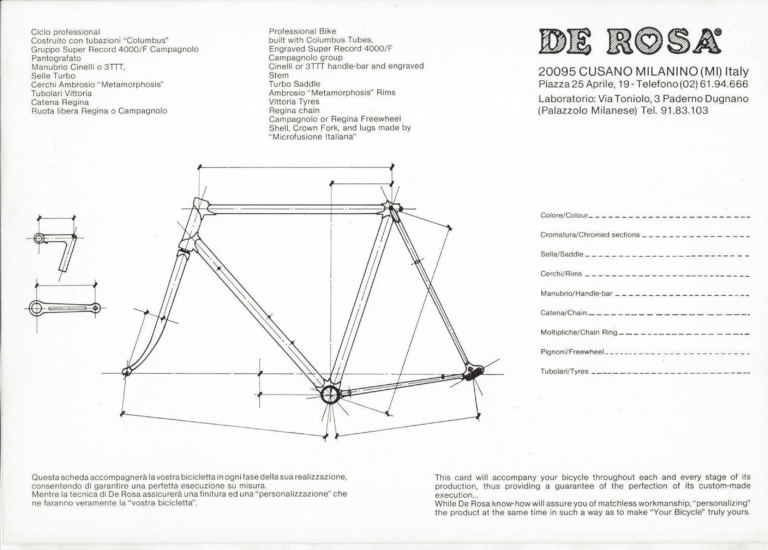
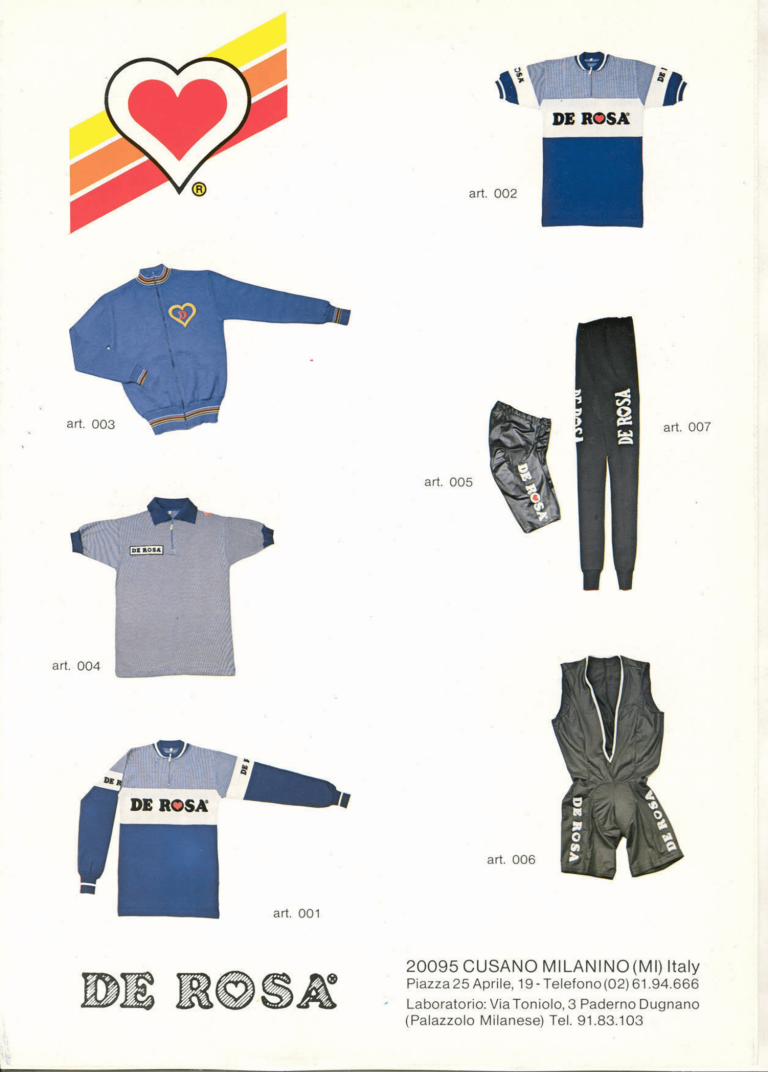
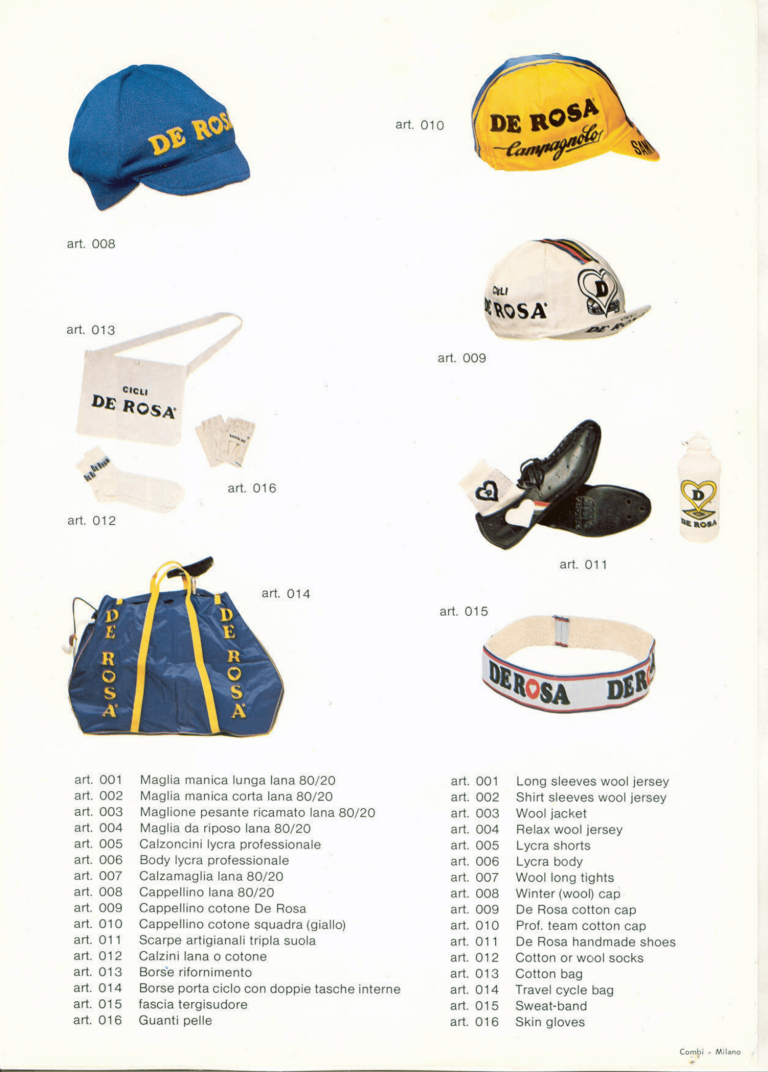
Twelve pages from the 1984 De Rosa catalogue, covering frame photography, the brazing production stage, custom-order specification cards, the six-day track frame and the team apparel line.
Equal parts idealism and vigor impassioned an eighteen year old De Rosa to set out and change the way racing bicycles were manufactured. In 1953 he opened the doors of his Milan shop to the public and started selling bicycles. More than a half century later production continues at a healthy pace. De Rosa marketing materials reflect on building bicycles in 1953:
“Those were difficult years. For Italy just recovering from the war, a racing bicycle was still a luxury. But cycling has the power to arouse people’s passions and everything led to believe that, in just a short time, the Italians would be clamoring for special bikes.
Among the few to believe this there was also Ugo De Rosa, who in that very year began his great adventure on two wheels. The only material available for making frames was steel. Cut by the skillful hands of the craftsman, welded and filed, it was transformed into authentic gems born to race. And to win.”
Building for the Champions
By 1958 De Rosa’s skills and notoriety had grown beyond the local Milan market’s confines. Racers in the professional peleton were hearing about bicycles built by an Italian “giovane straordinario” and had to know more. With reputation and livelihood mutually predicated on winning, the gravity between builder and racer is especially strong. France’s Raphaél “The Rocket” Gáminiani would be first to get pulled into the De Rosa orbit.
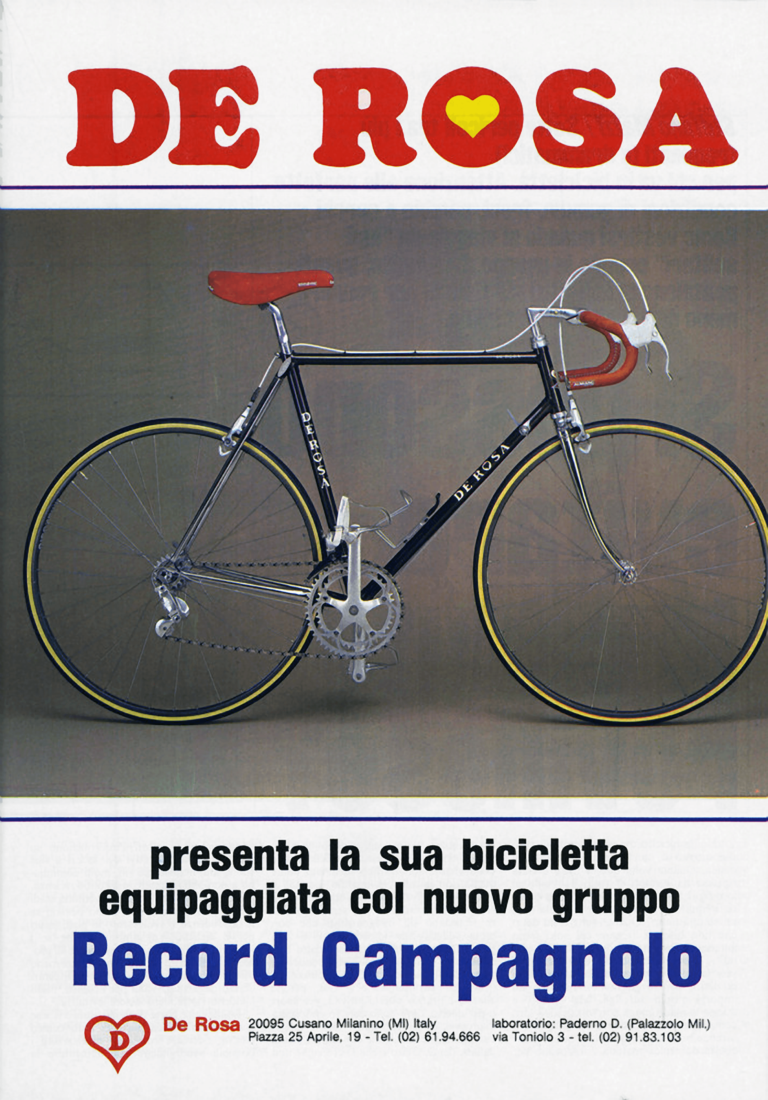
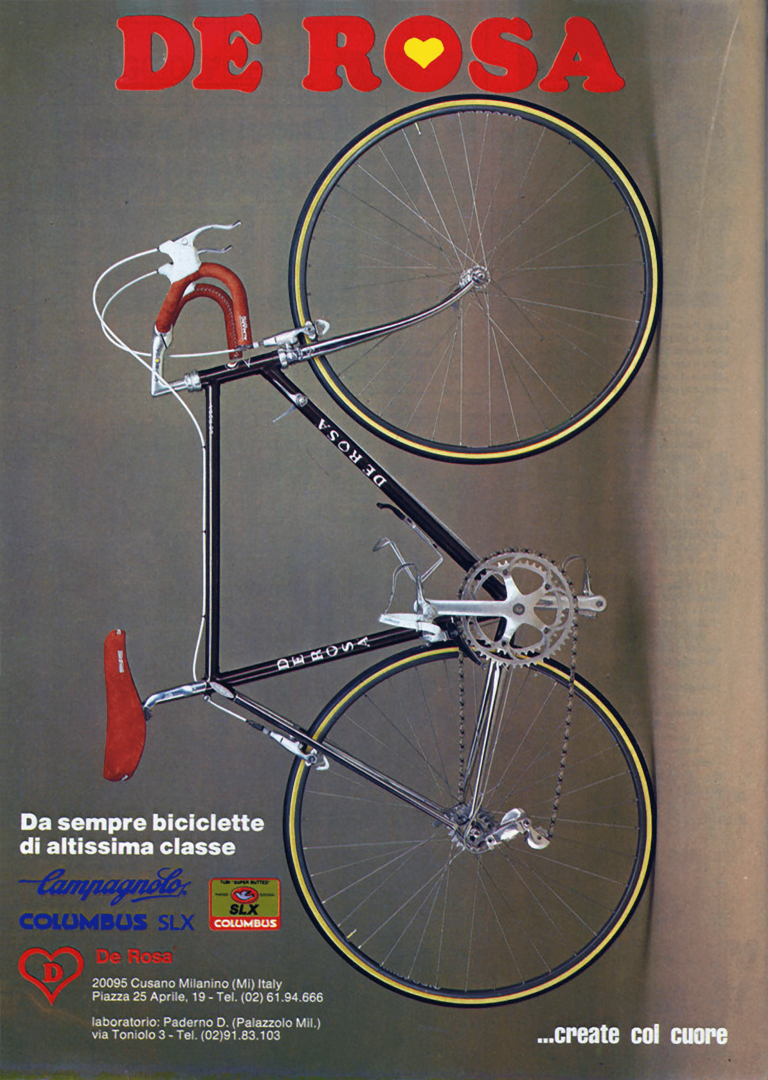
Two 1985 De Rosa advertisements showcasing the marque’s frames alongside the new Campagnolo Record groupset and Columbus SLX tubing.
After placing second at the Tour de France and winning its King of the Mountains jersey in one of twelve overall appearances at the event, Géminiani requested De Rosa build him a bicycle worthy of the upcoming Giro d’Italia. Seizing the opportunity, which presented itself at a Velodromo Vigorelli race — Masi’s home turf — De Rosa obliged by producing a bicycle that carried Géminiani to third place in the following Tour de France.
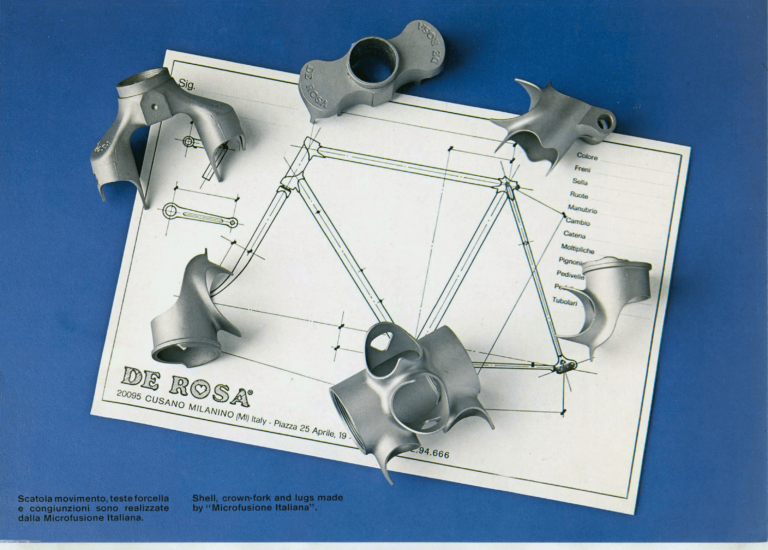
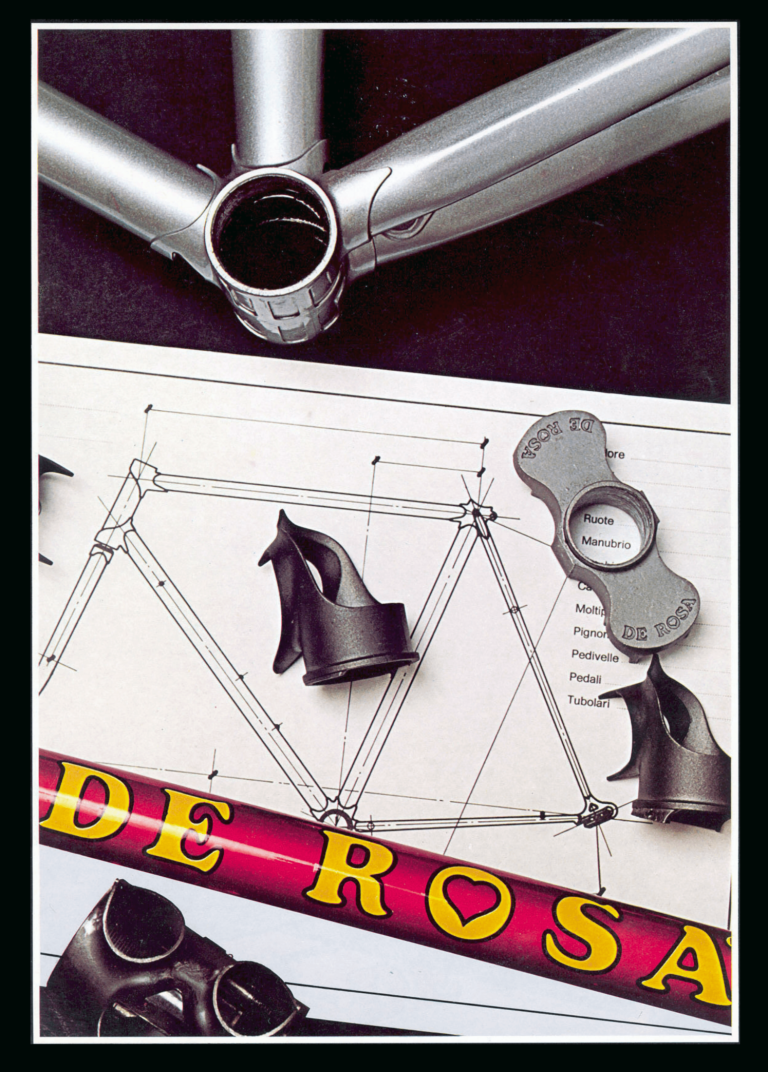
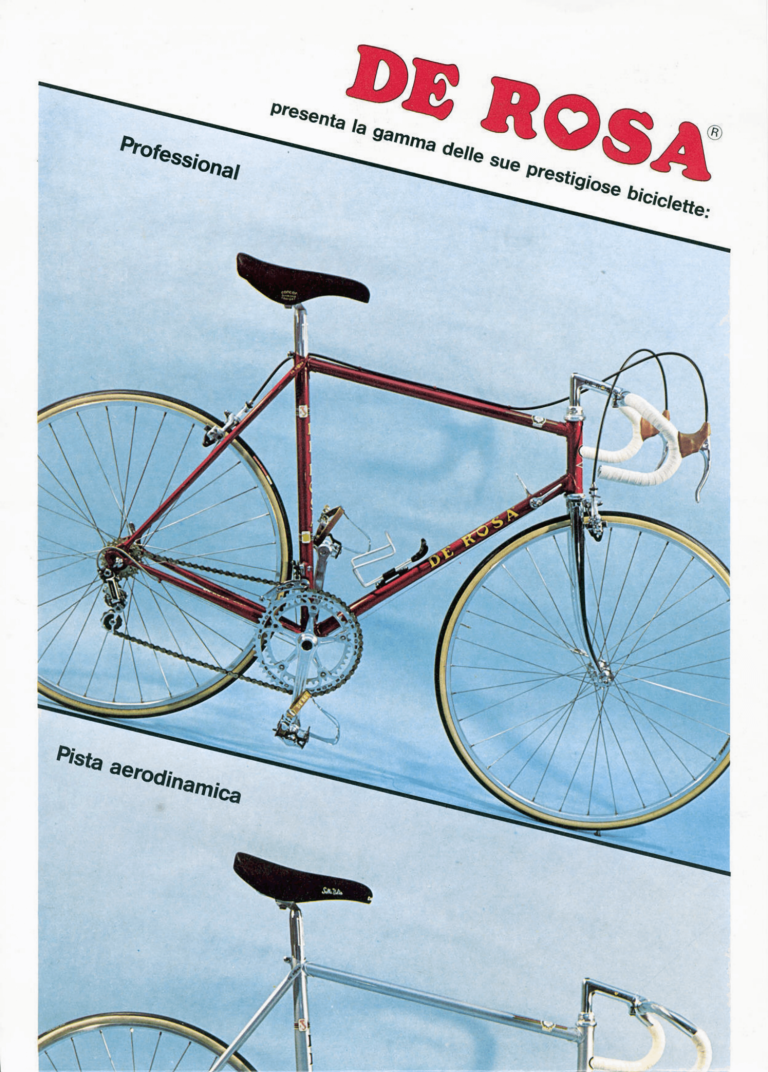
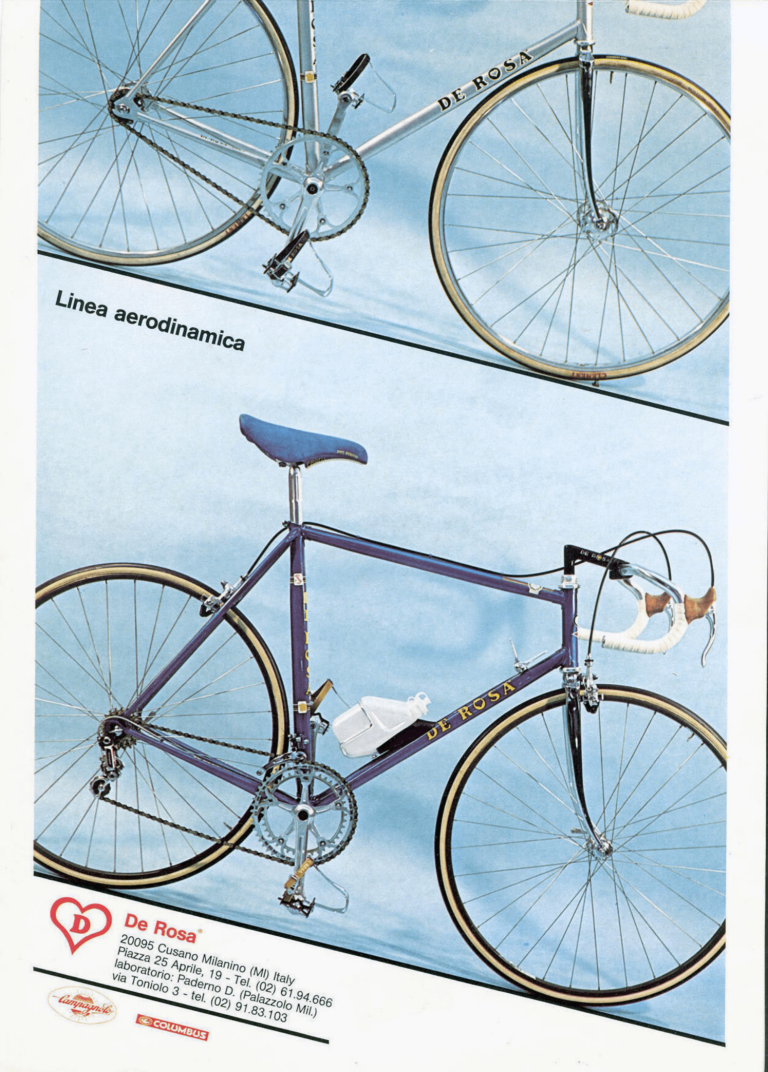
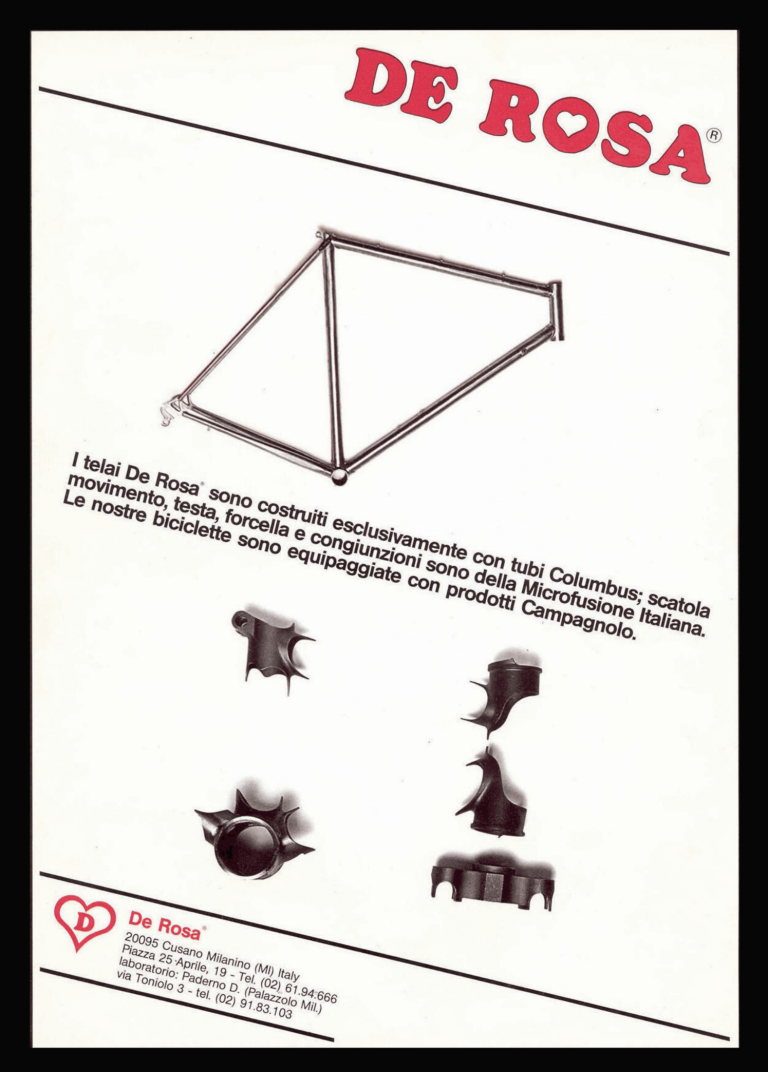
Pages from the 1985 De Rosa catalogue, from frame blueprints and cast-lug detail to the Professional and Pista aerodinamica models.
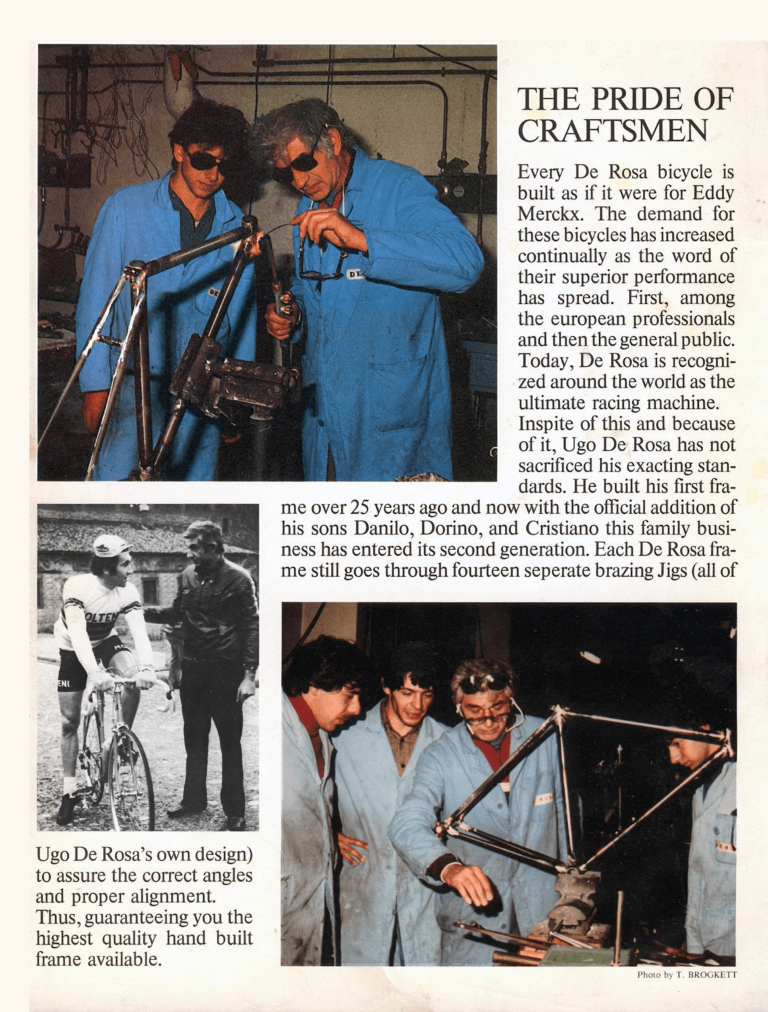
Years earlier De Rosa himself enjoyed a stint at amateur racing that familiarized him with the cutthroat technological demands of competitive cycling. Like so many other masters, De Rosa partnered with champion racers who relied on their “costruttore” to provide every mechanical advantage available for crushing the competition.
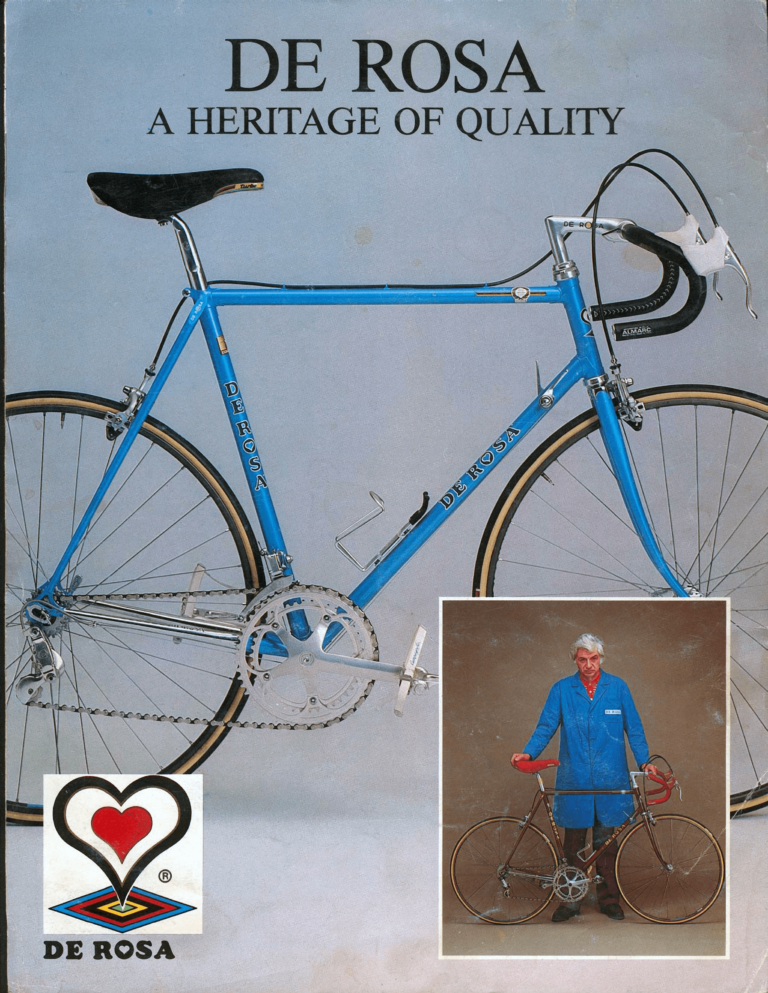
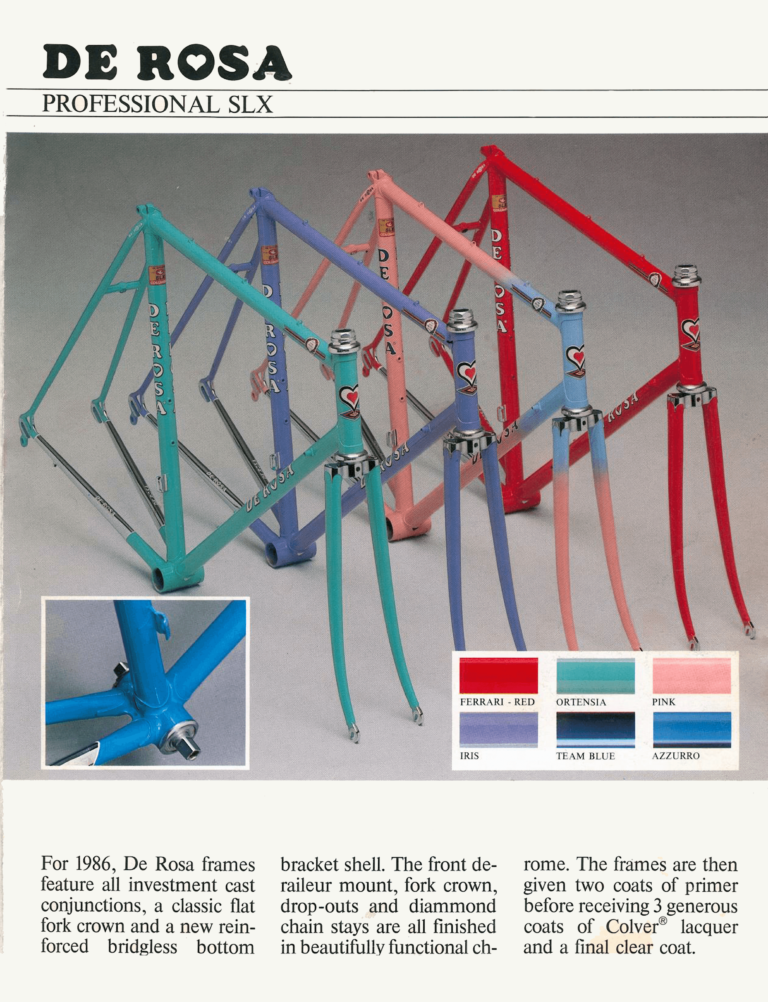
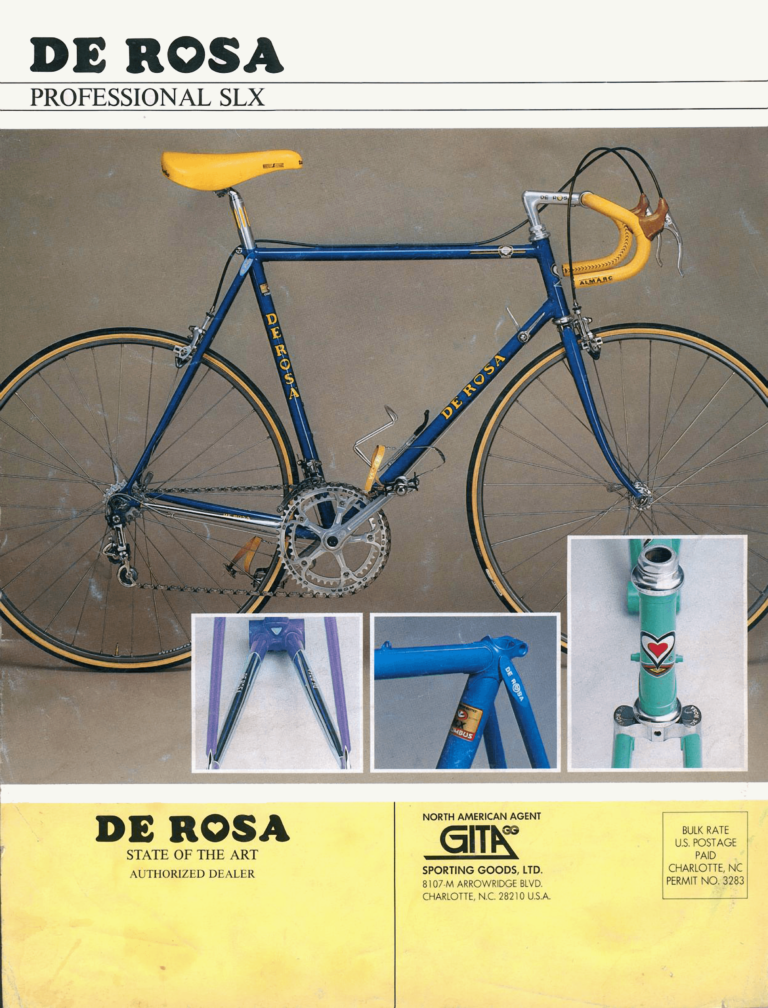
The 1986 De Rosa catalogue, introducing the Professional SLX in six house colors alongside a look inside the family workshop.
Unlike so many other masters, De Rosa was also a committed race day mechanic who regularly practiced the applied side of his trade. In addition to Géminiani, primary beneficiaries of this holistic outlook included such great racing cyclists as: Rik van Looy, Gastone Nencini, Gianni Motta and Eddy Merckx.
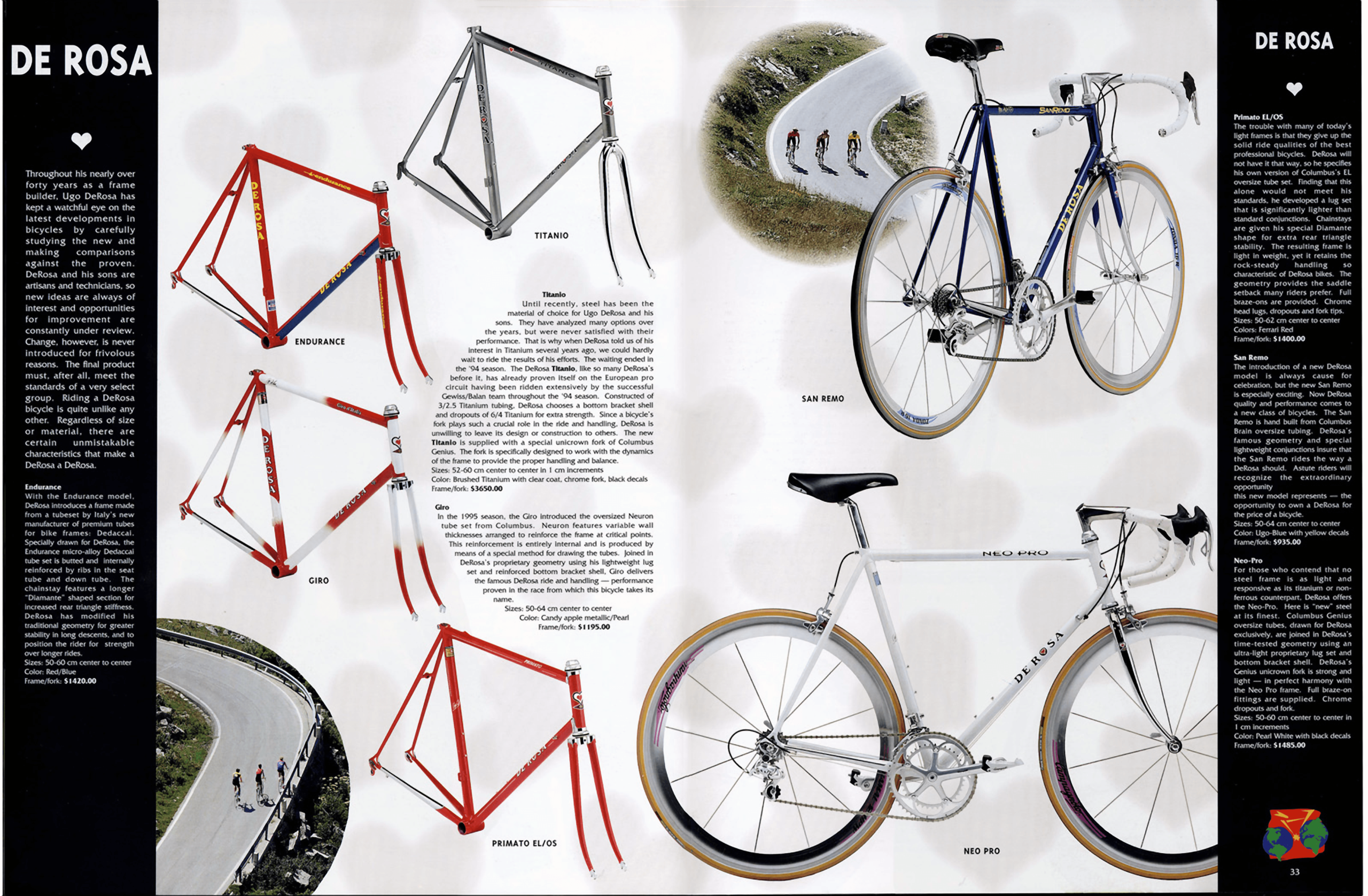
A 1988 De Rosa catalogue spread laying out the Milan builder’s full frame and bicycle lineup, from the Endurance and Giro to the Titanio, San Remo and Neo Pro.
The Cannibal and the Costruttore
De Rosa’s lionly heart and kid gloves fit Eddy “The Cannibal” Merckx particularly well. Perhaps the fiercest competitor and most meticulous tactician ever in cycling, Merckx partnered with De Rosa in a divinely devastating integration of racer and builder. With origins dating to 1969, their partnership took full effect in 1973 when Merckx invited De Rosa to join his Team Molteni as official frame builder and mechanic.
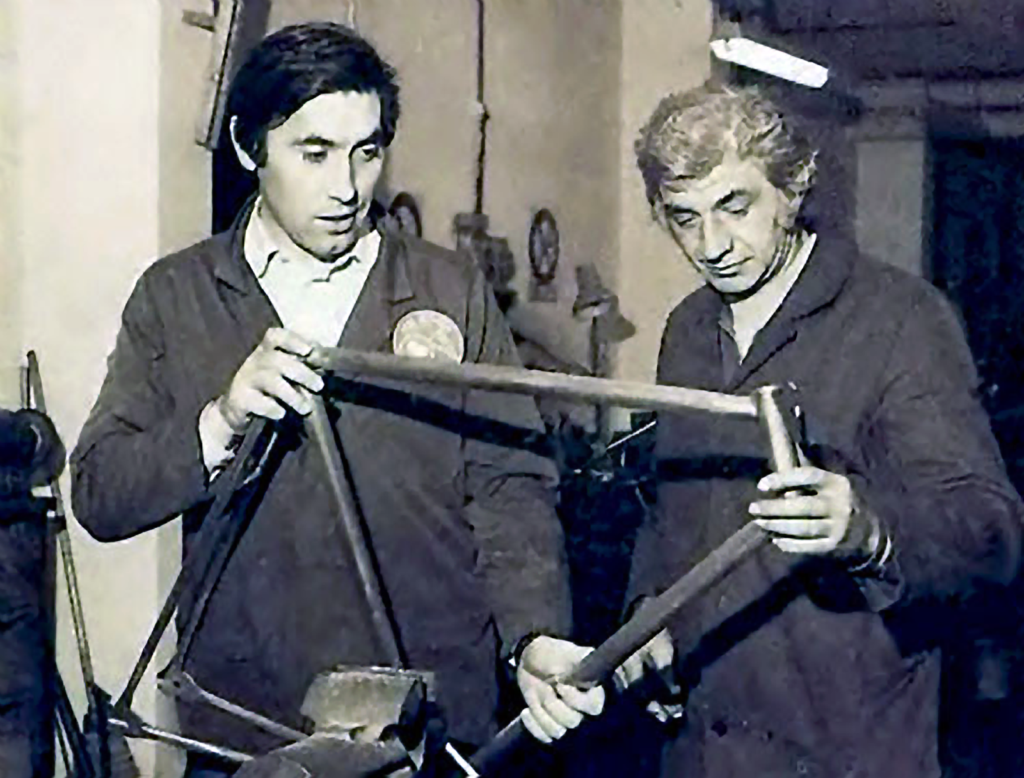
Eddy Merckx and Ugo De Rosa inspect a frame in the De Rosa workshop, the partnership that began in 1969 and put Merckx on De Rosa steel through his Molteni years.
The subsequent history they shared would become the stuff of legends even before Merckx retired in 1978. Every significant palmares in professional cycling went represented in the races Merckx won aboard De Rosa bicycles: Tour de France, Giro d’Italia, Vuelta a España, Tour of Flanders, Tour de Suisse, Milano-Sanremo, Paris-Roubaix, Paris-Brussels, Liège Bastogne Liège and Gent-Wevelgem.
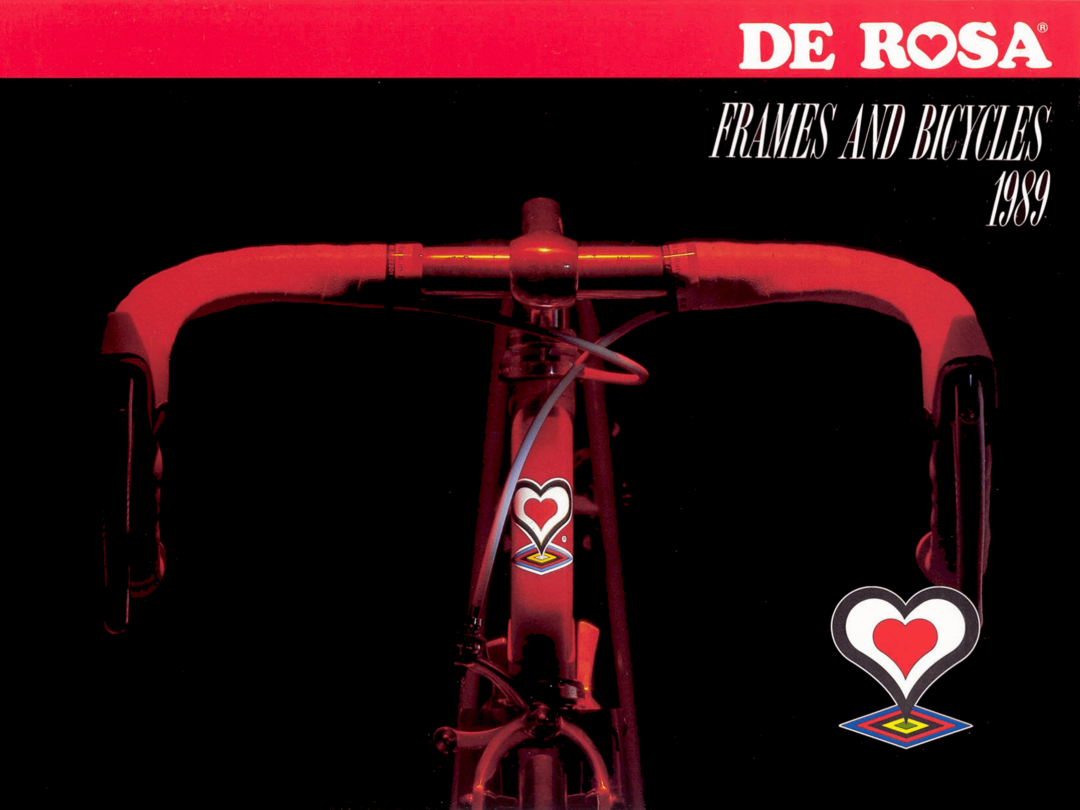
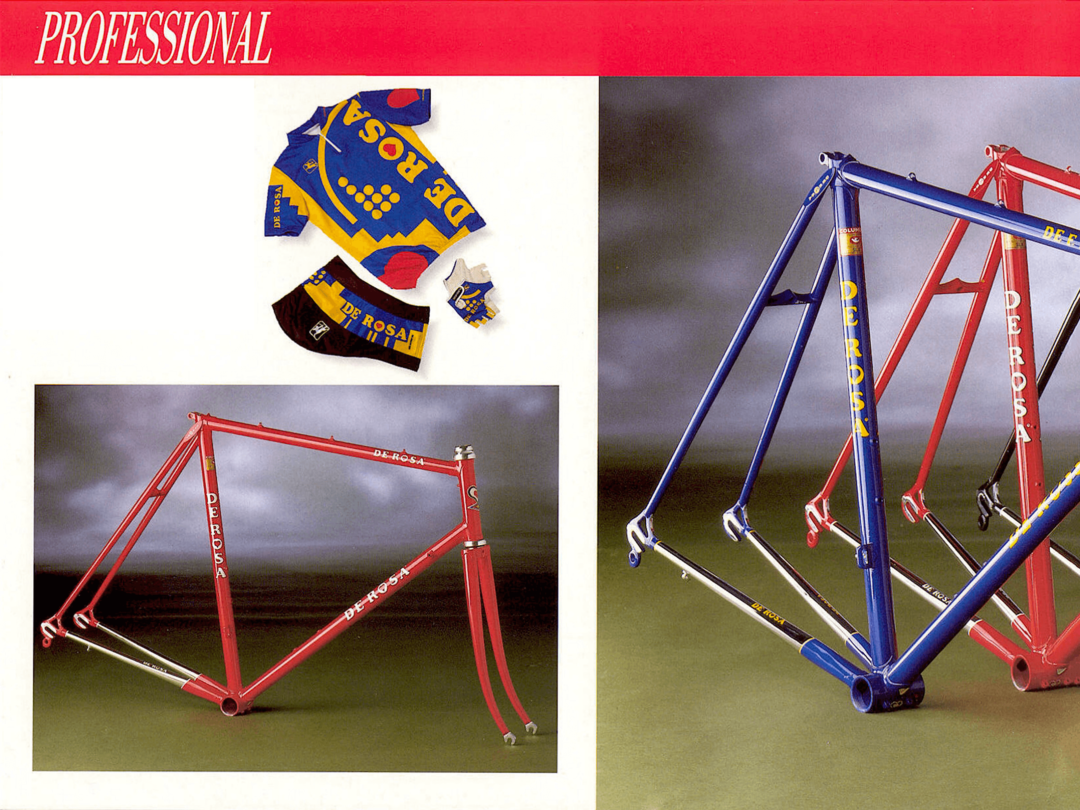
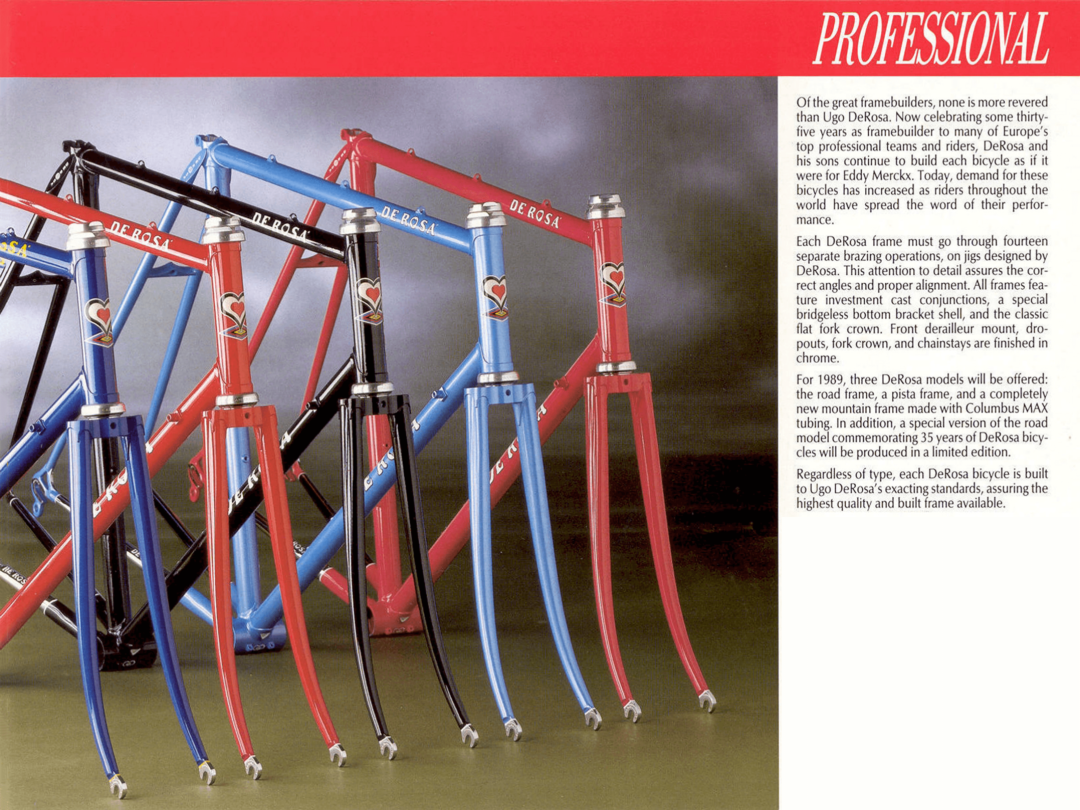
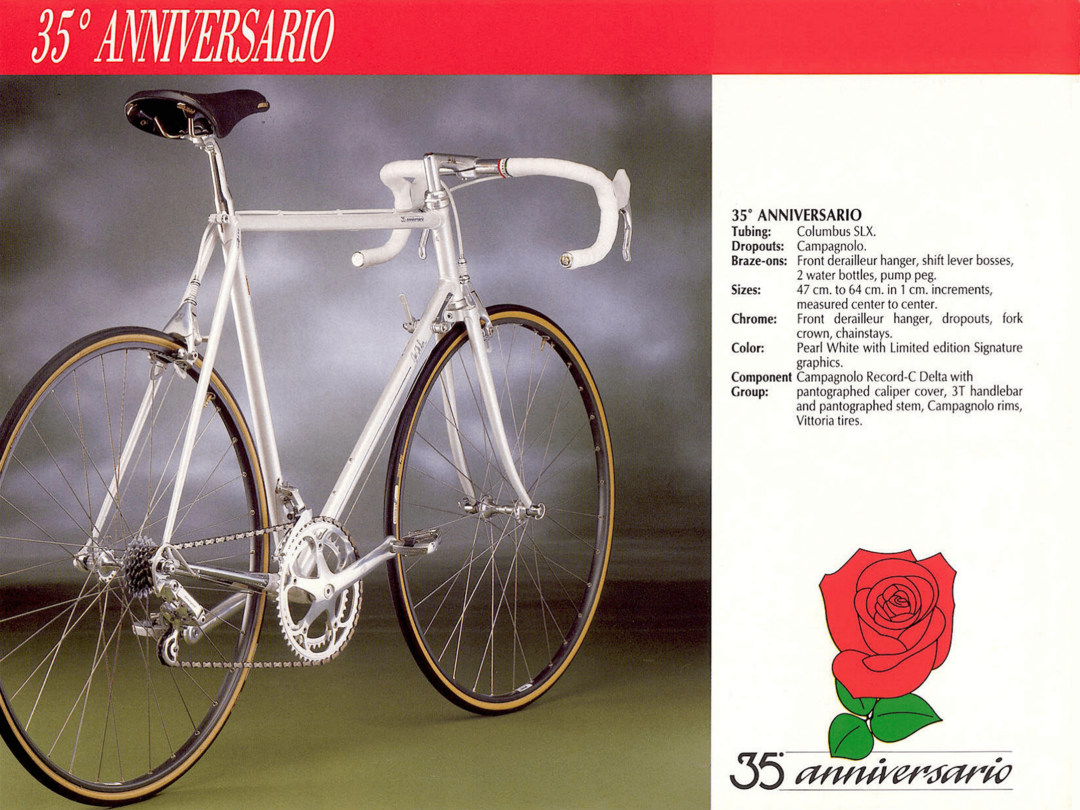
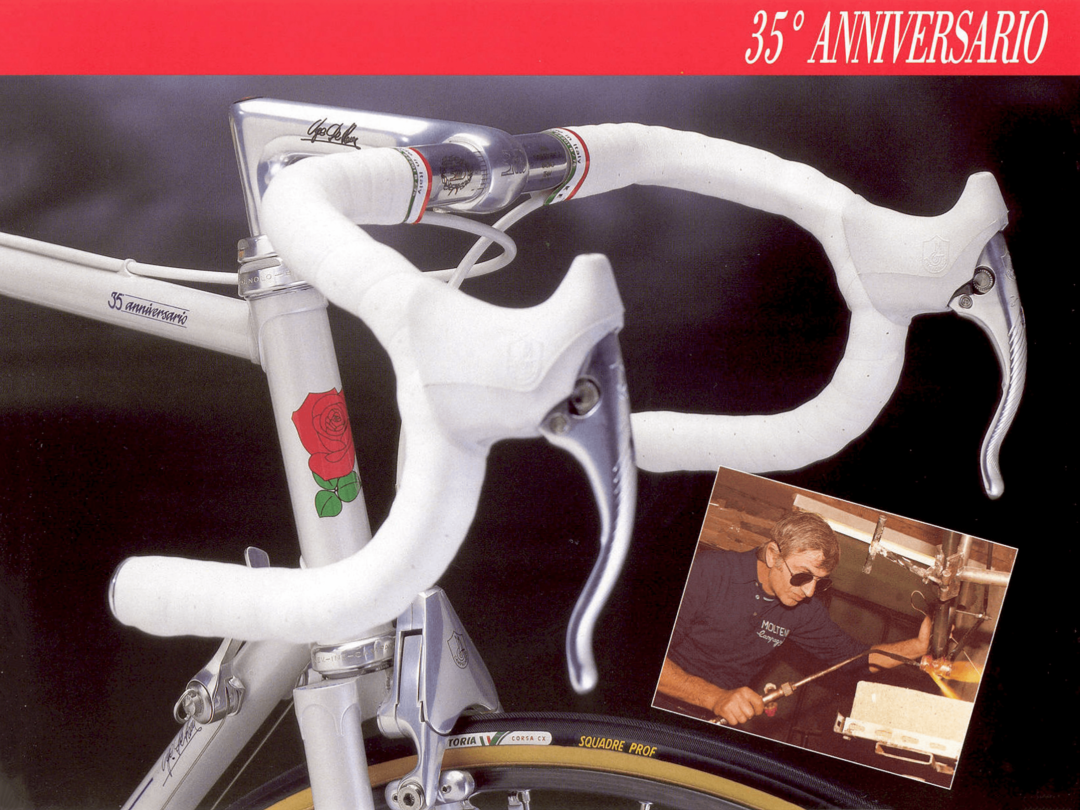
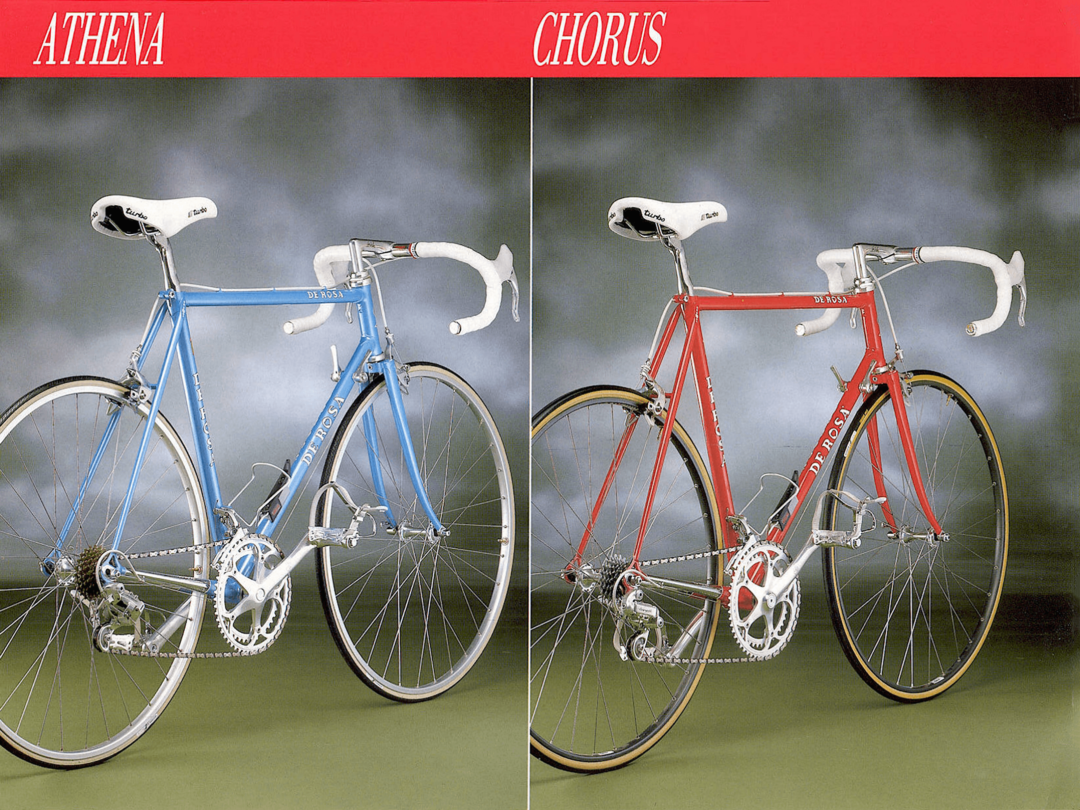
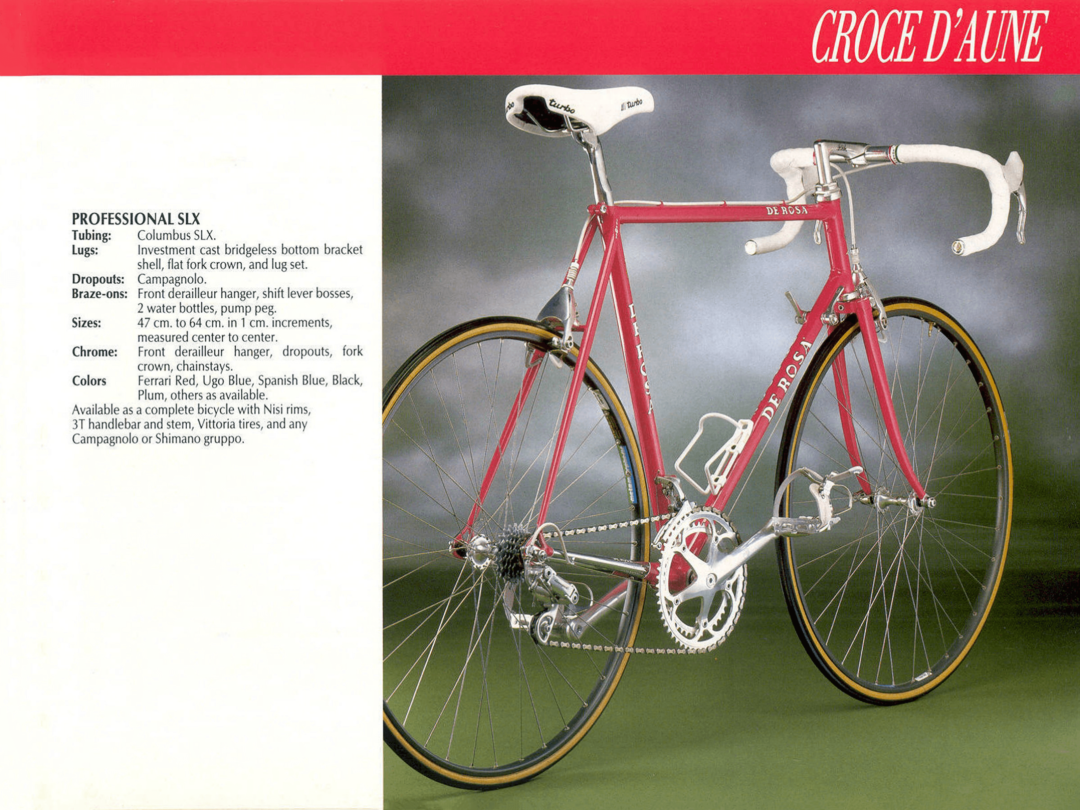
The 1989 “Frames and Bicycles” catalogue, marking De Rosa’s thirty-fifth anniversary with the Professional line, the Pearl White Signature edition and the Croce d’Aune road and Pista track models.
The De Rosa-Merckx partnership endured well beyond Merckx’s competitive departure from the sport. De Rosa provided technical consultation to Merckx when the former champion built manufacturing facilities upon establishing his own namesake brand of bicycles in 1981. Eddy Merckx bicycles remain popular today for their historical association and reputation for outstanding craftsmanship, qualities De Rosa played at least some part in shaping.
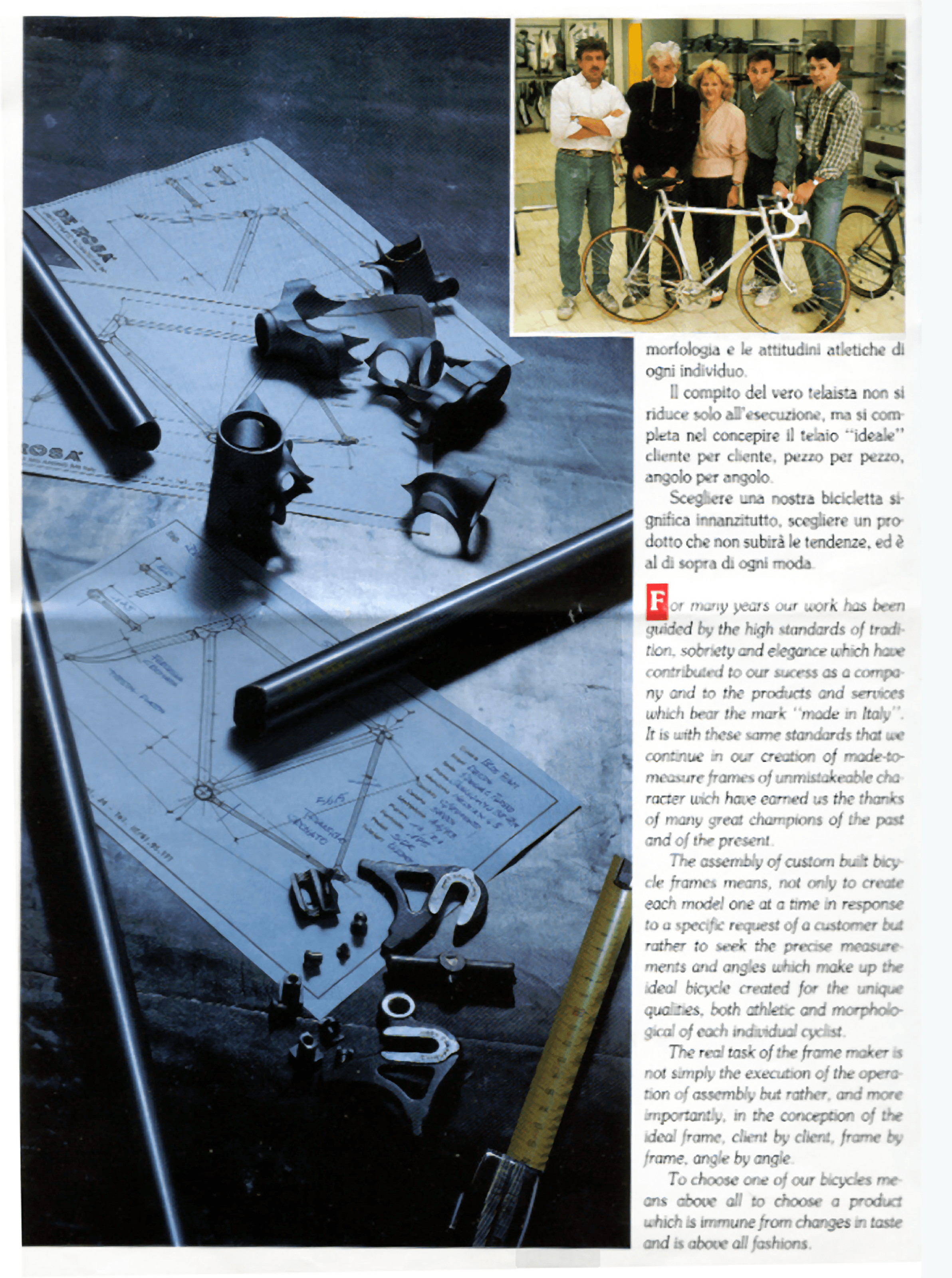
A 1988 De Rosa catalogue page lays frame blueprints and hand-cut tubing beside a shop photograph, framing the message that each De Rosa frame was built client by client, angle by angle.
Perhaps De Rosa was overly successful instilling his “healthy realism” philosophy on Merckx, according to which “first you have to know how to make bicycles, and then know how to sell them.” With both figures remaining tall in the elite world of competitive bicycle manufacturing and marketing, Eddy Merckx bicycles stand somewhat taller among ProTour and WorldTour riders.
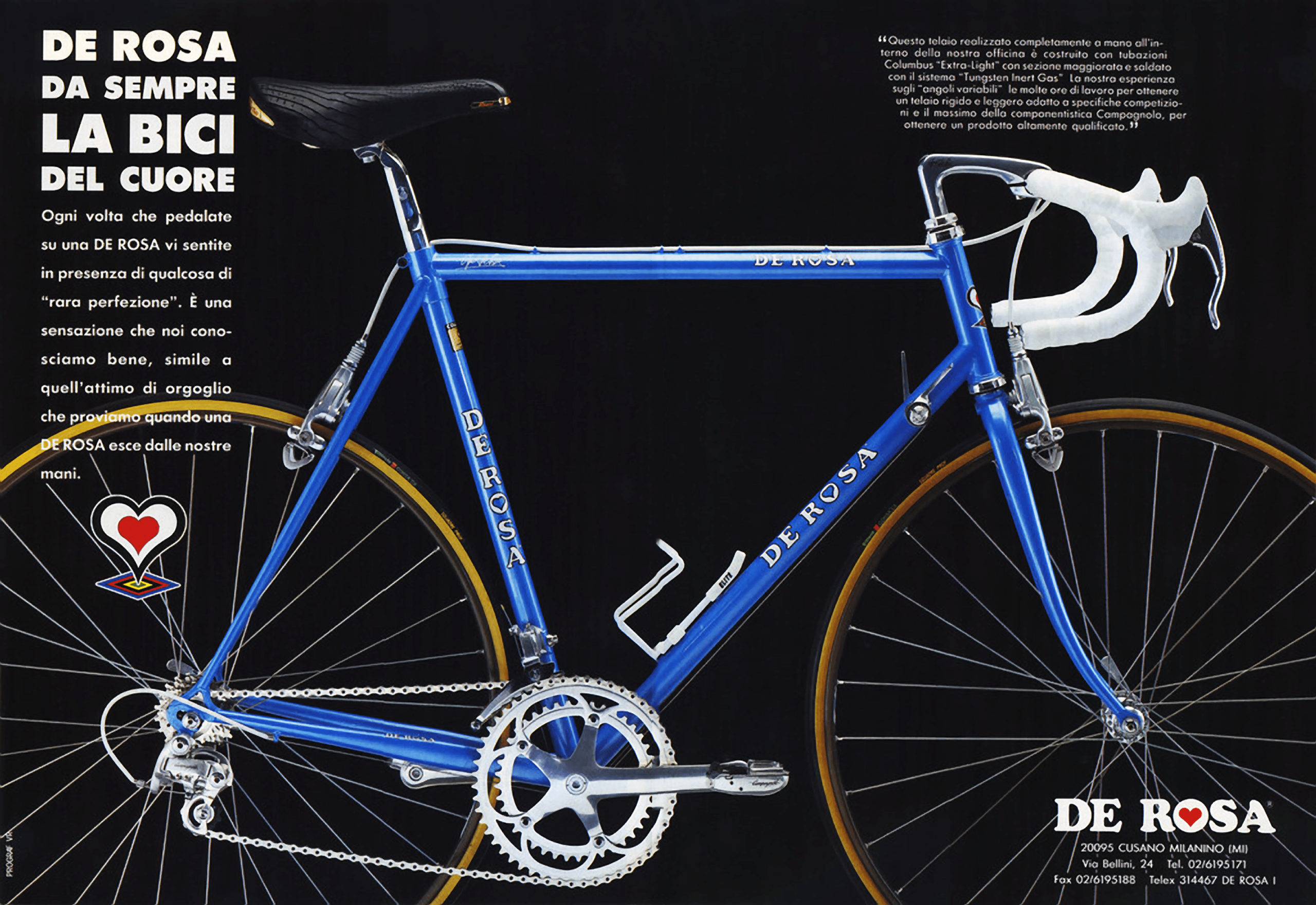
A 1991 De Rosa advertisement calls the marque “la bici del cuore,” the bike of the heart, still built by hand at the Cusano Milanino workshop with Columbus tubing and top Campagnolo componentry.
Axel Merckx, son of Eddy, even had special permission from Davitamon-Lotto to ride his father’s bicycles through the 2005 racing season despite Ridley being the official team bicycle sponsor. Star power works in mysterious ways.
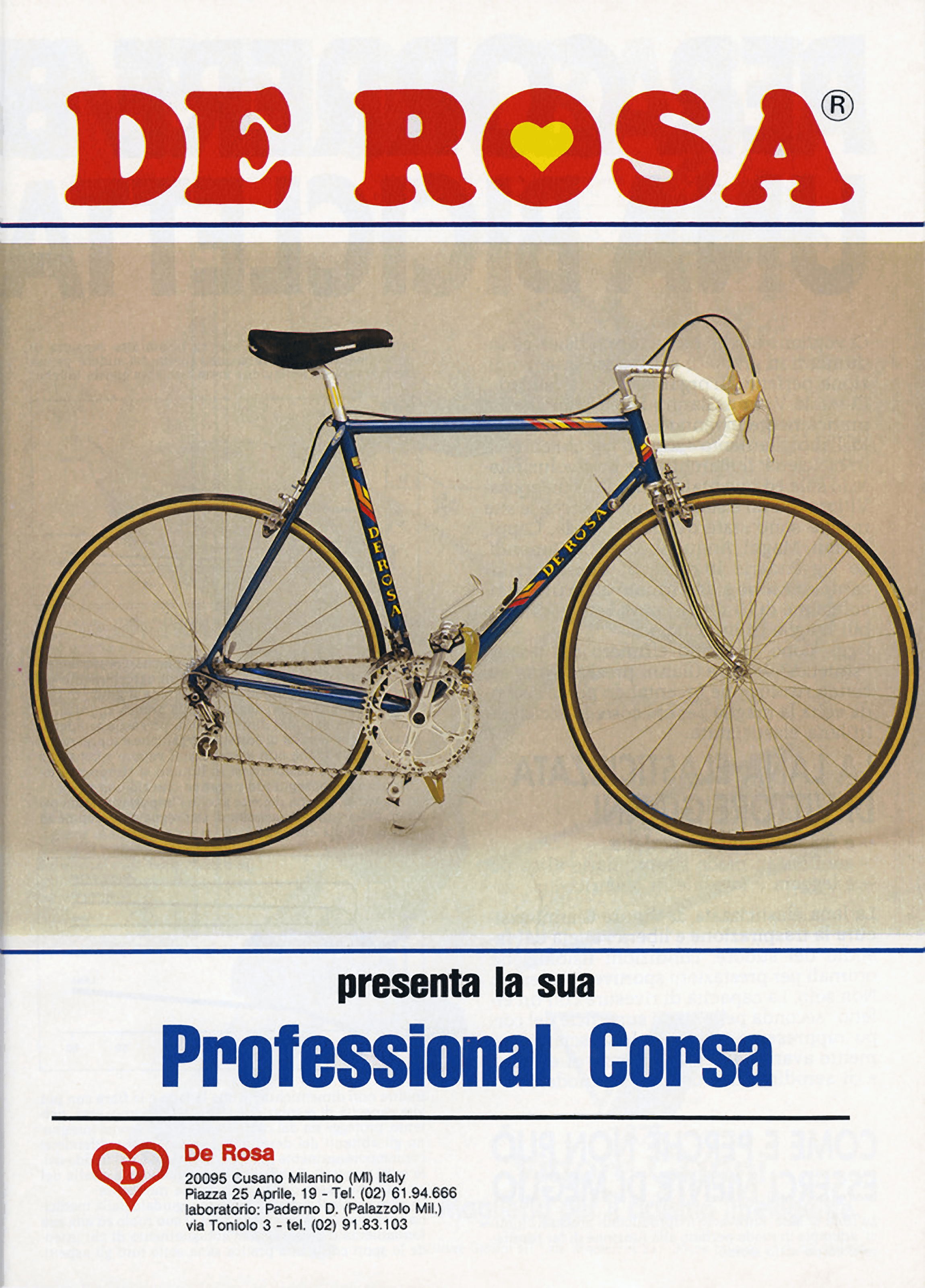
A 1984 De Rosa advertisement presents the Professional Corsa, listing the firm’s Cusano Milanino address alongside a separate workshop location at Paderno Dugnano.
Coveted by Collectors
So, too, does a half century of reliable greatness, which is why classic De Rosa bicycles are always courted by lines of eagerly awaiting suitors. Early models enjoy that magical combination of rich heritage and true scarcity, leading to a desirability factor shared only with the rarest Cinelli models, for example. Collectors continue proving themselves willing to pay exorbitant amounts for older or noteworthy models, especially those with heart shaped lugs, bottom bracket cutouts or drilled dropouts.
Along with impeccable workmanship, De Rosa bicycles are also revered for their wonderful ride characteristics. Racers have known for decades what collectors have more recently discovered: De Rosa bicycles offer highly compatible geometry and assuring balance in an exquisitely finished package. Their marriage of power, comfort and appearance truly is something special.
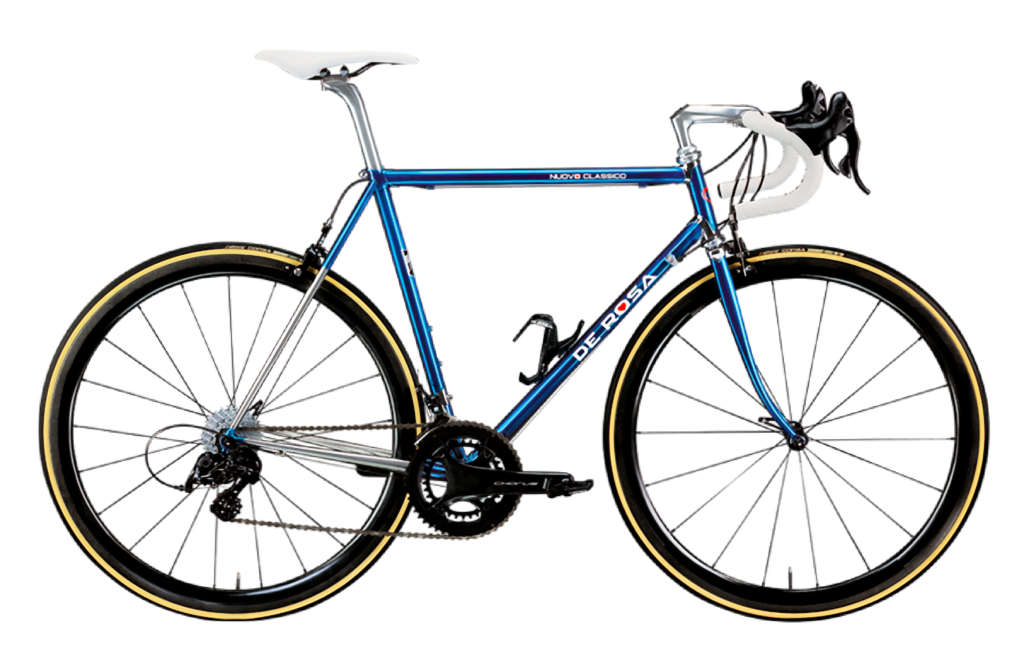
The 2019 De Rosa Nuovo Classico in blue chrome, built up with a Campagnolo Chorus groupset, carrying the marque’s steel tradition into a modern catalogue model.
Steel, Titanium and Beyond
Steel was the only material used to manufacture De Rosa frames and forks from 1953 until 1991. Following the U.S. “racing bike” boom of the early 1980s, titanium and its alloys grew more interesting to innovative builders like De Rosa. In 1991 the company was among the first to introduce titanium frames that “immediately distinguished themselves for their elegance and neatness of form, lightness and reliability.”
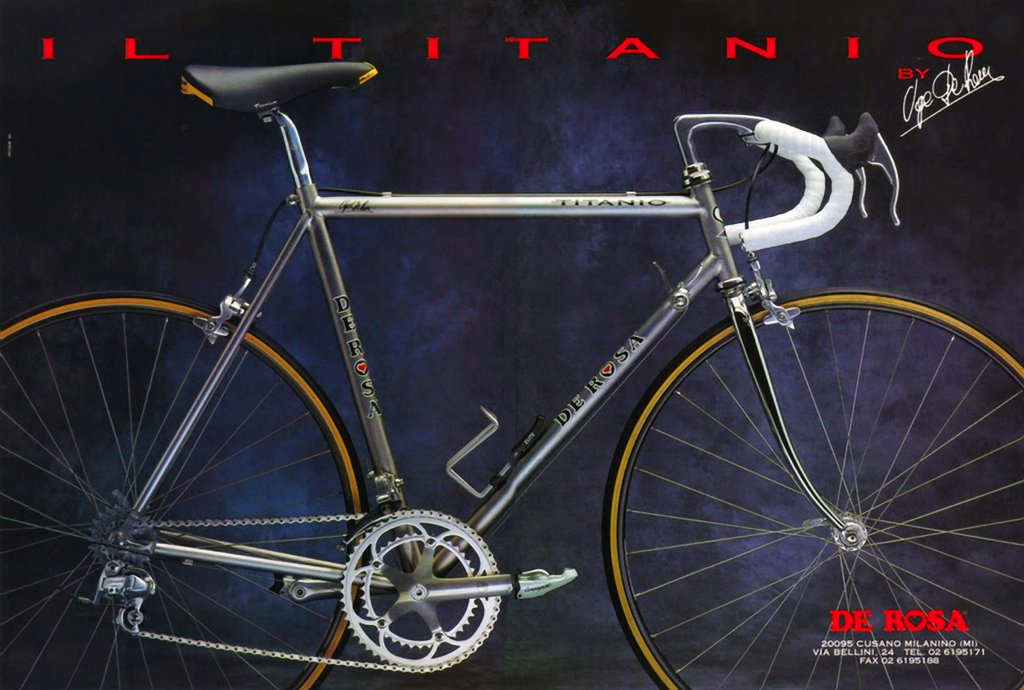
A 1984 De Rosa advertisement for the Titanio, promoting titanium years before it became a standard De Rosa frame material in 1991.
Five years later in 1996 De Rosa introduced aluminum bicycles, over a decade after pioneering aluminum manufacturer Cannondale first introduced their aluminum models. Never someone to fall behind the technology curve twice, let alone in the same decade, De Rosa promptly introduced carbon frames in 2000, first as combined with aluminum tubes and then as pure carbon creations weighing a parsimonious 1,000 grams. De Rosa marketing materials reflect on the history of using steel for building bicycles:
“How steel has changed in the half century! It seems only yesterday when we had to handle untreated tubes, shiny with oil, to be cut by hand, the joins to be filed one by one, to refine its shape and thickness so that they look more like embroidery than couplings. And we had to heat it with an oxyhydrogen flame, cast the brass and weld everything. And then file and file again.
Instead now we are in the days of TIG, of welds made directly from tube to tube, so fine that they seem invisible, and very difficult to perform if you are not well trained. And if you don’t know the metal you are working on, always lighter, always thinner.
The only thing that has not changed, and that is because we want it that way, is the typical De Rosa meticulousness in always wanting to do things well. First with the brain and then with the heart.”
If history truly is the best predictor of the future, the next fifty years should be exciting ones for De Rosa. Manufacturing composite frames and forks represents a relatively fresh direction for the man, family and company behind the De Rosa name. E-bikes are an even newer direction. Many are hoping these renewed commitments also represent the renaissance of a brand once accustomed to enjoying the “primo posto” among Italian bicycle builders.
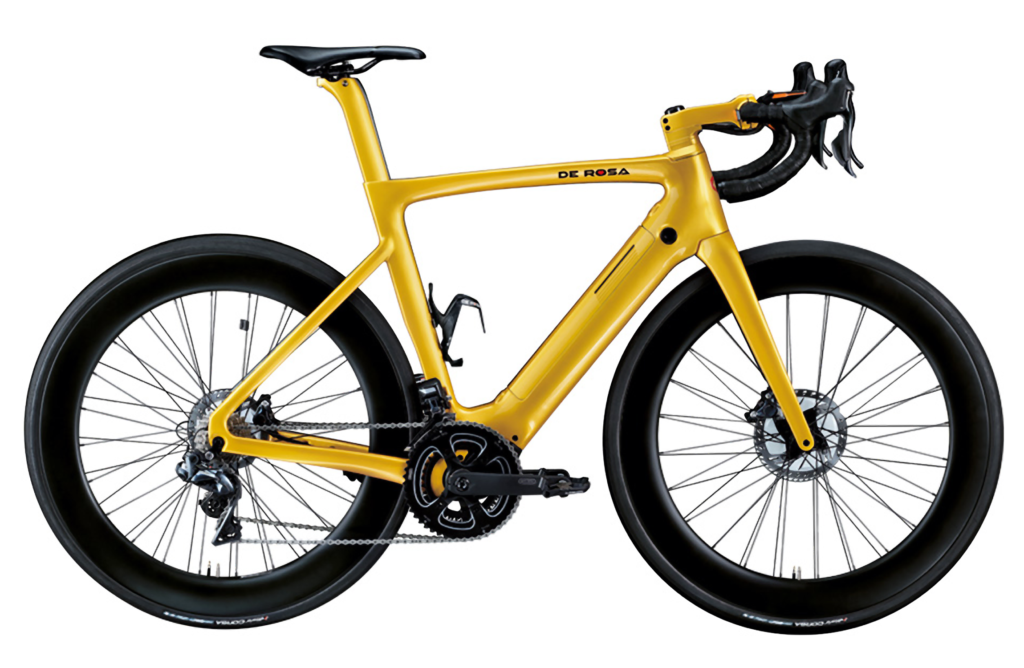
By 2019, De Rosa had extended its frame-building lineage, running from steel through titanium, aluminum and carbon, into its own electric road bike.
Regardless of where things continue growing from here, we will always have the De Rosa dream bikes of yesteryear to cherish and ride on the most special of occasions. The rest is icing on the cake.





[…] Interesting article posted today about one of the leading Italian bicycle manufacturers. EBykr, bicycle artistry. […]